Review
. 2020 Feb 19;9(2):477.
doi: 10.3390/cells9020477.

Succinic Semialdehyde Dehydrogenase Deficiency: An Update

Affiliations
Review

Succinic Semialdehyde Dehydrogenase Deficiency: An Update

Miroslava Didiášová et al. Cells. .

Abstract

Succinic semialdehyde dehydrogenase deficiency (SSADH-D) is a genetic disorder that results from the aberrant metabolism of the neurotransmitter γ-amino butyric acid (GABA). The disease is caused by impaired activity of the mitochondrial enzyme succinic semialdehyde dehydrogenase. SSADH-D manifests as varying degrees of mental retardation, autism, ataxia, and epileptic seizures, but the clinical picture is highly heterogeneous. So far, there is no approved curative therapy for this disease. In this review, we briefly summarize the molecular genetics of SSADH-D, the past and ongoing clinical trials, and the emerging features of the molecular pathogenesis, including redox imbalance and mitochondrial dysfunction. The main aim of this review is to discuss the potential of further therapy approaches that have so far not been tested in SSADH-D, such as pharmacological chaperones, read-through drugs, and gene therapy. Special attention will also be paid to elucidating the role of patient advocacy organizations in facilitating research and in the communication between researchers and patients.

Keywords: autophagy; clinical trials; enzyme replacement therapy; gamma-amino butyric acid; organic acidurias; pharmacological chaperones; succinic semialdehyde dehydrogenase deficiency.


Conflict of interest statement

The authors T.O., H.B. and R.T. declare to have received funding from SSADH-Defizit e.V, a patient advocacy organization. The funders had no role in the decision to publish the article.

Figures

Figure 1
Figure 1
Overview of the synaptic cleft and the metabolic synopsis of a GABAergic synapse. The glutamate/GABA-glutamine cycle is depicted. GABA is synthesized in the presynaptic GABAergic synapse from glutamate (Glu) by glutamate decarboxylase (GAD) and is then packaged into vesicles. Upon electrophysiological activation, GABA is released into the synaptic cleft where it can bind to three known receptors. GABAA and GABAC receptors represent ionotropic receptors, whereas the GABAB receptor is G-protein coupled and functions via adenylate cyclase or by direct coupling with other ion channels. GABA neurotransmission is terminated after uptake of GABA by GABA transporter 2/3 (GAT 2/3) into astrocytes, where GABA transaminase (GABAT) converts it into succinic semialdehyde (SSA). SSA is then oxidized by SSADH to succinate and serves as a substrate within the tricarboxylic acid (TCA) cycle. α-ketoglutarate (2-OG) can be used for the synthesis of Glu by alanine transaminase (ALAT) and glutamate dehydrogenase (GLDH) and glutamine (Gln) by glutaminase (GS). Gln is then shuttled back to presynaptic GABAergic neurons via glutamine transporter SLC38A3 (SN1) and glutamine transporter SLC38A2 (GLNT). In SSADH-D, SSA cannot be converted to succinate but is reduced to GHB by SSA reductase (SSAR) (adapted from [15,16]).
Figure 2
Figure 2
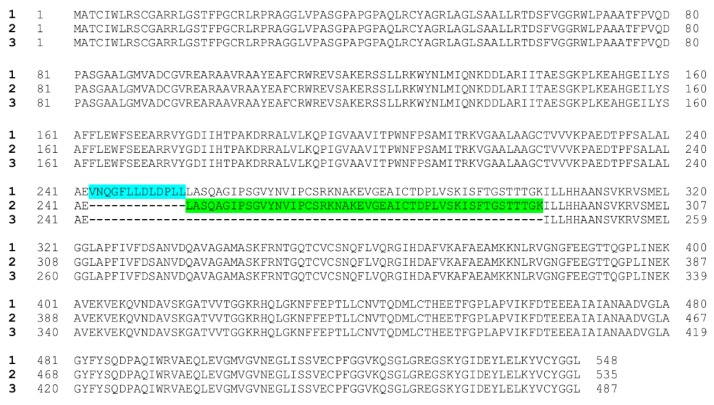
SSADH isoform protein sequences. Numbers to the left in bold show the isoform numbers. Blue highlight marks the 13 extra amino acids in isoform 1, whereas green highlight depicts the 48 amino acids present in isoforms 1 and 2 but missing from isoform 3.
Figure 3
Figure 3
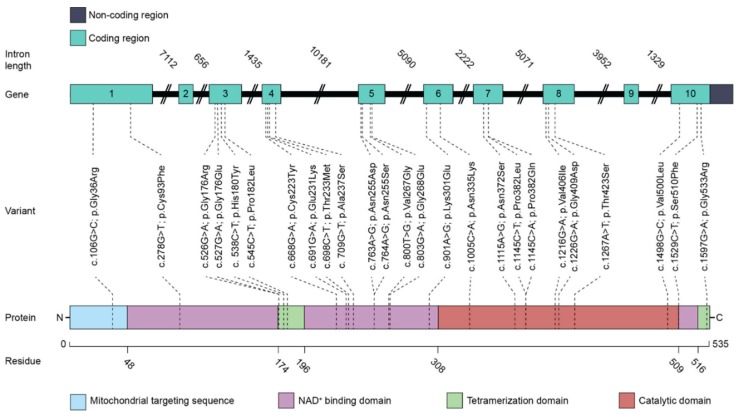
Exon and domain structure of SSADH, and localization of selected SSADH-D missense variants. The human SSADH isoform 2 exhibits 535 amino acids. Green boxes show the exons, joined by the black lines representing introns, the length of which is given above the lines. Colored blocks refer to the protein domains as indicated. Numbers below the bar refer to the first amino acid of the respective domain. Dashed lines connect the selected disease-causing variants with the respective exons and protein domains.

References

    1. Pearl P.L., Novotny E.J., Acosta M.T., Jakobs C., Gibson K.M. Succinic semialdehyde dehydrogenase deficiency in children and adults. Ann. Neurol. 2003;54(Suppl. 6):S73–S80. doi: 10.1002/ana.10629. - DOI - PubMed
    1. Gibson K.M., Jakobs C. Disorders of beta- and alpha-amino acids in free and peptide-linked forms. In: Scriver C.R., Beaudet A.L., Sly W.S., Valle D., Childs B., Kinzler K.W., Vogelstein B., editors. The Metabolic and Molecular Bases of Inherited Disease. 8th ed. McGraw-Hill; New York, NY, USA: 2001. pp. 2079–2105.
    1. Jakobs C., Bojasch M., Monch E., Rating D., Siemes H., Hanefeld F. Urinary excretion of gamma-hydroxybutyric acid in a patient with neurological abnormalities. The probability of a new inborn error of metabolism. Clin. Chim. Acta. 1981;111:169–178. doi: 10.1016/0009-8981(81)90184-4. - DOI - PubMed
    1. Gibson K.M., Sweetman L., Nyhan W.L., Jakobs C., Rating D., Siemes H., Hanefeld F. Succinic semialdehyde dehydrogenase deficiency: An inborn error of gamma-aminobutyric acid metabolism. Clin. Chim. Acta. 1983;133:33–42. doi: 10.1016/0009-8981(83)90018-9. - DOI - PubMed
    1. Chambliss K.L., Hinson D.D., Trettel F., Malaspina P., Novelletto A., Jakobs C., Gibson K.M. Two exon-skipping mutations as the molecular basis of succinic semialdehyde dehydrogenase deficiency (4-hydroxybutyric aciduria) Am. J. Hum. Genet. 1998;63:399–408. doi: 10.1086/301964. - DOI - PMC - PubMed

Publication types

MeSH terms

Substances

Supplementary concepts