Review
. 2020 Feb 20;13(4):934.
doi: 10.3390/ma13040934.

Electrospun Alginate Nanofibers Toward Various Applications: A Review

Affiliations
Review

Electrospun Alginate Nanofibers Toward Various Applications: A Review

Teboho Clement Mokhena et al. Materials (Basel). .

Abstract

Alginate has been a material of choice for a spectrum of applications, ranging from metal adsorption to wound dressing. Electrospinning has added a new dimension to polymeric materials, including alginate, which can be processed to their nanosize levels in order to afford unique nanostructured materials with fascinating properties. The resulting nanostructured materials often feature high porosity, stability, permeability, and a large surface-to-volume ratio. In the present review, recent trends on electrospun alginate nanofibers from over the past 10 years toward advanced applications are discussed. The application of electrospun alginate nanofibers in various fields such as bioremediation, scaffolds for skin tissue engineering, drug delivery, and sensors are also elucidated.

Keywords: alginate; biofiltration; bioremediation; electrospinning; nanofibers; sensors; tissue engineering.


Conflict of interest statement

The authors declare no conflict of interest.

Figures
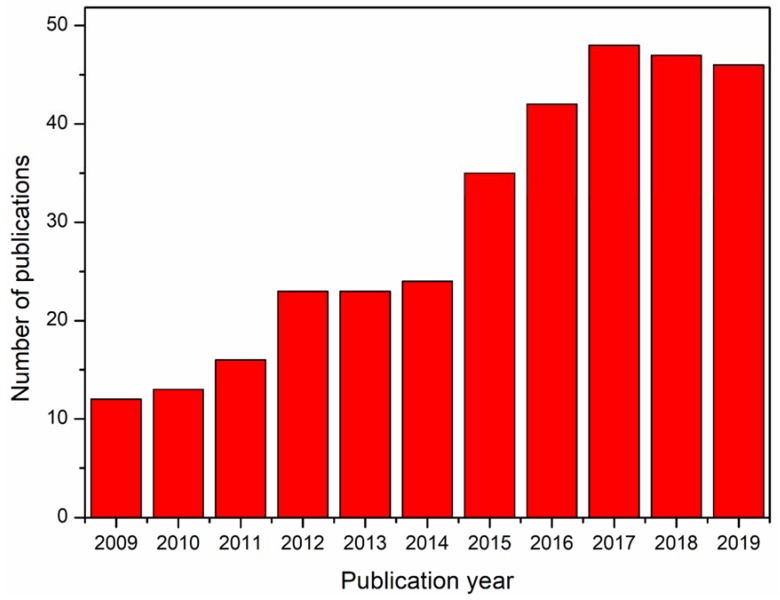
Figure 1
Figure 1
Illustration of the annual number of scientific publications since 2009.
Figure 2
Figure 2
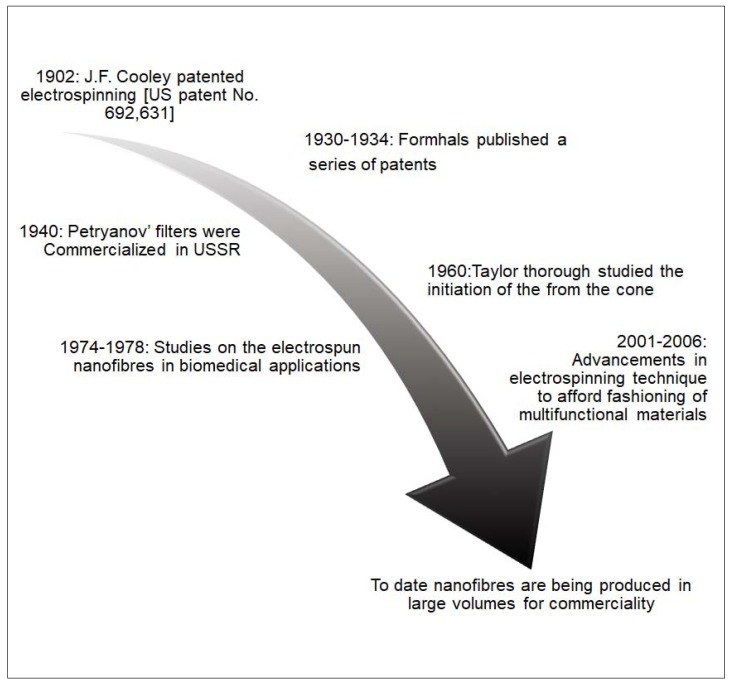
Brief history on the development of electrospinning.
Figure 3
Figure 3
Electrospinning technique setup. Reprinted with permission from [22].
Figure 4
Figure 4
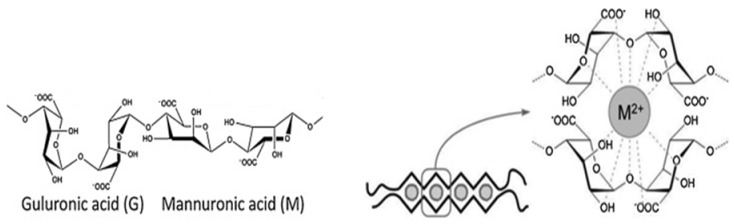
Structure of alginate and “egg-box” model representing alginate organization in the presence of multivalent cations.
Figure 5
Figure 5
Antimicrobial activity of alginate-based scaffolds with 10% (w/w) cephalexin (CEF)-HNT. Reprinted with permission from [74]. HNT: halloysite nanotubes and CEF: cephalexin.
Figure 6
Figure 6
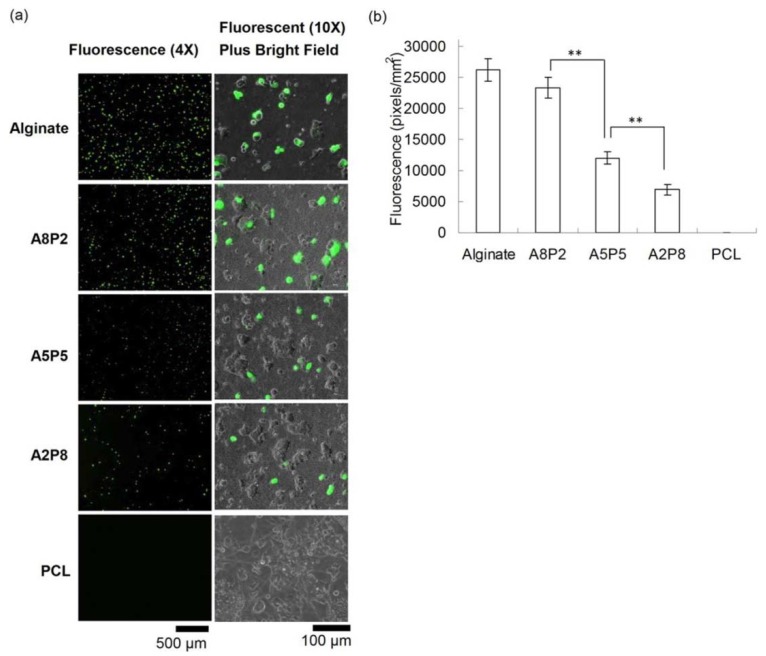
In situ transfection on nanofibers. (a) After immobilizing DNA/polyethyleneimine (PEI) nanoparticles, HEK-293T cells were seeded on nanofibers and cultured for 3 days, and the GFP expression from transfected cells was evaluated using fluorescent microscopy. The results suggested the transfection efficiency of composites fibers increased with their alginate ratios. (b) The quantification of GFP from fluorescent images also showed the same trend (where, 80% alginate/20% polycaprolactone (PCL), 50% alginate/50% PCL, and 20% alginate/80% PCL, which were denoted as A8P2, A5P5, and A2P8, respectively). Reprinted with permission from [58].
Figure 7
Figure 7
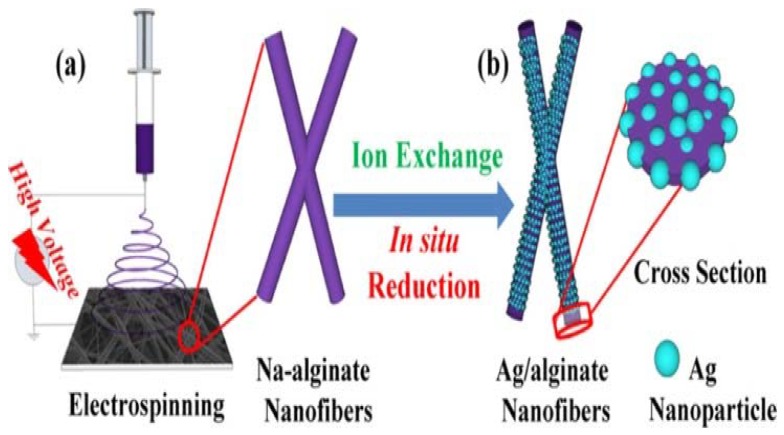
Schematic illustration of Ag–alginate nanofibers fabrication. (a) Electrospinning sodium alginate, and (b) ion exchange and in situ reduction processes for AgNPs/alginate nanofibers. Reprinted with permission from [85].

References

    1. Schiffman J.D., Schauer C.L. A review: Electrospinning of Biopolymer Nanofibers and their Applications. Polym. Rev. 2008;48:317–352. doi: 10.1080/15583720802022182. - DOI
    1. Hedayati A., Barnett C.J., Swan G., White A.O. Chemical recycling of consumer-grade black plastic into electrically conductive carbon nanotubes. C J. Carbon Res. 2019;5:32. doi: 10.3390/c5020032. - DOI
    1. Gönen S.Ö., Erol Taygun M., Küçükbayrak S. Evaluation of the factors influencing the resultant diameter of the electrospun gelatin/sodium alginate nanofibers via Box–Behnken design. Mater. Sci. Eng. C. 2016;58:709–723. doi: 10.1016/j.msec.2015.09.024. - DOI - PubMed
    1. Venkatesan J., Bhatnagar I., Manivasagan P., Kang K.-H., Kim S.-K. Alginate composites for bone tissue engineering: A review. Int. J. Biol. Macromol. 2015;72:269–281. doi: 10.1016/j.ijbiomac.2014.07.008. - DOI - PubMed
    1. Jeong S.I., Krebs M.D., Bonino C.A., Khan S.A., Alsberg E. Electrospun Alginate Nanofibers with Controlled Cell Adhesion for Tissue Engineeringa. Macromol. Biosci. 2010;10:934–943. doi: 10.1002/mabi.201000046. - DOI - PubMed

LinkOut - more resources