


Balance between Health Risks and Benefits for Outdoor Workers Exposed to Solar Radiation: An Overview on the Role of Near Infrared Radiation Alone and in Combination with Other Solar Spectral Bands
- PMID: 32093162
- PMCID: PMC7068431
- DOI: 10.3390/ijerph17041357
Balance between Health Risks and Benefits for Outdoor Workers Exposed to Solar Radiation: An Overview on the Role of Near Infrared Radiation Alone and in Combination with Other Solar Spectral Bands
Abstract
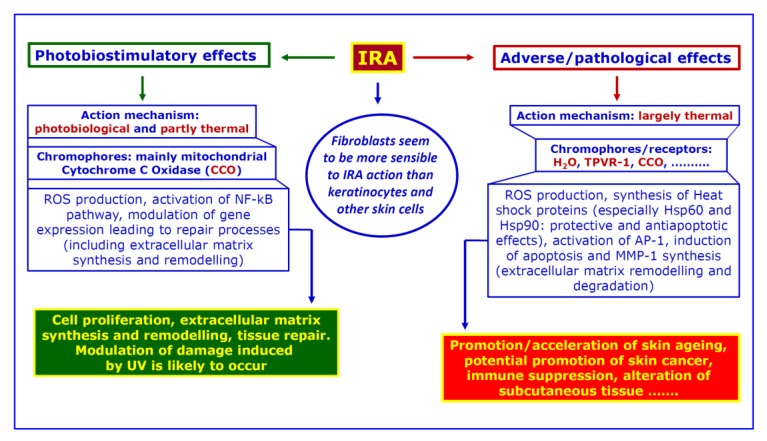
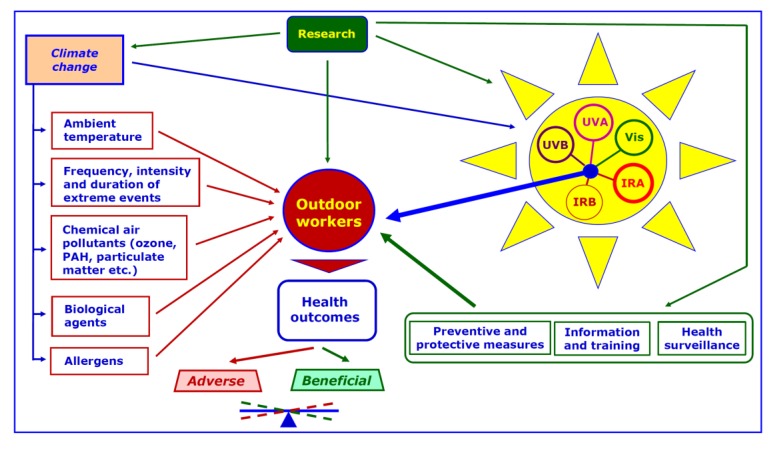
Near infrared or infrared A (IRA) accounts for over 40% of the solar spectrum (SS) and is able to reach subcutaneous tissue as well as the retina. Outdoor workers are occupationally exposed to solar radiation (SR), but the level of exposure may differ widely depending on the job performed, time spent outdoors, latitude, altitude, season, personal protection, etc. Until now, risk assessment and management for outdoor workers has focused on the prevention of both acute and long-term effects on the eye and the skin due to solar ultraviolet radiation (UVR) with little consideration of the other components of the SS (a possible exception is represented by visible radiation with reference to the eye). A growing body of evidence coming from in vitro studies indicates that IRA is involved in cellular reactive oxygen species (ROS) production and may interfere with the respiratory chain in the mitochondria. Moreover, it can modulate gene expression and some metabolic pathways. The biological action of IRA is only partly attributable to a thermal mechanism, should it be also involved in photochemical ones. The cellular and molecular pathways affected by IRA are partly similar and partly different with respect to those involved in the case of visible ultraviolet A (UVA) and ultraviolet B (UVB) radiation. Consequently, the net effect of the SS is very difficult to predict at different levels of the biological organization, making more difficult the final balance of health risk and benefits (for the skin, eye, immune system, blood pressure, etc.) in a given exposure situation. Moreover, few in vivo studies and no epidemiological data are presently available in this regard. Investigating this topic may contribute to better defining the individual exposome. More practically, it is expected to bring benefits to the risk assessment and management for outdoor workers exposed to SS, contributing to: (1) better definition of the individual profiles of susceptibility, (2) more focused preventive and protective measures, (3) better implementation of the health surveillance and (4) a more effective information and training.
Keywords: adverse effects; health surveillance; immune response; near infrared; outdoor workers; preventive and protective measures; solar radiation.
Conflict of interest statement
The authors declare to have no conflict of interest.
Figures
References
-
- World Health Organization . Global Solar UV Index: A Practical Guide: A Joint Recommendation of WHO, WMO, UNEP and ICNIRP. WHO; Geneva, Switzerland: 2002.
-
- International Agency for Research on Cancer (IARC) A Review of Human Carcinogens, IARC Monographs on the Evaluation of Carcinogenic Risks to Humans, Vol. 100 D-Radiation. IARC; Lyon, French: 2012. [(accessed on 12 November 2019)]. Available online: http://publications.iarc.fr/121.
-
- Kochevar I.E., Pathak M.A., Parrish J.A. Photophysics, photochemistry and photobiology. In: Fitzpatrick, editor. Dermatology in General Medicine. McGraw-Hill; New York, NY, USA: 1999. pp. 220–229.
Publication types
MeSH terms
LinkOut - more resources
Full Text Sources
Medical
Research Materials
