Review
. 2020 Feb 20;21(4):1446.
doi: 10.3390/ijms21041446.

Functions of Jasmonic Acid in Plant Regulation and Response to Abiotic Stress

Affiliations
Review

Functions of Jasmonic Acid in Plant Regulation and Response to Abiotic Stress

Jia Wang et al. Int J Mol Sci. .

Abstract

Jasmonic acid (JA) is an endogenous growth-regulating substance, initially identified as a stress-related hormone in higher plants. Similarly, the exogenous application of JA also has a regulatory effect on plants. Abiotic stress often causes large-scale plant damage. In this review, we focus on the JA signaling pathways in response to abiotic stresses, including cold, drought, salinity, heavy metals, and light. On the other hand, JA does not play an independent regulatory role, but works in a complex signal network with other phytohormone signaling pathways. In this review, we will discuss transcription factors and genes involved in the regulation of the JA signaling pathway in response to abiotic stress. In this process, the JAZ-MYC module plays a central role in the JA signaling pathway through integration of regulatory transcription factors and related genes. Simultaneously, JA has synergistic and antagonistic effects with abscisic acid (ABA), ethylene (ET), salicylic acid (SA), and other plant hormones in the process of resisting environmental stress.

Keywords: crosstalk; endogenous and exogenous; plant hormone; signal transduction; transcription factors and genes.


Conflict of interest statement

The authors declare no conflict of interest. The funders had no role in the design of the study; in the collection, analyses, or interpretation of data; in the writing of the manuscript, or in the decision to publish the results.

Figures
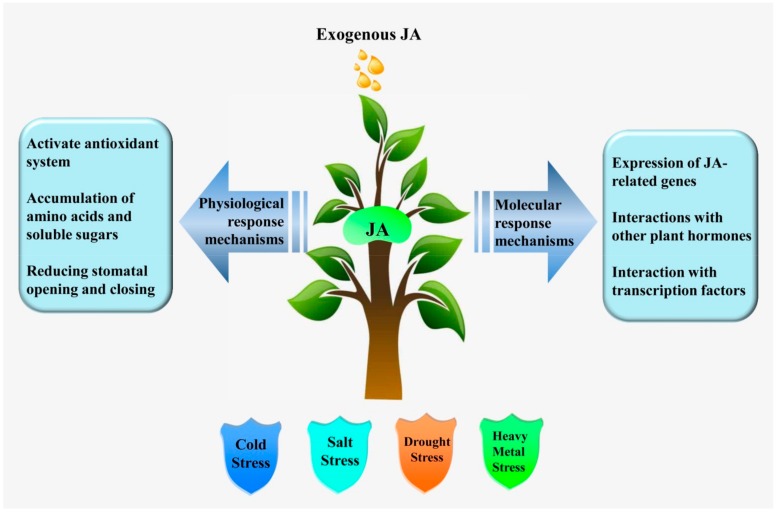
Figure 1
Figure 1
The role of jasmonic acid (JA) in plant response to abiotic stress.
Figure 2
Figure 2
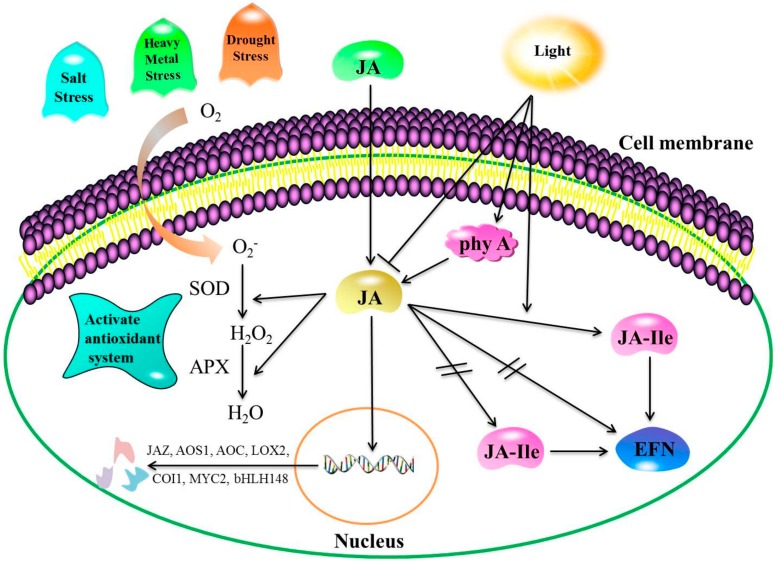
Response mechanism of endogenous JA to abiotic stress. Note: Positive regulatory actions or under light conditions are indicated by arrows and by lines and bars under dark conditions. Double slashes indicate that the process cannot proceed. Salt, drought, or heavy metal stress conditions induce oxidative stress due to elevated reactive oxygen species (ROS) generation levels. The JA produced facilitates stress tolerance by modulating major enzymatic components (SOD and APX) of antioxidant defense systems. In light, the secretion of extra-floral nectar (EFN) is promoted by JA and jasmonate isoleucine conjugate (JA-Ile). Conversely, no light inhibits the secretion of EFN by JA, but not JA-Ile. Far-red (FR) light induces phytochrome A (phyA) and activities of the JA singling pathway. SOD: superoxide dismutase; APX: ascorbate peroxidase.
Figure 3
Figure 3
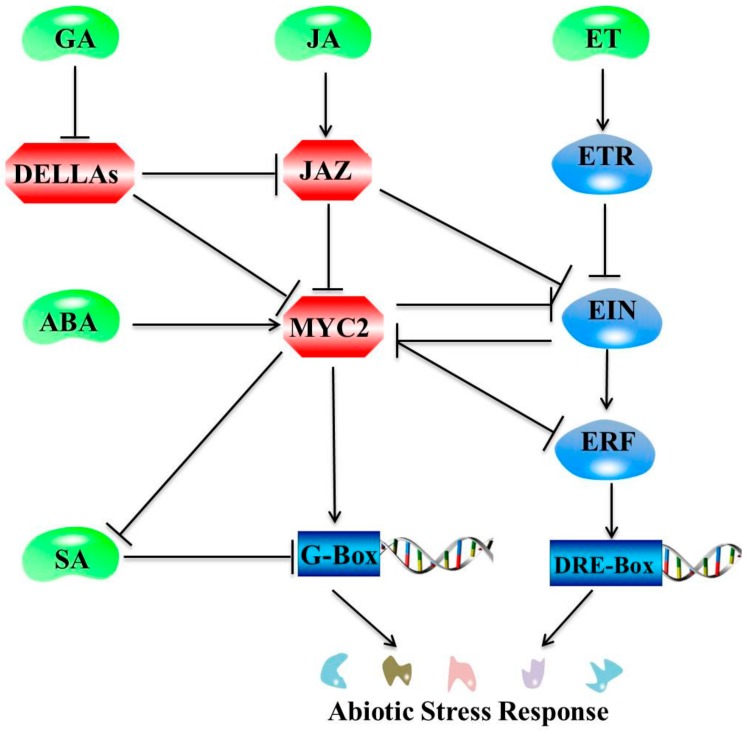
Schematic diagram representing crosstalk of JA with other plant hormone signaling pathways. Note: Positive and negative regulatory actions are indicated by arrows and lines with bars, respectively. MYC2 is the major component involved in interactions between JA and gibberellin (GA). DELLAs interact with JAZ repressors, relieving MYC2 from JAZ repression, and facilitate JA-mediated defense responses by the activation of MYC2. MYC2 is also positively regulated by ABA. Conversely, MYC2 inhibits salicylic acid (SA) regulation of abiotic stress response genes. The JAZ inhibition of EIN mediates JA and ET signaling synergy in plant resistance, whereas the reciprocal counteraction between MYC2 and EIN mediates JA and ethylene (ET) signaling antagonism.

References

    1. Mittler R. Abiotic stress, the field environment and stress combination. Trends Plant Sci. 2006;11:15–19. doi: 10.1016/j.tplants.2005.11.002. - DOI - PubMed
    1. Suzuki N., Rivero R.M., Shulaev V., Blumwald E., Mittler R. Abiotic and biotic stress combinations. New Phytol. 2014;203:32–43. doi: 10.1111/nph.12797. - DOI - PubMed
    1. Ku Y.S., Sintaha M., Cheung M.Y., Lam H.M. Plant hormone signaling crosstalks between biotic and abiotic stress responses. Int. J. Mol. Sci. 2018;19:3206. doi: 10.3390/ijms19103206. - DOI - PMC - PubMed
    1. Yang J., Duan G.H., Li C.Q., Liu L., Han G.Y., Zhang Y.L., Wang C.M. The crosstalks between jasmonic acid and other plant hormone signaling highlight the involvement of jasmonic acid as a core component in plant response to biotic and abiotic stresses. Front. Plant Sci. 2019;10:1349. doi: 10.3389/fpls.2019.01349. - DOI - PMC - PubMed
    1. Ruan J.J., Zhou Y.X., Zhou M.L., Yan J., Khurshid M., Weng W.F., Cheng J.P., Zhang K.X. Jasmonic acid signaling pathway in plants. Int. J. Mol. Sci. 2019;20:2479. doi: 10.3390/ijms20102479. - DOI - PMC - PubMed

MeSH terms

LinkOut - more resources