Review
. 2020 Feb 20;13(2):31.
doi: 10.3390/ph13020031.

Cell Secretome: Basic Insights and Therapeutic Opportunities for CNS Disorders

Affiliations
Review

Cell Secretome: Basic Insights and Therapeutic Opportunities for CNS Disorders

Andreia G Pinho et al. Pharmaceuticals (Basel). .

Abstract

Transplantation of stem cells, in particular mesenchymal stem cells (MSCs), stands as a promising therapy for trauma, stroke or neurodegenerative conditions such as spinal cord or traumatic brain injuries (SCI or TBI), ischemic stroke (IS), or Parkinson's disease (PD). Over the last few years, cell transplantation-based approaches have started to focus on the use of cell byproducts, with a strong emphasis on cell secretome. Having this in mind, the present review discusses the current state of the art of secretome-based therapy applications in different central nervous system (CNS) pathologies. For this purpose, the following topics are discussed: (1) What are the main cell secretome sources, composition, and associated collection techniques; (2) Possible differences of the therapeutic potential of the protein and vesicular fraction of the secretome; and (3) Impact of the cell secretome on CNS-related problems such as SCI, TBI, IS, and PD. With this, we aim to clarify some of the main questions that currently exist in the field of secretome-based therapies and consequently gain new knowledge that may help in the clinical application of secretome in CNS disorders.

Keywords: Parkinson’s disease; central nervous system; ischemic stroke; mesenchymal stem cells; regeneration; secretome; spinal cord injury; traumatic brain injury.


Conflict of interest statement

The authors declare no conflict of interest.

Figures
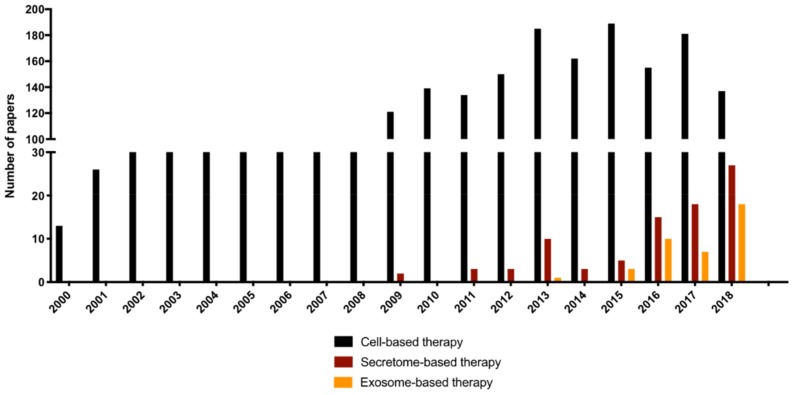
Figure 1
Figure 1
Number of publications per year of cell-, secretome-, or exosome-based therapies on central nervous system (CNS) disorders (Parkinson’s disease (PD), spinal cord injury (SCI), traumatic brain injury (TBI) and ischemic stroke (IS)). An electronic research on PubMed database for literature describing cell-, secretome-, and exosome-based therapies was performed on 18 January 2019 using the following keywords: (cell OR cellular OR stem OR cells) AND (transplantation OR transplant OR “Co-Transplantation” OR Cotransplantation OR engraft OR engraftment OR graft OR grafts) AND (therapy OR therapies OR therapeutics OR therapeutic) NOT Review [Publication Type] AND (“spinal cord injury” or “brain injury” or stroke or parkinson) AND (primates OR mice OR mouse OR rat OR rats OR rodent OR “in vivo” OR “clinical Trials” OR humans) for cell-based therapies and (conditioned medium OR conditioned media OR secretory OR “trophic factors” OR Exosomes OR vesicles OR microvesicles OR vesicular OR “Extracellular vesicles” OR “nanovesicles” OR “exosomal”) AND (therapy OR therapies OR therapeutics OR therapeutic) NOT Review[Publication Type] AND (“spinal cord injury” or “brain injury” or stroke or parkinson) AND (primates OR mice OR mouse OR rat OR rats OR rodent OR “in vivo” OR “clinical Trials” OR humans) for secretome- and exosome-based therapies. The search retrieved 3676 articles for cell-based therapies and 682 articles for secretome- and exosome-based therapies. Data extraction was independently performed by two researchers.
Figure 2
Figure 2
Mesenchymal stem cell secretome composition and their main effects on the CNS. On their soluble fraction (red circles), MSC secretome contains cytokines, chemokines, growth factors, and glycoproteins. On their vesicular fractions (orange circles), the exosomes and microvesicles contain essentially microRNAs. Both the soluble and the vesicular fractions may act on distinct damaged cells of the nervous system, promoting their survival, angiogenesis, neurite outgrowth, and immunomodulation. This information is based on the articles [85,86].

References

    1. Dewan M.C., Rattani A., Gupta S., Baticulon R.E., Hung Y., Punchak M., Agrawal A., Adeleye A.O., Shrime M.G., Rubiano A.M., et al. Estimating the global incidence of traumatic brain injury. J. Neurosurg. 2018 doi: 10.3171/2017.10.JNS17352. - DOI - PubMed
    1. Singh A., Tetreault L., Kalsi-Ryan S., Nouri A., Fehlings M.G. Global Prevalence and incidence of traumatic spinal cord injury. Clin. Epidemiol. 2014;6:309–331. - PMC - PubMed
    1. Pringsheim T., Jette N., Frolkis A., Steeves T.D.L. The prevalence of Parkinson’s disease: A systematic review and meta-analysis. Mov. Disord. 2014;29:1583–1590. doi: 10.1002/mds.25945. - DOI - PubMed
    1. Ekker M.S., Boot E., Singhal A., Tan K.S., Debette S., Tuladhar A.M., Erik F. Epidemiology, aetiology, and management of ischaemic stroke in young adults. Lancet Neurol. 2018;17:790–801. doi: 10.1016/S1474-4422(18)30233-3. - DOI - PubMed
    1. Tanaka E.M., Ferretti P. Considering the evolution of regeneration in the central nervous system. Nat. Rev. Neurosci. 2009;10:713–723. doi: 10.1038/nrn2707. - DOI - PubMed

LinkOut - more resources
