. 2020 Feb 20;9(2):579.
doi: 10.3390/jcm9020579.

Relationships Among and Predictive Values of Obesity, Inflammation Markers, and Disease Severity in Pediatric Patients with Obstructive Sleep Apnea Before and After Adenotonsillectomy

Affiliations

Relationships Among and Predictive Values of Obesity, Inflammation Markers, and Disease Severity in Pediatric Patients with Obstructive Sleep Apnea Before and After Adenotonsillectomy

Hai-Hua Chuang et al. J Clin Med. .

Abstract

Both obstructive sleep apnea (OSA) and obesity are major health issues that contribute to increased systemic inflammation in children. To date, adenotonsillectomy (AT) is still the first-line treatment for childhood OSA. However, the relationships among and predictive values of obesity, inflammation, and OSA severity have not been comprehensively investigated. This prospective study investigated body mass index (BMI), serum inflammatory markers, and OSA severity before and after AT in 60 pediatric patients with OSA. At baseline, differences in levels of interleukin-6, interleukin-9, basic fibroblast growth factor, platelet-derived growth factor-BB, as well as regulated on activation, normal T cell expressed and secreted (RANTES) were significant among the various weight status and OSA severity subgroups. After 3 months postoperatively, the differences in these inflammatory markers diminished along with a decrease in OSA severity while obesity persisted. The rate of surgical cure (defined as postoperative obstructive apnea-hypopnea index < 2.0 and obstructive apnea index < 1.0) was 62%. Multivariate analysis revealed that age, BMI z-score, granulocyte-macrophage colony-stimulating factor, monocyte chemotactic protein-1, and RANTES independently predicted surgical cure. Despite the significant reductions in inflammatory markers and OSA severity after AT, an inter-dependent relationship between obesity and OSA persisted. In addition to age and BMI, several inflammatory markers helped to precisely predict surgical cure.

Keywords: RANTES; adenotonsillectomy; basic fibroblast growth factor; children; granulocyte-macrophage colony-stimulating factor; interleukin; monocyte chemotactic protein; obesity; obstructive sleep apnea; platelet-derived growth factor.


Conflict of interest statement

The authors declare no conflict of interest.

Figures
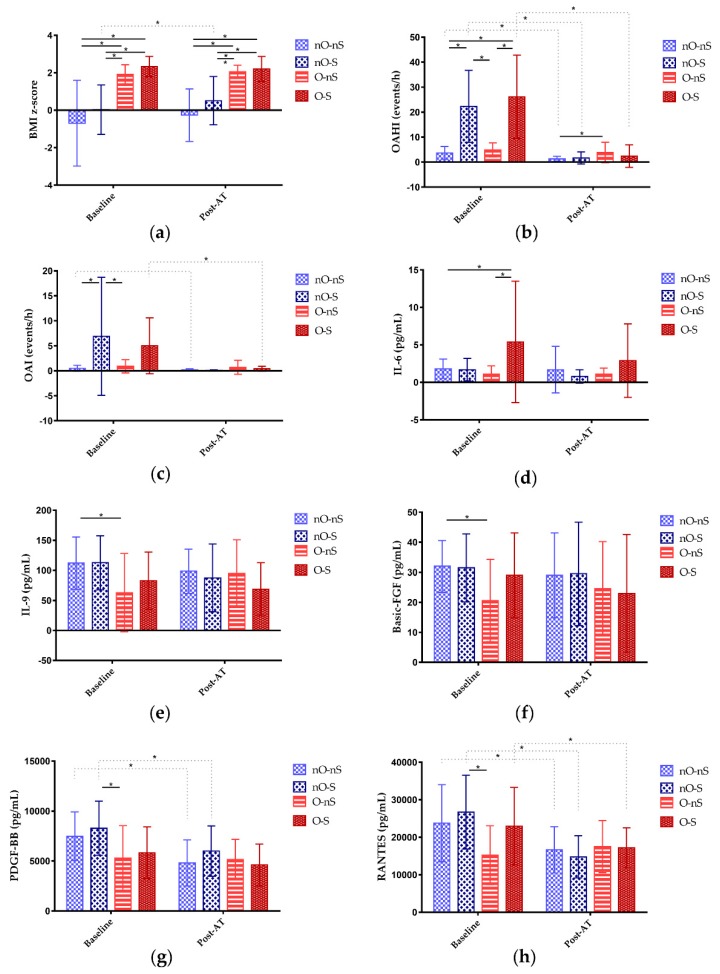
Figure 1
Figure 1
Distributions of variables of interests (means ± standards deviations) at baseline and after adenotonsillectomy (AT). (a) Body mass index (BMI) significantly differed between the non-obese with non-severe OSA (nO-nS) and obese with non-severe OSA (O-nS) subgroups, between the nO-nS and obese with severe OSA (O-S) subgroups, between the non-obese with severe OSA (nO-S) and O-nS subgroups, and between the nO-S and O-S subgroups at baseline. After AT, BMI z-score significantly increased in the nO-S subgroup. However, post-AT BMI z-score significantly differed between the nO-nS and O-nS subgroups, between the nO-nS and O-S subgroups, between the nO-S and O-nS subgroups, and between the nO-S and O-S subgroups. (b) The obstructive apnea-hypopnea index (OAHI) significantly differed between the nO-nS and nO-S subgroups, between the nO-nS and O-S subgroups, between the nO-S and O-nS subgroups, and between the O-nS and O-S subgroups at baseline. After AT, OAHI significantly decreased in the nO-nS, nO-S, and O-S subgroups. Therefore, post-AT AHI only significantly differed between the nO-nS and O-nS subgroups. (c) The obstructive apnea index (OAI) significantly differed between the nO-nS and nO-S subgroups and between the nO-S and O-nS subgroups at baseline. After AT, OAI significantly decreased in the nO-nS and O-S subgroups. However, post-AT AHIs were equal across the four subgroups. (d) The levels of interleukin (IL)-6 significantly differed between the nO-nS and O-S subgroups, and the O-nS and O-S subgroups at baseline. After AT, the intra-group and inter-group differences in the levels of IL-6 were not statistically significant. (e) The levels of IL-9 significantly differed between the nO-nS and O-nS subgroups at baseline. After AT, the intra-group and inter-group differences in the levels of IL-9 were not statistically significant. (f) The levels of basic fibroblast growth factor (FGF) significantly differed between the nO-S and O-nS subgroups. After AT, the intra-group and inter-group differences in the levels of basic FGF were not statistically significant. (g) The levels of platelet-derived growth factor (PDGF)-BB significantly differed between the nO-S and O-nS subgroups. After AT, PDGF-BB significantly decreased in the nO-nS and nO-S subgroups. However, the inter-group differences in the levels of basic FGF after AT were not statistically significant. (h) The levels of regulated on activation, normal T cell expressed and secreted (RANTES) significantly differed between the nO-S and O-nS subgroups. After AT, RANTES significantly decreased in the nO-nS, nO-S, and O-S subgroups. However, the inter-group differences in the levels of RANTES after AT were not statistically significant.
Figure 2
Figure 2
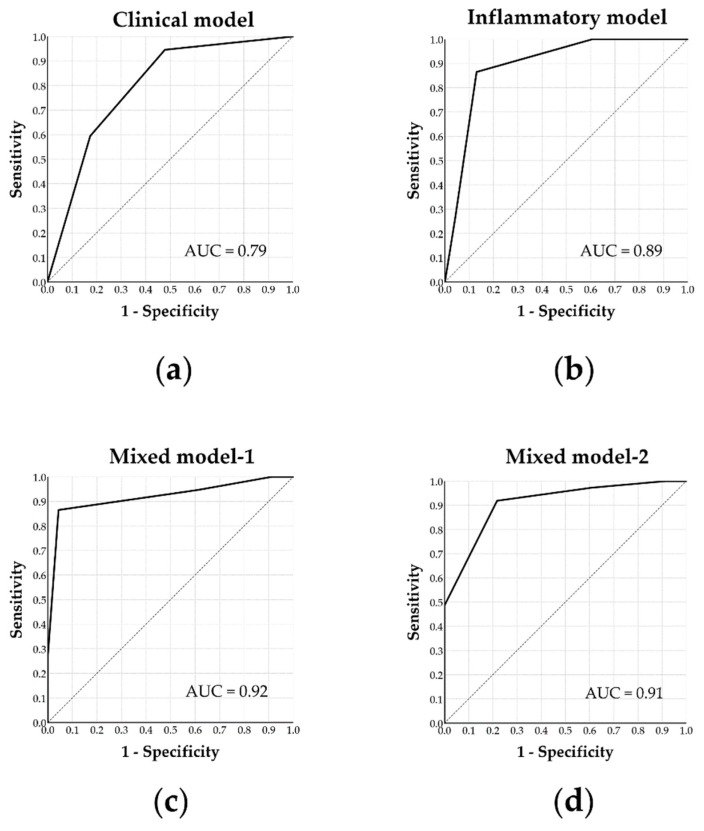
Receiver operator curves using various models to predict surgical cure of adenotonsillectomy in children with obstructive sleep apnea. (a) The ‘clinical model’ included age and body mass index z-score to independently predict surgical cure. (b) The ‘inflammatory model’ included four independent inflammatory markers (interleukin-1ra, interleukin-17, granulocyte-macrophage colony-stimulating factor, and monocyte chemotactic protein-1) to predict surgical cure. (c) The ‘mixed model-1′ included age, granulocyte-macrophage colony-stimulating factor, monocyte chemotactic protein-1, as well as regulated on activation, normal T cell expressed and secreted to best predict surgical cure. (d) The ‘Mixed model-2′ included age, body mass index z-score, monocyte chemotactic protein-1, and regulated on activation, normal T cell expressed and secreted to second-best predict surgical cure. AUC: area under the curve.

References

    1. Peppard P.E., Young T., Barnet J.H., Palta M., Hagen E.W., Hla K.M. Increased prevalence of sleep-disordered breathing in adults. Am. J. Epidemiol. 2013;177:1006–1014. doi: 10.1093/aje/kws342. - DOI - PMC - PubMed
    1. Franklin K.A., Lindberg E. Obstructive sleep apnea is a common disorder in the population-a review on the epidemiology of sleep apnea. J. Thorac. Dis. 2015;7:1311–1322. - PMC - PubMed
    1. Heinzer R., Vat S., Marques-Vidal P., Marti-Soler H., Andries D., Tobback N., Mooser V., Preisig M., Malhotra A., Waeber G., et al. Prevalence of sleep-disordered breathing in the general population: The HypnoLaus study. Lancet Respir. Med. 2015;3:310–318. doi: 10.1016/S2213-2600(15)00043-0. - DOI - PMC - PubMed
    1. Senaratna C.V., Perret J.L., Lodge C.J., Lowe A.J., Campbell B.E., Matheson M.C., Hamilton G.S., Dharmage S.C. Prevalence of obstructive sleep apnea in the general population: A systematic review. Sleep Med. Rev. 2017;34:70–81. doi: 10.1016/j.smrv.2016.07.002. - DOI - PubMed
    1. Martinelli E.O., Haddad F.L.M., Stefanini R., Moreira G.A., Rapoport P.B., Gregorio L.C., Tufik S., Bittencourt L.R.A. Clinicals And Upper Airway Characteristics in Obese Children with Obstructive Sleep Apnea. Sleep Sci. 2017;10:1–6. doi: 10.5935/1984-0063.20170001. - DOI - PMC - PubMed