


A randomized controlled trial study of the acceptability, feasibility, and preliminary impact of SITA (SMS as an Incentive To Adhere): a mobile technology-based intervention informed by behavioral economics to improve ART adherence among youth in Uganda
- PMID: 32093630
- PMCID: PMC7041095
- DOI: 10.1186/s12879-020-4896-0
A randomized controlled trial study of the acceptability, feasibility, and preliminary impact of SITA (SMS as an Incentive To Adhere): a mobile technology-based intervention informed by behavioral economics to improve ART adherence among youth in Uganda
Abstract
Background: Studies report serious adherence problems among youth (individuals age 15-24 years of age) in Uganda. Recent growth in mobile phone ownership has highlighted the potential of using text-based interventions to improve antiretroviral treatment (ART) adherence among Ugandan youth. We piloted a randomized controlled trial of a text-based intervention providing weekly real-time antiretroviral adherence feedback, based on information from a smart pill box, to HIV-positive Ugandan youth. In this paper, we report the acceptability, feasibility, and preliminary impact of the intervention.
Methods: We randomized participants to a control group, or to receive messages with information on either their own adherence levels (Treatment 1 - T1), or their own adherence and peer adherence levels (Treatment 2 - T2). We conducted six focus groups from December 2016 to March 2017 with providers and youth ages 15-24, double coded 130 excerpts, and achieved a pooled Cohen's Kappa of 0.79 and 0.80 based on 34 randomly selected excerpts.
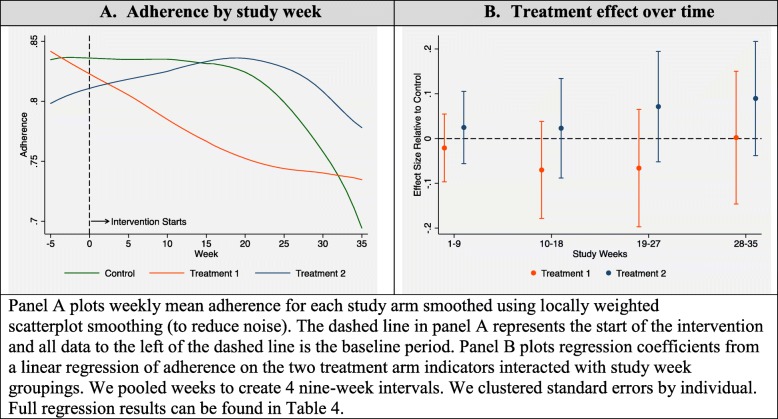
Results: The quantitative and qualitative data show that the intervention was deemed acceptable and feasible. After controlling for baseline adherence, the T1 group had 3.8 percentage point lower adherence than the control group (95% CI -9.9, 2.3) and the T2 group had 2.4 percentage points higher adherence than the control group (95% CI -3.0, 7.9). However, there was an increasing treatment effect over time for the T2 group with the largest effect towards the end of the study; a 2.5 percentage point increase in the initial 9-weeks that grows steadily to 9.0 percentage points by the last 9-weeks of the study. We find negative treatment effects for T1 in 3 of the 4 9-week intervals. This pilot study was not designed to detect statistically significant differences.
Conclusions: Improving youth's adherence by supplementing information about their adherence with information about the adherence of peers is a promising new strategy that should be further evaluated in a fully-powered study. Providing one's own adherence information alone appears to have less potential.
Trial registration: NCT02514356 07/30/2015.
Keywords: ART adherence; Behavioral economics; Uganda; Youth.
Conflict of interest statement
The authors declare that they have no competing interests.
Figures
References
-
- HIV/AIDS, U.N.P.o. Global AIDS Monitoring 2018: indicators for monitoring the 2016 United Nations Political Declaration on Ending AIDS. Viena: UNAIDS; 2017.
-
- The Alan Guttmacher Institute . Adolescent in Uganda: Sexual and reproductive health, in Research in Brief. New York, NY: The Alan Guttmacher Institute; 2005. pp. 1–4.
Publication types
MeSH terms
Substances
Associated data
Grants and funding
LinkOut - more resources
Full Text Sources
Medical
