


Essential newborn care utilization and associated factors in Ethiopia: a systematic review and meta-analysis
- PMID: 32093648
- PMCID: PMC7041192
- DOI: 10.1186/s12884-020-2804-7
Essential newborn care utilization and associated factors in Ethiopia: a systematic review and meta-analysis
Abstract
Background: Globally, newborn death accounted for 46% of under-five deaths and more than 80% of newborn deaths are the result of preventable and treatable conditions. Findings on the prevalence and associated factors of essential newborn care utilization are highly variable and inconsistent across Ethiopia. Therefore, this systematic review and meta-analysis aimed to estimate the pooled prevalence of essential newborn care utilization and associated factors in Ethiopia.
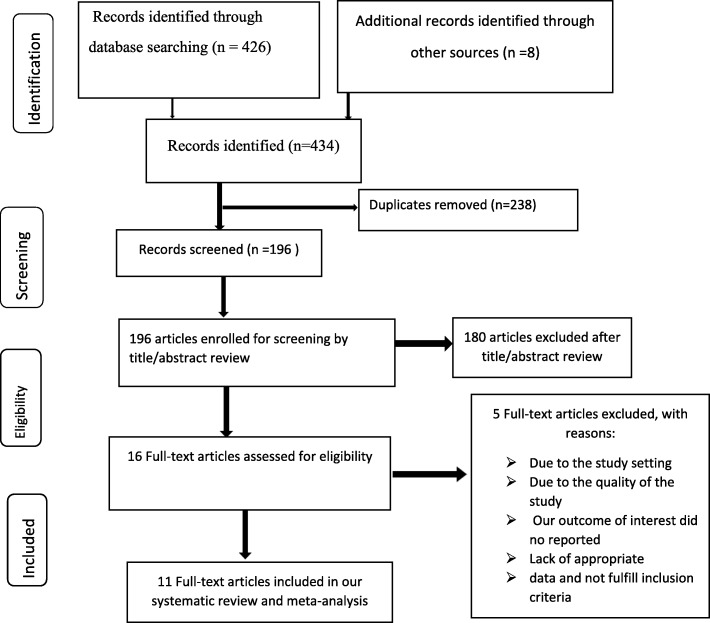
Methods: The international databases accessed included MEDLINE/PubMed, EMBASE, Web of Sciences, Scopus, and Grey literature databases, Google Scholar, Science Direct and Cochrane library were scientifically explored. We considered all primary studies reporting the prevalence of essential newborn care utilization and associated factors in Ethiopia. We retrieved all necessary data by using a standardized data extraction format spreadsheet. STATA 14 statistical software was used to analyze the data and Cochrane Q test statistics and I2 test was used to assess the heterogeneity between the studies. There significant heterogeneity between the studies so a random effect model was employed.
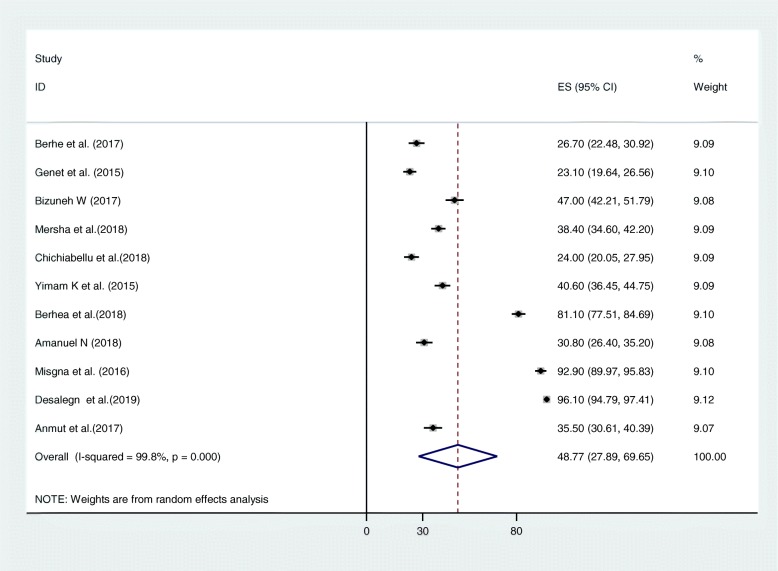
Results: The pooled estimate of essential newborn care utilization from 11 studies in Ethiopia was 48.77% (95% CI: 27.89, 69.65). Residence [OR = 2.50 (95% CI: 1.64, 3.88)], Postnatal care [OR = 5.53, 95% CI = (3.02, 10.13], counseling during pregnancy and delivery [OR = 4.39, 95% CI = (2.99, 6.45], antenatal care follows up (OR = 6.84; 95% CI: 1.15, 4.70) and maternal educational status [OR = 1.63 (95% CI: 1.12, 2.37)] were identified as associated factors of essential newborn care utilization.
Conclusion: Based on the current study essential newborn care utilization in Ethiopia was significantly low in comparison with the current global recommendation on essential newborn care utilization. Place of residence, Postnatal care, counseling during pregnancy and delivery, antenatal care follow up, and maternal educational status were associated risk factors. Therefore, on the basis of the results, it is suggested that special attention should be given to attempts to ensure that education should focus on women during ante and postnatal follow-up, counseling during pregnancy and delivery, as well as rural and illiterate mothers. Finally, appropriate newborn services at health facilities and raising mother's level of awareness about newborn care practices are imperative in addressing the gaps in essential newborn care utilization in Ethiopia.
Keywords: Ante/post-natal care; Essential newborn care utilization; Ethiopia.
Conflict of interest statement
The authors declare that they have no competing interests.
Figures

References
-
- Mohammadi Y, Parsaeian M, Farzadfar F, Kasaeian A, Mehdipour P, Sheidaei A, Mansouri A, Moghaddam SS, Djalalinia S, Mahmoudi M. Levels and trends of child and adult mortality rates in the Islamic Republic of Iran, 1990–2013; protocol of the NASBOD study. Arch Iran Med. 2014;17(3):176–181. - PubMed
-
- Jamison DT, Breman JG, Measham AR, Alleyne G, Claeson M, Evans DB, Jha P, Mills A, Musgrove P. Disease control priorities in developing countries: the World Bank. 2006. - PubMed
-
- Ahmad S, Goel K, Agarwal G, Goel P, Kumar V, Prakash A. Assessment of the newborn care practices in home deliveries among urban slums of Meerut, UP India. J Community Med Health Educ. 2012;2(171):2161–0711.1000171.
-
- Khan MH, Noman N, Hashmi G, Gul S, Ali A, Babar KS. Essential newborn care practice in the hospital versus home deliveries. Gomal J Med Sci. 2004;4(1):7-9.
Publication types
MeSH terms
LinkOut - more resources
Full Text Sources
Medical
