


Unstimulated whole saliva flow for diagnosis of primary Sjögren's syndrome: time to revisit the threshold?
- PMID: 32093745
- PMCID: PMC7041275
- DOI: 10.1186/s13075-020-2132-3
Unstimulated whole saliva flow for diagnosis of primary Sjögren's syndrome: time to revisit the threshold?
Abstract
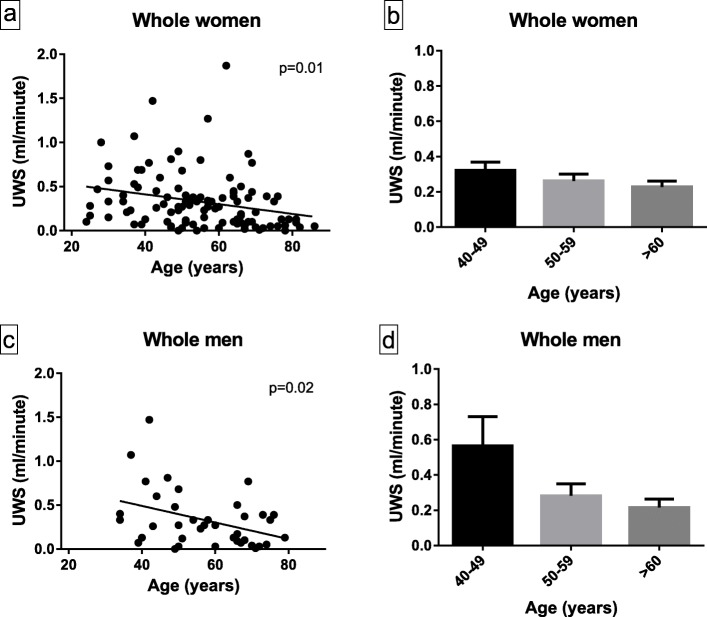
Background: Unstimulated whole saliva (UWS) flow rate is one of the ACR/EULAR 2016 criteria for primary Sjögren's syndrome (pSS). With a single threshold of ≤ 0.1 mL/min, UWS flow does not take into account the age- and sex-related physiological variations. Furthermore, it has a low sensitivity for the diagnosis of pSS (about 50%), contrary to the screening test for xerophthalmia, Schirmer's test (sensitivity of about 70%). We aimed to identify UWS thresholds allowing better performances for a screening test for pSS comparable to Schirmer's test, and considering age- and sex-related variations.
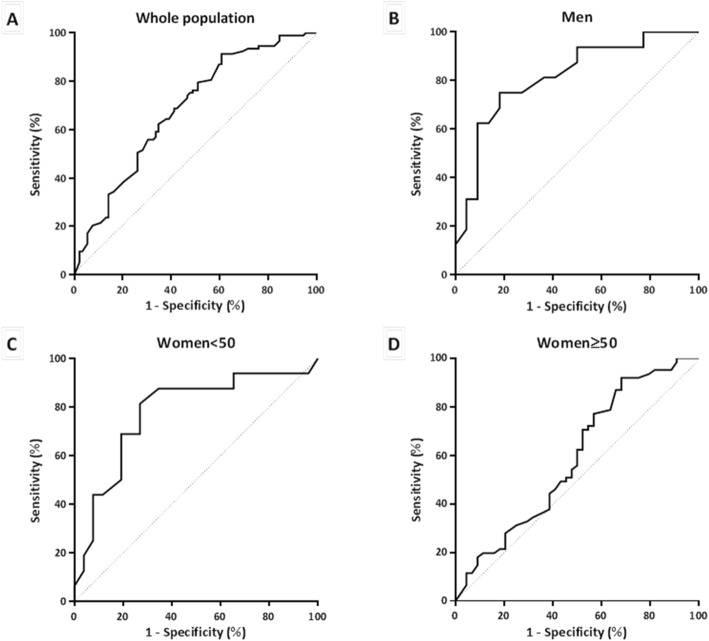
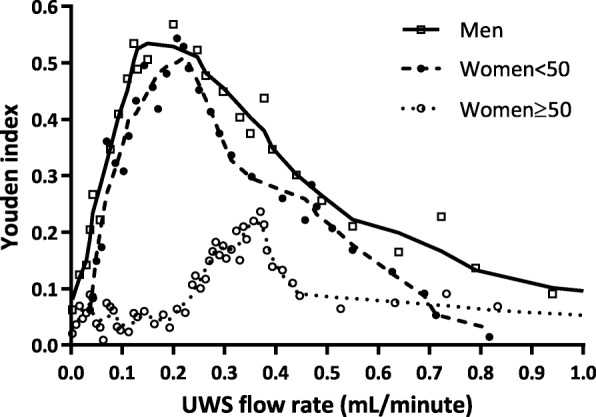
Methods: A prospective cohort of 185 patients with oral and/or ocular dryness was classified into 3 groups: men, women < 50 (< 50 years old), and women ≥ 50 (≥ 50 years old). The diagnostic performances of UWS flow rate in these groups were compared in terms of sensitivity, specificity, positive and negative predictive values, and ROC curves. The identification of thresholds that optimize diagnostic performances was carried out using Youden's index.
Results: The diagnostic performances of UWS flow rate varied according to age and sex. UWS had poor diagnostic performances whatever the threshold in the women ≥ 50 group. The threshold of 0.2 mL/min had a sensitivity of ≥ 70% and a specificity of ≥ 50% in both men and women < 50 groups. In the whole population and compared to the current cutoff, a threshold of 0.2 mL/min increased sensitivity (+ 19.8%) and positive (+ 2.3%) and negative (+ 7.0%) predictive values, with a better specificity (65.2%) than Schirmer's test.
Conclusion: For objective assessment of xerostomia, raising the threshold of the UWS flow rate to 0.2 mL/min would optimize its screening performances for pSS.
Keywords: Age groups; Classification; Saliva; Sex; Sjögren’s syndrome; Xerostomia.
Conflict of interest statement
The authors declare that they have no competing interests.
Figures
References
-
- Shiboski CH, Shiboski SC, Seror R, Criswell LA, Labetoulle M, Lietman TM, et al. 2016 American College of Rheumatology/European League Against Rheumatism Classification Criteria for Primary Sjögren’s Syndrome: a consensus and data-driven methodology involving three international patient cohorts. Arthritis Rheumatol. 2017;69:35–45. - PMC - PubMed
-
- Mariette X, Criswell LA. Primary Sjögren’s syndrome. Solomon CG, editor. N Engl J Med 2018;378:931–939. - PubMed
-
- Vitali C, Bombardieri S, Moutsopoulos HM, Balestrieri G, Bencivelli W, Bernstein RM, et al. Preliminary criteria for the classification of Sjögren’s syndrome. Results of a prospective concerted action supported by the European community. Arthritis Rheum. 1993;36:340–347. doi: 10.1002/art.1780360309. - DOI - PubMed
-
- Vitali C, Bombardieri S, Jonsson R, Moutsopoulos HM, Alexander EL, Carsons SE, et al. Classification criteria for Sjögren’s syndrome: a revised version of the European criteria proposed by the American-European Consensus Group. Ann Rheum Dis. 2002;61:554–558. doi: 10.1136/ard.61.6.554. - DOI - PMC - PubMed
Publication types
MeSH terms
LinkOut - more resources
Full Text Sources
Medical
