. 2020 Feb 20;4(1):010904.
doi: 10.1063/1.5129563. eCollection 2020 Mar.

Endothelial mechanobiology

Affiliations

Endothelial mechanobiology

Ming He et al. APL Bioeng. .

Abstract

Lining the luminal surface of the vasculature, endothelial cells (ECs) are in direct contact with and differentially respond to hemodynamic forces depending on their anatomic location. Pulsatile shear stress (PS) is defined by laminar flow and is predominantly located in straight vascular regions, while disturbed or oscillatory shear stress (OS) is localized to branch points and bifurcations. Such flow patterns have become a central focus of vascular diseases, such as atherosclerosis, because the focal distribution of endothelial dysfunction corresponds to regions exposed to OS, whereas endothelial homeostasis is maintained in regions defined by PS. Deciphering the mechanotransduction events that occur in ECs in response to differential flow patterns has required the innovation of multidisciplinary approaches in both in vitro and in vivo systems. The results from these studies have identified a multitude of shear stress-regulated molecular networks in the endothelium that are implicated in health and disease. This review outlines the significance of scientific findings generated in collaboration with Dr. Shu Chien.


Figures

FIG. 1.
FIG. 1.
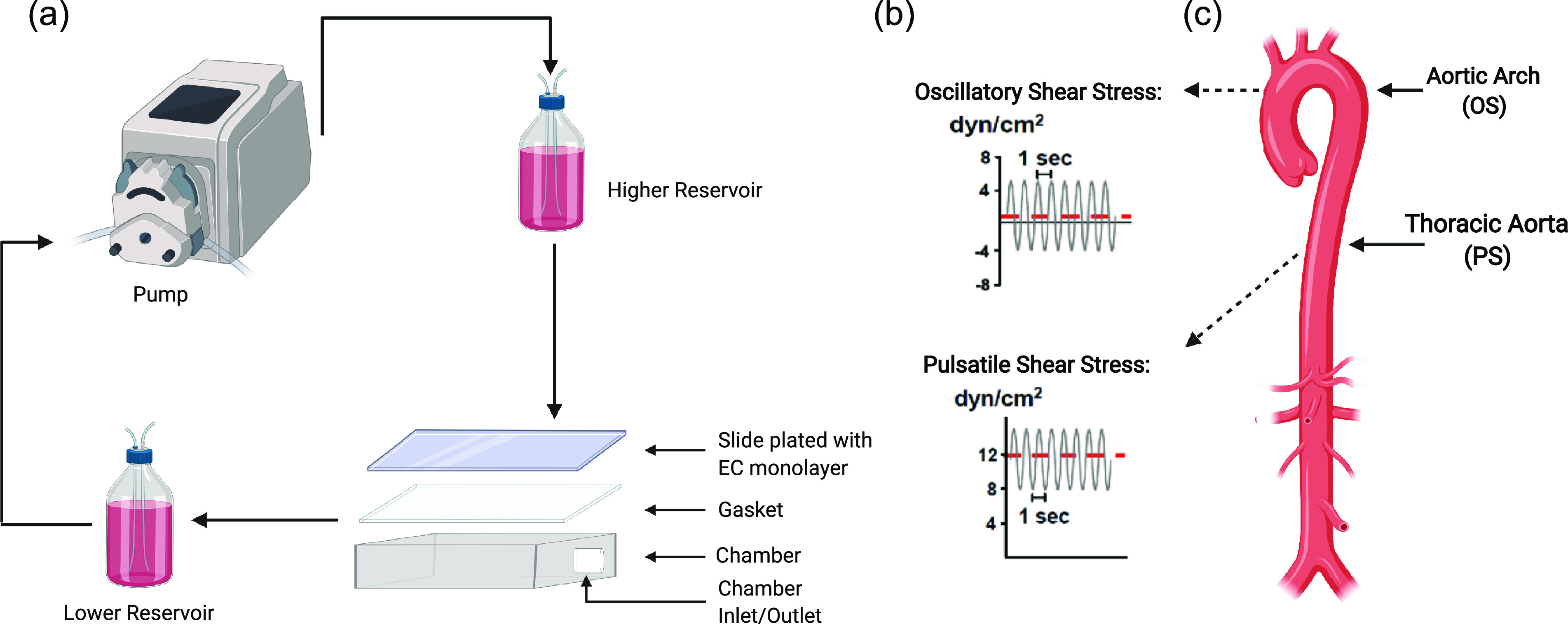
Techniques to study the effect of shear stress on the endothelium. (a) Diagram illustrating the perfusable flow system for the application of PS or OS to ECs in vitro. (b) The perfusion system applies shear stress, with pulsating a net directional flow rate of 12 ± 4 dynes/cm2, characteristic of PS (lower panel); while pulsating shear, with a minimal net directional flow rate of 0.5 ± 4 dynes/cm2, is characteristic of OS (upper panel). (c) Illustration of an aorta annotated with the aortic arch, a region characterized by disturbed flow patterns modeled by OS, and the thoracic aorta, a region characterized by laminar flow patterns modeled by PS.
FIG. 2.
FIG. 2.
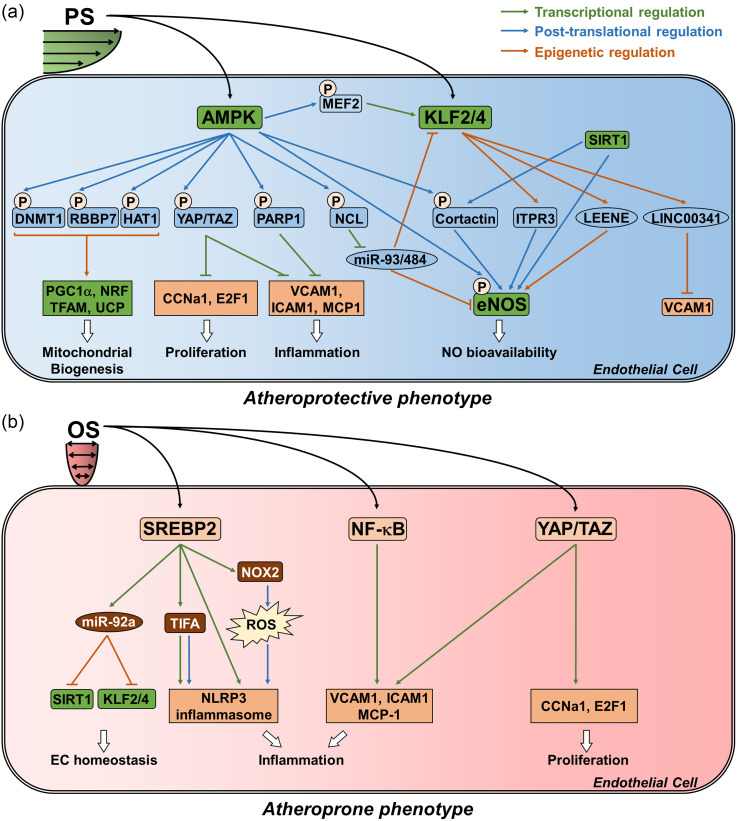
The effect of shear stress on the endothelium. (a) Network schematic for the effect of PS on ECs. PS activates AMPK, KLF2, and KLF4. AMPK is atheroprotective by phosphorylating DNMT1, RBBP7, HAT1, YAP/TAZ, PARP1, NCL, and cortactin. KLF2 exerts a similar atheroprotective effect by transcriptionally inducing ITPR3, LEENE, and LINC00341. Collectively, the activities of these targets are modulated to enhance mitochondrial biogenesis and function, increase eNOS-derived NO bioavailability, and reduce EC proliferation and inflammation. (b) Network schematic for the effect of OS on ECs. OS activates SREBP2, YAP/TAZ, and NF-κB which collectively impair EC homeostasis, and enhance EC inflammation and proliferation.

References

    1. Cicha I., Goppelt-Struebe M., Yilmaz A., Daniel W. G., and Garlichs C. D., “ Endothelial dysfunction and monocyte recruitment in cells exposed to non-uniform shear stress,” Clin. Hemorheol. Microcirc. 39, 113–119 (2008). 10.3233/CH-2008-1074 - DOI - PubMed
    1. Hsiai T. K., Cho S. K., Wong P. K., Ing M., Salazar A., Sevanian A., Navab M., Demer L. L., and Ho C. M., “ Monocyte recruitment to endothelial cells in response to oscillatory shear stress,” FASEB 17, 1648–1657 (2003). 10.1096/fj.02-1064com - DOI - PMC - PubMed
    1. Ueba H., Kawakami M., and Yaginuma T., “ Shear stress as an inhibitor of vascular smooth muscle cell proliferation. Role of transforming growth factor-beta 1 and tissue-type plasminogen activator,” Arterioscler., Thromb., Vasc. Biol. 17, 1512–1516 (1997). 10.1161/01.ATV.17.8.1512 - DOI - PubMed
    1. Dell'Era P., Belleri M., Stabile H., Massardi M. L., Ribatti D., and Presta M., “ Paracrine and autocrine effects of fibroblast growth factor-4 in endothelial cells,” Oncogene 20, 2655–2663 (2001). 10.1038/sj.onc.1204368 - DOI - PubMed
    1. Baumgartner-Parzer S. M. and Waldhäusl W. K., “ The endothelium as a metabolic and endocrine organ: Its relation with insulin resistance,” Exp. Clin. Endocrinol. Diabetes 109, S166–S179 (2001). 10.1055/s-2001-18579 - DOI - PubMed