Tablet-Based Application for Objective Measurement of Motor Fluctuations in Parkinson Disease
- PMID: 32095754
- PMCID: PMC7015371
- DOI: 10.1159/000485468
Tablet-Based Application for Objective Measurement of Motor Fluctuations in Parkinson Disease
Abstract
Background: The motor subscale of the Movement Disorder Society-Unified Parkinson's Disease Rating Scale (MDS-UPDRS-III) has limited applicability for the assessment of motor fluctuations in the home setting.
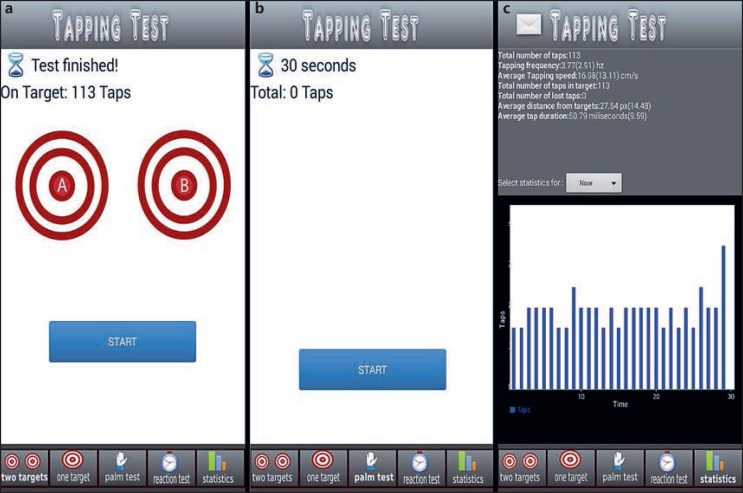
Methods: To assess whether a self-administered, tablet-based application can reliably quantify differences in motor performance using two-target finger tapping and forearm pronation-supination tasks in the ON (maximal dopaminergic medication efficacy) and OFF (reemergence of parkinsonian deficits) medication states, we recruited 11 Parkinson disease (PD) patients (age, 60.6 ± 9.0 years; disease duration, 12.8 ± 4.1 years) and 11 healthy age-matched controls (age, 62.5 ± 10.5 years). The total number of taps, tap interval, tap duration, and tap accuracy were algorithmically calculated by the application, using the more affected side in patients and the dominant hand in healthy controls.
Results: Compared to the OFF state, PD patients showed a higher number of taps (84.2 ± 20.3 vs. 54.9 ± 26.9 taps; p = 0.0036) and a shorter tap interval (375.3 ± 97.2 vs. 708.2 ± 412.8 ms; p = 0.0146) but poorer tap accuracy (2,008.4 ± 995.7 vs. 1,111.8 ± 901.3 pixels; p = 0.0055) for the two-target task in the ON state, unaffected by the magnitude of coexistent dyskinesia. Overall, test-retest reliability was high (r >0.75) and the discriminatory ability between OFF and ON states was good (0.60 ≤ AUC ≤ 0.82). The correlations between tapping data and MDS-UPDRS-III scores were only moderate (-0.55 to 0.55).
Conclusions: A self-administered, tablet-based application can reliably distinguish between OFF and ON states in fluctuating PD patients and may be sensitive to additional motor phenomena, such as accuracy, not captured by the MDS-UPDRS-III.
Keywords: App-based digital biomarkers; Motor symptoms; Objective monitoring of motor symptoms; Parkinson disease-related motor symptoms.
Copyright © 2018 by S. Karger AG, Basel.
Conflict of interest statement
B.D.W. is supported by the NIH (T32GM063483-14). G.M. is the founder and CEO of Apptomics, Inc. A.K.D. is supported by the NIH as a co-investigator (1R01HL125016-01) and as a collaborator (R21 AI118228). He has also been serving as a statistician in 4 CPRIT grants (PP110156, PP140211, PP150031, and PP130083), Coldwell (co-investigator), and MSA Coalition (collaborator) and as a principal investigator in a TTUHSC ELP mini seed grant. He is a director of biostatistics and epidemiology consulting laboratory at the TTUHSC ELP. S.P. is a full-time employee at TEVA Pharmaceuticals and co-chair of the Task Force on Technology for the International Parkinson and Movement Disorder Society. S.K., J.R.L.C., and E.S. have nothing to disclose. A.P.D. has served as a consultant for Merz Pharma, US WorldMeds, and Auspex Pharmaceuticals and has received honoraria from UCB. F.R.-P., J.V., L.L., I.T., and A.S. have nothing to disclose. A.J.E. is the chair of the Task Force on Technology for the International Parkinson and Movement Disorder Society, is supported by the NIH, and has received grant support from Cleveland Medical Devices Inc./Great Lakes NeuroTechnologies, the Davis Phinney Foundation, and the Michael J. Fox Foundation; personal compensation as a consultant/scientific advisory board member for Solvay, Abbott, Chelsea Therapeutics, TEVA, Impax, Merz, Lundbeck, and Eli Lilly; honoraria from TEVA, UCB, the American Academy of Neurology, and the Movement Disorder Society; and publishing royalties from Lippincott Williams & Wilkins, Cambridge University Press, and Springer. He has no financial interests in, nor has received compensation from, iMotor or Apptomics, Inc.
Figures
References
-
- Lieber B, Taylor BE, Appelboom G, McKhann G, Connolly ES., Jr Motion sensors to assess and monitor medical and surgical management of Parkinson disease. World Neurosurg. 2015;84:561–566. - PubMed
-
- Arora S, Venkataraman V, Zhan A, Donohue S, Biglan KM, Dorsey ER, et al. Detecting and monitoring the symptoms of Parkinson's disease using smartphones: a pilot study. Parkinsonism Relat Disord. 2015;21:650–653. - PubMed
LinkOut - more resources
Full Text Sources
Research Materials
Miscellaneous