


The impact of longstanding illness and common mental disorder on competing employment exits routes in older working age: A longitudinal data-linkage study in Sweden
- PMID: 32097437
- PMCID: PMC7041791
- DOI: 10.1371/journal.pone.0229221
The impact of longstanding illness and common mental disorder on competing employment exits routes in older working age: A longitudinal data-linkage study in Sweden
Abstract
Objectives: Comorbidity is prevalent in older working ages and might affect employment exits. This study aimed to 1) assess the associations between comorbidity and different employment exit routes, and 2) examine such associations by gender.
Methods: We used data from employed adults aged 50-62 in the Stockholm Public Health Survey 2002 and 2006, linked to longitudinal administrative income records (N = 10,416). The morbidity measure combined Limiting Longstanding Illness and Common Mental Disorder-captured by the General Health Questionnaire-12 (≥4)-into a categorical variable: 1) No Limiting Longstanding Illness, no Common Mental Disorder, 2) Limiting Longstanding Illness only, 3) Common Mental Disorder only, and 4) comorbid Limiting Longstanding Illness+Common Mental Disorder. Employment status was followed up until 2010, treating early retirement, disability pension and unemployment as employment exits. Competing risk regression analysed the associations between morbidity and employment exit routes, stratifying by gender.
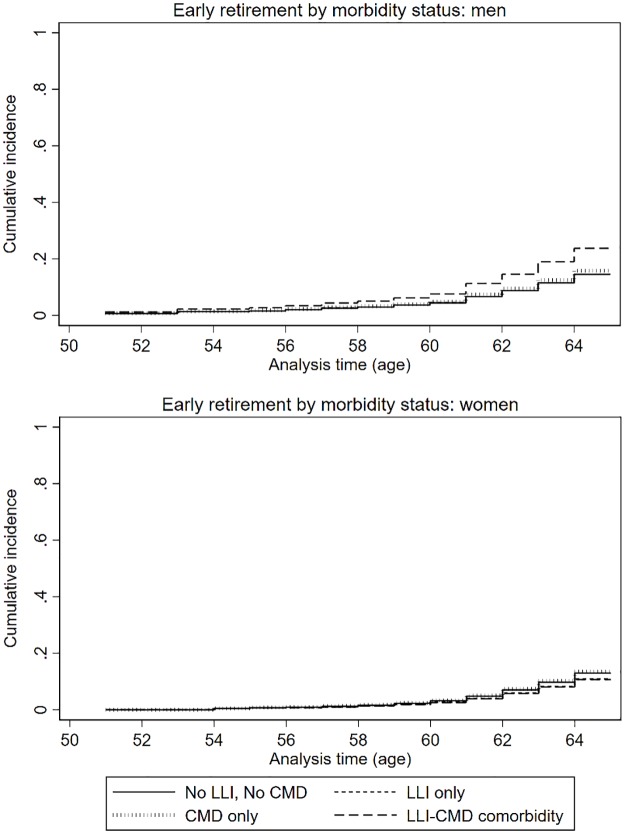
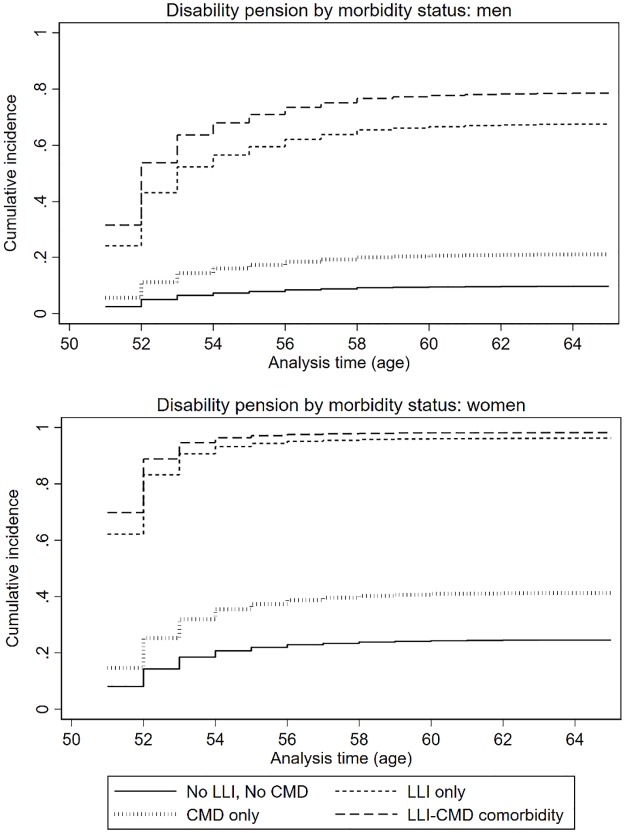
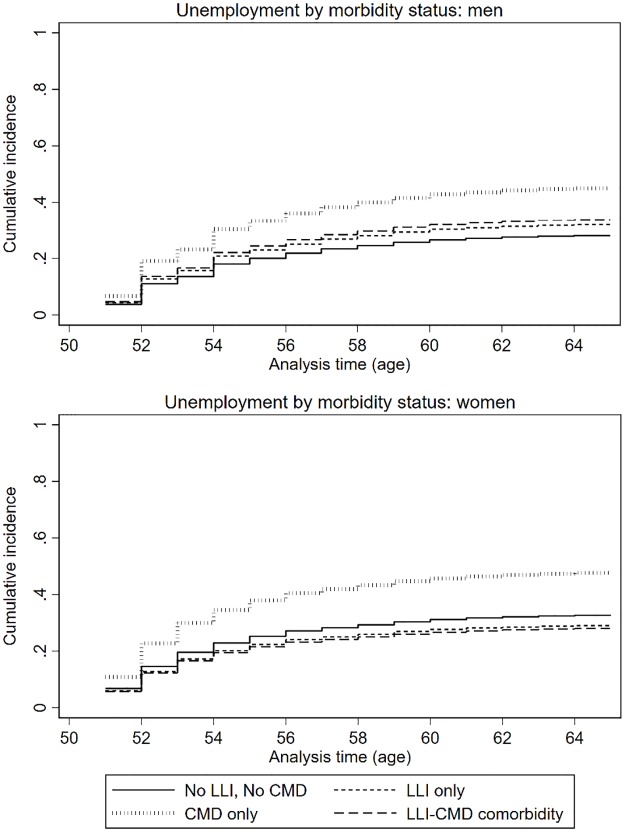
Results: Compared to No Limiting Longstanding Illness, no Common Mental Disorder, comorbid Limiting Longstanding Illness+Common Mental Disorder was associated with early retirement in men (subdistribution hazard ratio = 1.73, 95% confidence intervals: 1.08-2.76), but not in women. For men and women, strong associations for disability pension were observed with Limiting Longstanding Illness only (subdistribution hazard ratio = 11.43, 95% confidence intervals: 9.40-13.89) and Limiting Longstanding Illness+Common Mental Disorder (subdistribution hazard ratio = 14.25, 95% confidence intervals: 10.91-18.61), and to a lesser extent Common Mental Disorder only (subdistribution hazard ratio = 2.00, 95% confidence intervals: 1.31-3.05). Women were more likely to exit through disability pension than men (subdistribution hazard ratio = 1.96, 95% confidence intervals: 1.60-2.39). Common Mental Disorder only was the only morbidity category associated with unemployment (subdistribution hazard ratio = 1.70, 95% confidence intervals: 1.36-2.15).
Conclusions: Strong associations were observed between specific morbidity categories with different employment exit routes, which differed by gender. Initiatives to extend working lives should consider older workers' varied health needs to prevent inequalities in older age.
Conflict of interest statement
The authors have declared that no competing interests exist.
Figures
References
-
- Vickerstaff S. Older Workers: The ‘Unavoidable Obligation’ of Extending Our Working Lives? Sociol Compass. 2010;10: 869–879.
-
- Sewdas R, Van Der Beek AJ, De Wind A, Van Der Zwaan LGL, Boot CRL. Determinants of working until retirement compared to a transition to early retirement among older workers with and without chronic diseases: Results from a Dutch prospective cohort study. Scand J Public Health. 2018;46: 400–408. 10.1177/1403494817735223 - DOI - PMC - PubMed
Publication types
MeSH terms
Grants and funding
LinkOut - more resources
Full Text Sources
Medical
