


Exploring Heterosis in Melon (Cucumis melo L.)
- PMID: 32098173
- PMCID: PMC7076541
- DOI: 10.3390/plants9020282
Exploring Heterosis in Melon (Cucumis melo L.)
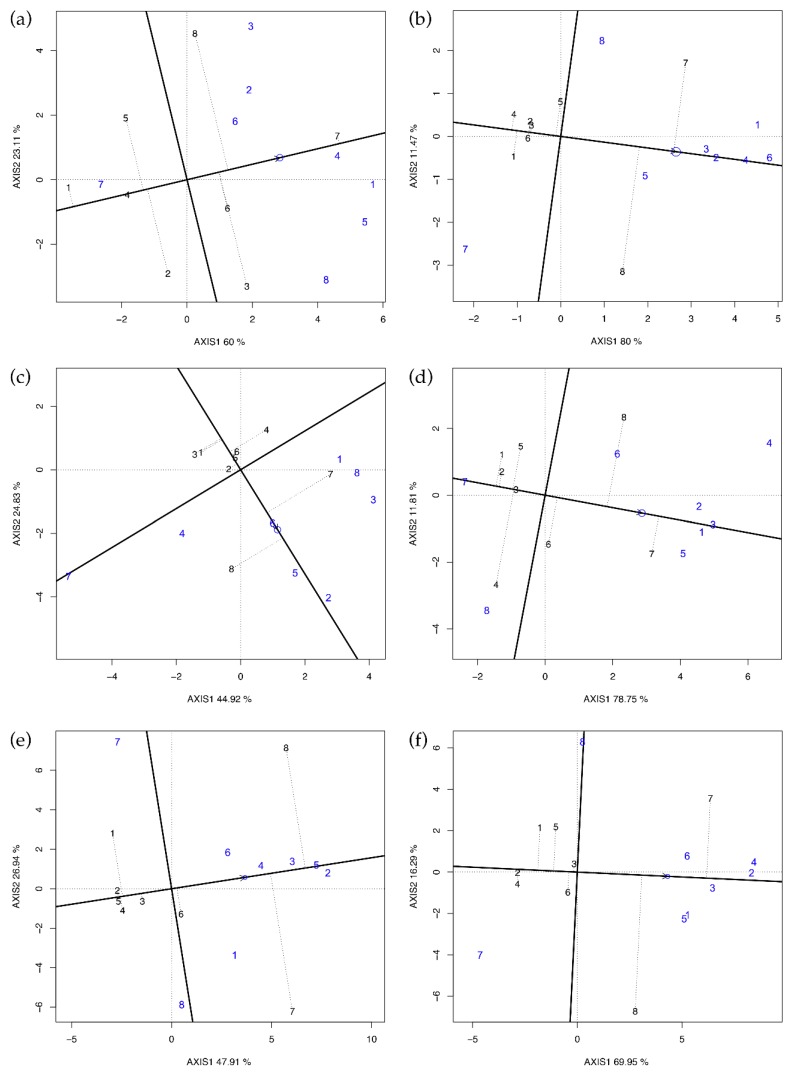
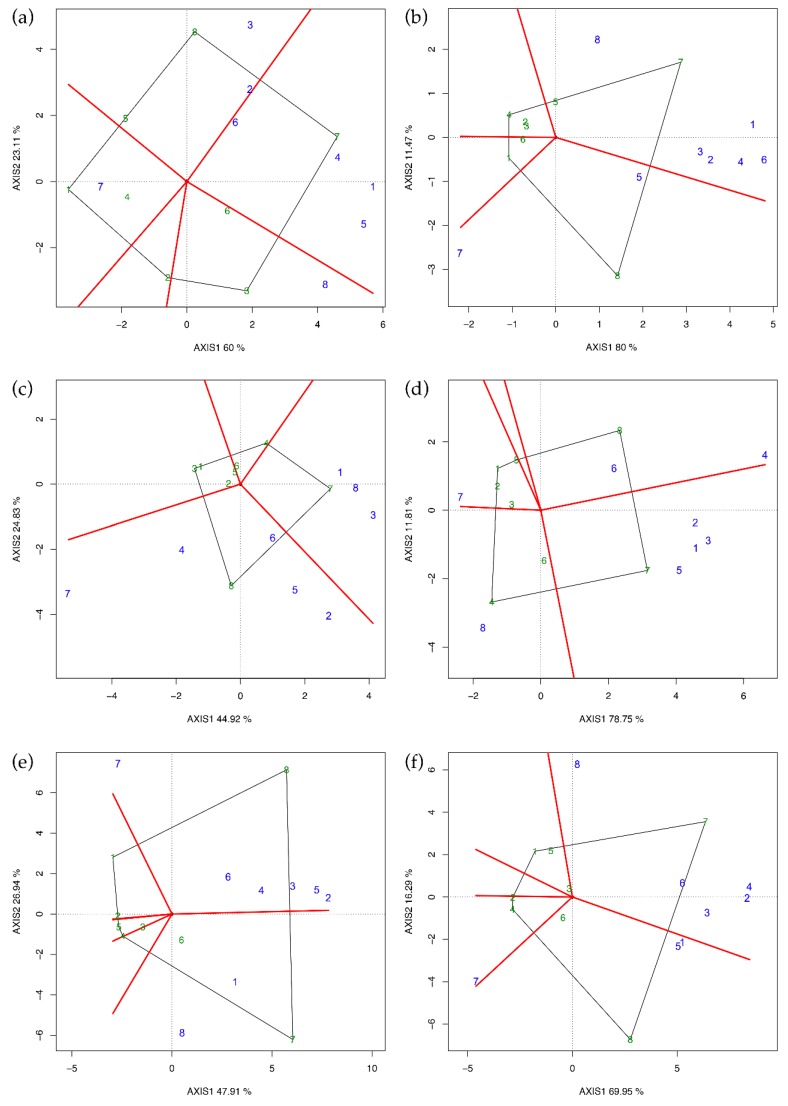
Abstract
Heterosis is the superiority of an F1 hybrid over its parents. Since this phenomenon is still unclear in melon, a half diallel experiment based on eight genetically distant breeding lines was conducted in six environments of Central Italy, assessing commercially important traits: yield, total soluble solids (TSS), and days to ripening (DTR). To estimate the additive (general combining ability; GCA) and the non-additive gene effects (specific combining ability; SCA), yield was analyzed by Griffing's methods two and four, and the results were compared to the GGE (Genotype plus Genotype by Environment interaction) biplot methodology; TSS and earliness were evaluated only by Griffing's method four. Overall, GCAs were significantly more relevant than SCAs for all examined traits. Least square means (LsM), mid-parent heterosis (MPH), best-parent heterosis (BPH), as well as Euclidean and Mahalanobis' distances were calculated and compared with the genetic distance (GD). As a few correlations were found statistically significant (only for TSS), it was difficult to predict the value of a hybrid combination only by knowing the genetic distance of its parents. Despite this, heterosis was observed, indicating either the presence of epistatic effects (additive × additive interactions) and/or an underestimate of SCAs embedded within Griffing's method. The significant Env × Entries source of variation suggests development of hybrids in specific environments. The results are discussed with a breeding perspective.
Keywords: GCA; GGE biplot; Griffing’s method; SCA; breeding; diallel; epistasis; genetic distance; heritability.
Conflict of interest statement
Marco Napolitano, Subash Kashyap and Elen Jones-Evans are Bayer employees. The funder Bayer had no role in designing the study, in the collection, analyses, or interpretation of data and in writing the manuscript.
Figures
References
-
- Jeffrey C. A review of the Cucurbitaceae. Biol. J. Linn. Soc. 1980;81:233–247. doi: 10.1111/j.1095-8339.1980.tb01676.x. - DOI
-
- FAOSTAT FAO Statistical Databases Data Sets. [(accessed on 15 July 2019)];2017 Available online: http://www.fao.org/faostat/en/#data.
-
- Griffing B. Concept of General and Specific Combining Ability in Relation to Diallel Crossing Systems. Aust. J. Biol. Sci. 1956;9:463–493. doi: 10.1071/BI9560463. - DOI
-
- Christie B.R., Shattuck V.I. The Diallel Cross: Design, Analysis, and Use for Plant Breeders. John Wiley & Sons, Inc.; Oxford, UK: 2010. Plant Breeding Reviews.
Grants and funding
LinkOut - more resources
Full Text Sources
Research Materials
