Review
. 2020 Feb 21;12(2):183.
doi: 10.3390/pharmaceutics12020183.

Non-Viral in Vitro Gene Delivery: It is Now Time to Set the Bar!

Affiliations
Review

Non-Viral in Vitro Gene Delivery: It is Now Time to Set the Bar!

Nina Bono et al. Pharmaceutics. .

Abstract

Transfection by means of non-viral gene delivery vectors is the cornerstone of modern gene delivery. Despite the resources poured into the development of ever more effective transfectants, improvement is still slow and limited. Of note, the performance of any gene delivery vector in vitro is strictly dependent on several experimental conditions specific to each laboratory. The lack of standard tests has thus largely contributed to the flood of inconsistent data underpinning the reproducibility crisis. A way researchers seek to address this issue is by gauging the effectiveness of newly synthesized gene delivery vectors with respect to benchmarks of seemingly well-known behavior. However, the performance of such reference molecules is also affected by the testing conditions. This survey points to non-standardized transfection settings and limited information on variables deemed relevant in this context as the major cause of such misalignments. This review provides a catalog of conditions optimized for the gold standard and internal reference, 25 kDa polyethyleneimine, that can be profitably replicated across studies for the sake of comparison. Overall, we wish to pave the way for the implementation of standardized protocols in order to make the evaluation of the effectiveness of transfectants as unbiased as possible.

Keywords: PEI; cationic polymers; in vitro transfection; non-viral gene delivery; physico-chemical characterization; polyplexes; reproducibility; standardization; variability.


Conflict of interest statement

The authors declare no conflict of interest.

Figures
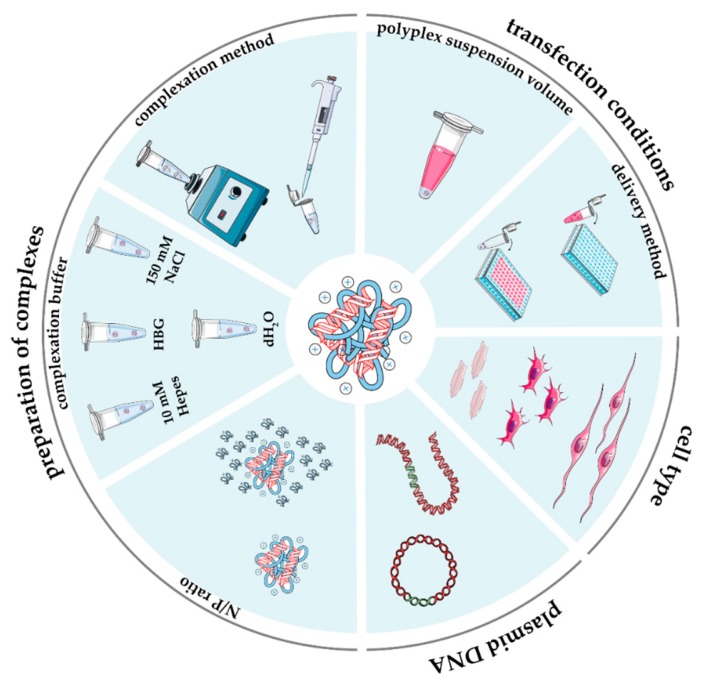
Figure 1
Figure 1
Main experimental parameters influencing the in vitro performance of gene delivery vectors.
Figure 2
Figure 2
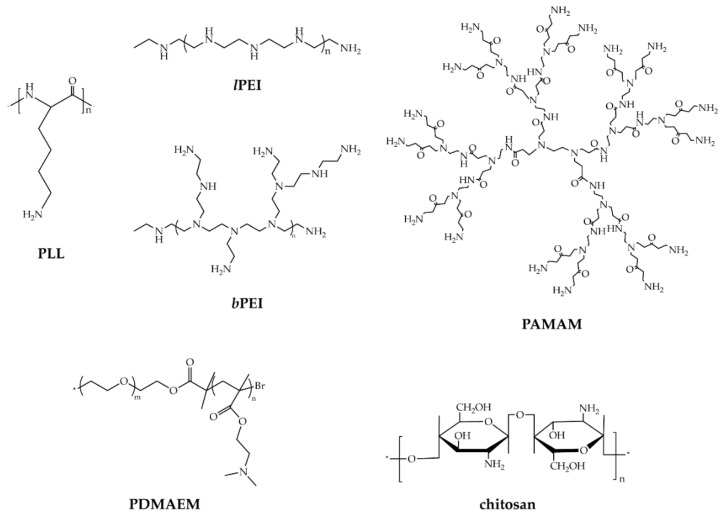
Chemical structures of commonly used cationic polymers for gene delivery purposes.
Figure 3
Figure 3
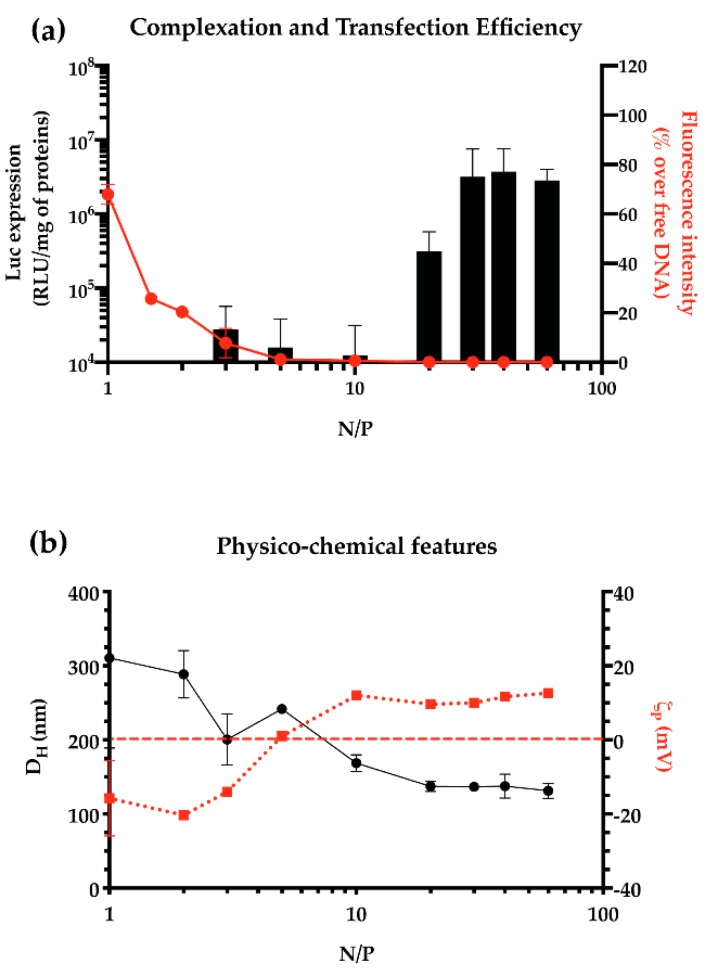
DNA complexation ability, transfection efficiency, and physico-chemical characteristics of pDNA/lPEI complexes prepared in 10 mM Hepes at different N/Ps. (a) Transfection efficiency (black bars) in L929 cells of pDNA/lPEI complexes prepared at different N/Ps. Results are expressed as luminescence signal (RLU) normalized to the total protein content in each cell lysate, and the DNA complexation ability of lPEI (red dots, solid line), evaluated by monitoring the fluorochrome exclusion from complexes as a function of the N/P. (b) Mean hydrodynamic diameter (DH, black dots solid line) and overall surface charge (ζP, red squares and dotted line) of pDNA/lPEI complexes at different N/Ps, as measured by dynamic light scattering (DLS) and electrophoretic light scattering (ELS), respectively. Results are expressed as mean ± SD (n ≥ 3).
Figure 4
Figure 4
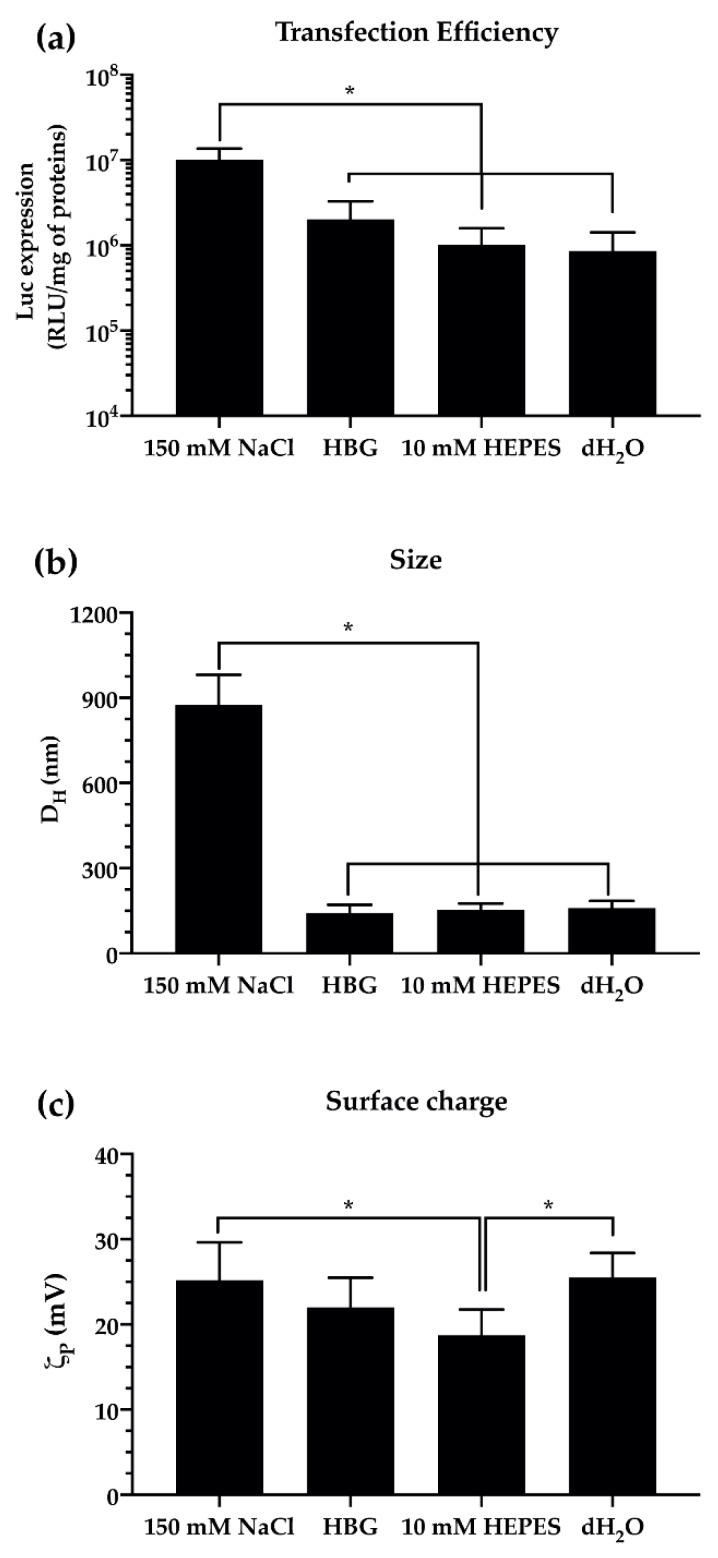
Effect of complexation buffer on the transfection efficiency and physico-chemical features of pDNA/lPEI polyplexes prepared at N/P 30 in L929 cells. (a) Transfection efficiency of pDNA/lPEI complexes prepared in different buffers. Complexes were prepared by adding 160 ng/cm2 of pGL3 to the lPEI solution. (b) Hydrodynamic diameter (DH) and (c) overall surface charge (ζP) of pDNA/lPEI complexes prepared by adding 1 μg of pDNA to the lPEI solution, then complexes were diluted in different buffers. Measurements were carried out by means of a dynamic light scattering (DLS; for DH measurements) and electrophoretic light scarring (ELS; for ζP measurements) apparatus. Results are expressed as mean ± SD (n ≥ 3) (* p < 0.05).
Figure 5
Figure 5
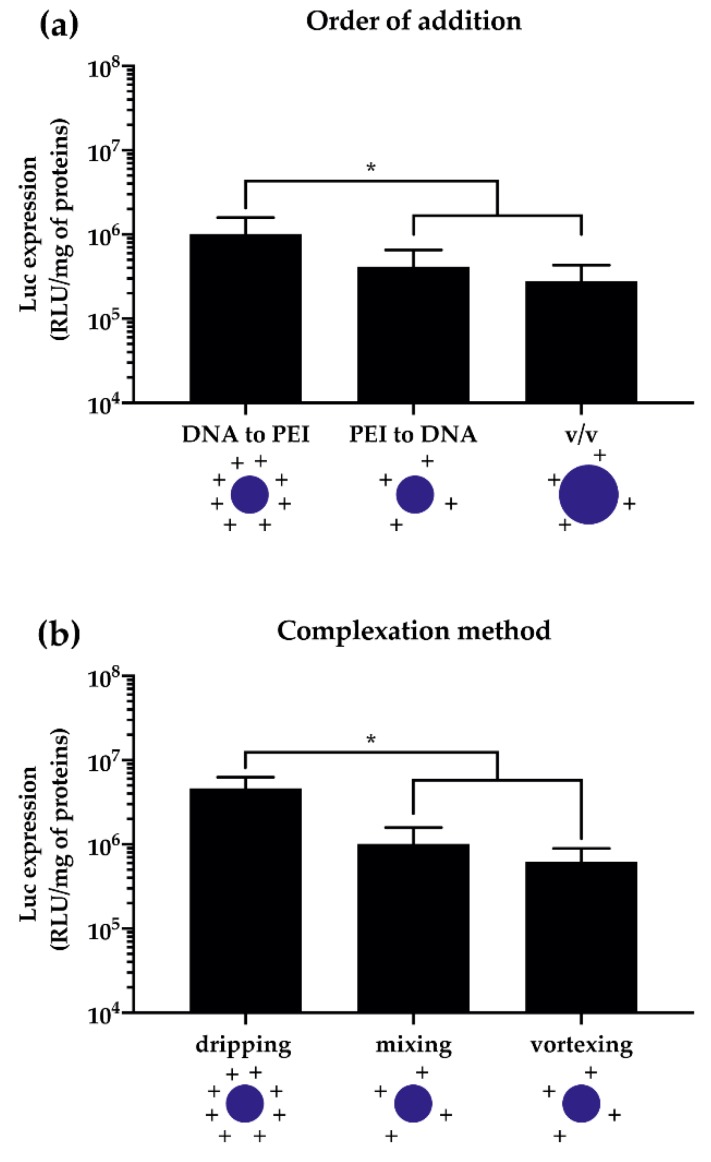
Effect of the complexation method on the transfection efficiency of pDNA/lPEI complexes at N/P 30 in L929 cells. (a) Transfection efficiency of pDNA/lPEI complexes as a function of the order of mixing and volumes of lPEI and pDNA solutions. Complexes were prepared by adding 160 ng/cm2 of pGL3 with the lPEI solution in 10 mM Hepes (DNA to PEI), or vice versa (PEI to DNA), then mixing the two solutions by rigorous pipetting, or by mixing equivolumes of DNA and PEI solutions (v/v). (b) Transfection efficiency of pDNA/lPEI complexes as a function of the complexation method. Complexes were prepared by adding 160 ng/cm2 of pGL3 to lPEI in 10 mM Hepes by single dripping, mixing (i.e., repeated and rigorous pipetting), and vortexing. Results are expressed as mean ± SD (n ≥ 3) (* p < 0.05).
Figure 6
Figure 6
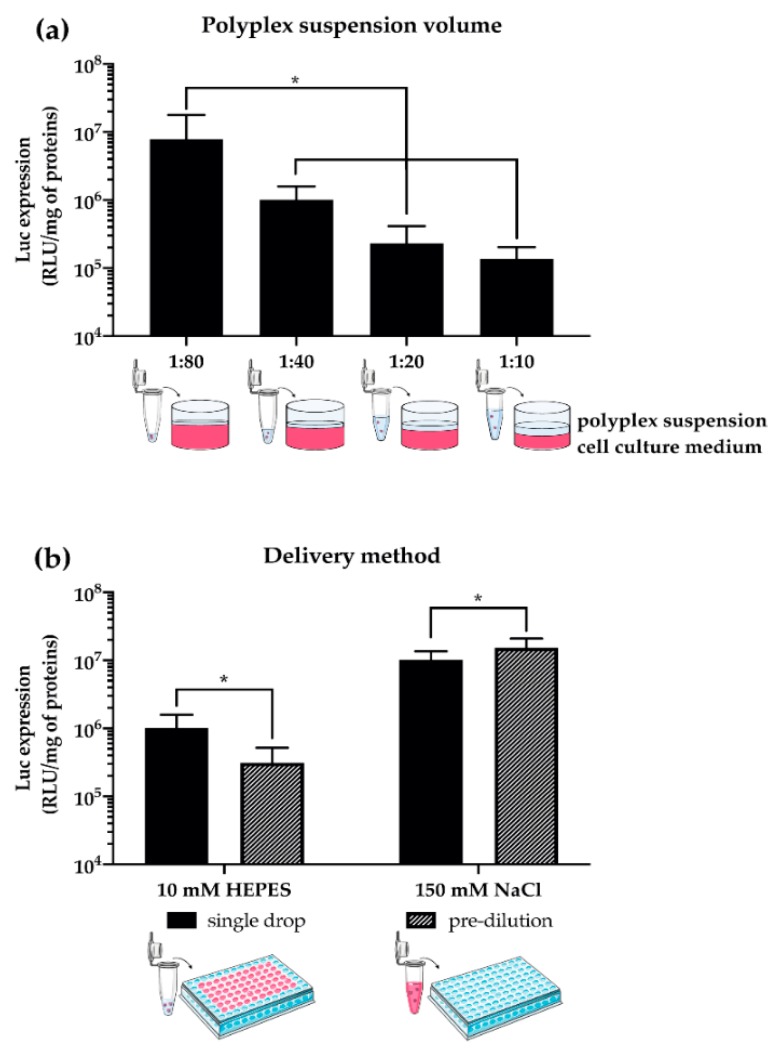
Effect of the volume of polyplex suspension and the delivery method on the transfection efficiency of pDNA/lPEI complexes prepared at N/P 30 in L929 cells. (a) Transfection efficiency of pDNA/lPEI complexes as a function of the polyplex volume:medium volume ratio. Complexes were prepared by mixing 160 ng/cm2 of pGL3 with lPEI solutions prepared in 10 mM Hepes in a final transfection volume of 1.28, 2.5, 5.12, and 10 μL, corresponding to 1:80, 1:40, 1:20, and 1:10 (v/v) ratios, respectively. The final volume of cell culture medium was 100 μL/well. (b) Transfection efficiency of pDNA/lPEI complexes as a function of the delivery method. Complexes were prepared by mixing 160 ng/cm2 of pGL3 with the lPEI in 10 mM Hepes in a final transfection volume of 2.56 μL/well and (i) directly added to culture medium in every well (i.e., single drop) or (ii) pre-diluted in the cell culture medium and next added to every well (i.e., pre-dilution). Results are expressed as mean ± SD (n ≥ 3) (* p < 0.05).

References

    1. Lostalé-Seijo I., Montenegro J. Synthetic materials at the forefront of gene delivery. Nat. Rev. Chem. 2018;2:258–277. doi: 10.1038/s41570-018-0039-1. - DOI
    1. Wirth T., Parker N., Ylä-Herttuala S. History of gene therapy. Gene. 2013;525:162–169. doi: 10.1016/j.gene.2013.03.137. - DOI - PubMed
    1. Pan J., Zhang S., Chen C., Xiao S., Sun Y., Liu C., Su X., Li D., Xu G., Xu B., et al. Effect of recombinant adenovirus-p53 combined with radiotherapy on long-term prognosis of advanced nasopharyngeal carcinoma. J. Clin. Oncol. 2009;27:799–804. doi: 10.1200/JCO.2008.18.9670. - DOI - PubMed
    1. Aied A., Greiser U., Pandit A., Wang W. Polymer gene delivery: Overcoming the obstacles. Drug Discov. Today. 2013;18:1090–1098. doi: 10.1016/j.drudis.2013.06.014. - DOI - PubMed
    1. Baldi L., Hacker D.L., Adam M., Wurm F.M. Recombinant protein production by large-scale transient gene expression in mammalian cells: State of the art and future perspectives. Biotechnol. Lett. 2007;29:677–684. doi: 10.1007/s10529-006-9297-y. - DOI - PubMed

LinkOut - more resources