Review
. 2020 Feb 21;9(2):497.
doi: 10.3390/cells9020497.

Ribosome and Translational Control in Stem Cells

Affiliations
Review

Ribosome and Translational Control in Stem Cells

Mathieu Gabut et al. Cells. .

Abstract

Embryonic stem cells (ESCs) and adult stem cells (ASCs) possess the remarkable capacity to self-renew while remaining poised to differentiate into multiple progenies in the context of a rapidly developing embryo or in steady-state tissues, respectively. This ability is controlled by complex genetic programs, which are dynamically orchestrated at different steps of gene expression, including chromatin remodeling, mRNA transcription, processing, and stability. In addition to maintaining stem cell homeostasis, these molecular processes need to be rapidly rewired to coordinate complex physiological modifications required to redirect cell fate in response to environmental clues, such as differentiation signals or tissue injuries. Although chromatin remodeling and mRNA expression have been extensively studied in stem cells, accumulating evidence suggests that stem cell transcriptomes and proteomes are poorly correlated and that stem cell properties require finely tuned protein synthesis. In addition, many studies have shown that the biogenesis of the translation machinery, the ribosome, is decisive for sustaining ESC and ASC properties. Therefore, these observations emphasize the importance of translational control in stem cell homeostasis and fate decisions. In this review, we will provide the most recent literature describing how ribosome biogenesis and translational control regulate stem cell functions and are crucial for accommodating proteome remodeling in response to changes in stem cell fate.

Keywords: rRNA modifications; ribosomal proteins; ribosome biogenesis; ribosomes; specialized ribosomes; stem cells; translational regulation.


Conflict of interest statement

The authors declare no conflict of interest.

Figures
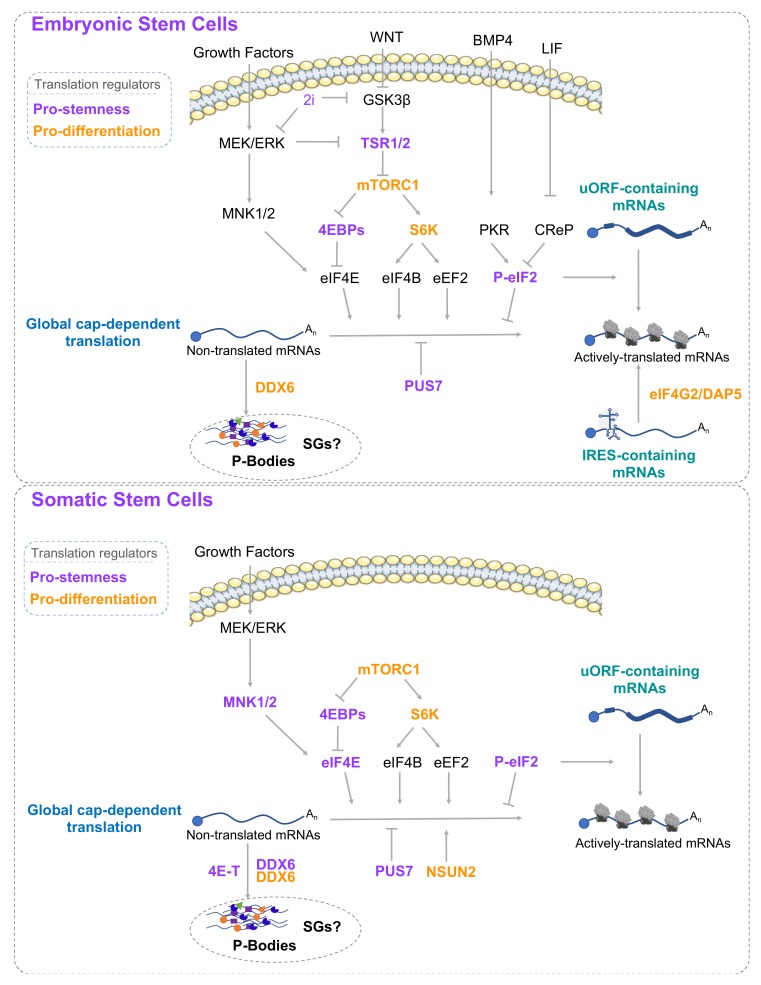
Figure 1
Figure 1
Translational control in stem cells. Upper panel: main signaling pathways that may regulate translational efficiency in embryonic stem cells. Translation regulators that promote stemness or in contrast stimulate differentiation are depicted in purple or orange, respectively. Lower panel: Similar to the upper panel in somatic stem cells. Translation regulators that promote stemness or induce differentiation are depicted in purple or orange, respectively. Images of cell membranes were kindly provided by the SMART Servier medical art database [9].
Figure 2
Figure 2
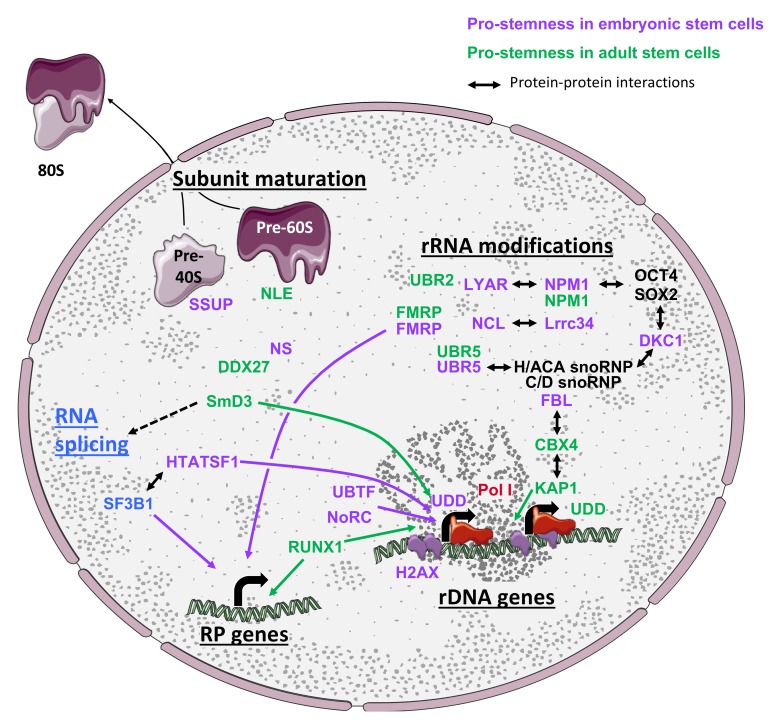
Ribosome biogenesis is highly regulated in embryonic and adult stem cells. Key RBFs described in this review and their implication in ribosome biogenesis in stem cells are presented. Factors stimulating ESC and ASC maintenance are depicted in purple and green, respectively. Direct protein/protein interactions are indicated by double-headed black arrows. Images of nucleic acids, the nucleus, and proteins were kindly provided by the SMART Servier medical art database [9].
Figure 3
Figure 3
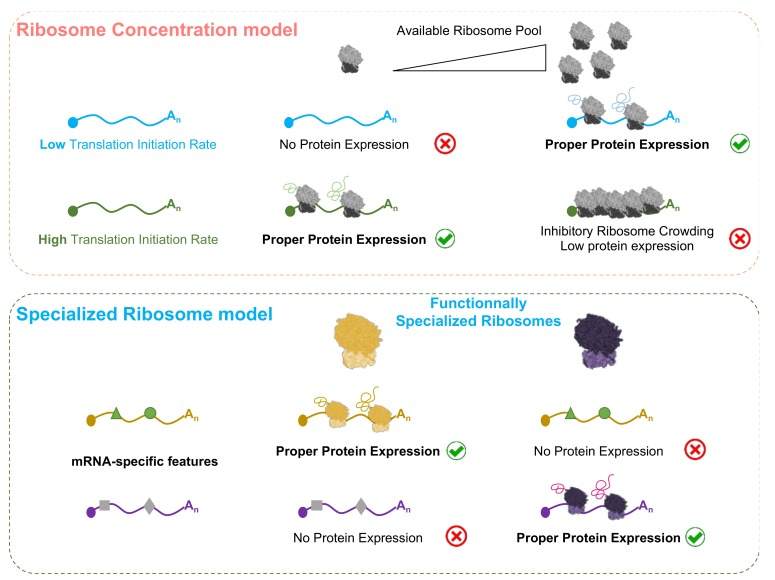
Ribosomes regulate gene-specific expression. Schematic diagram illustrating two models describing the impact of ribosome concentration on translation of specific mRNA subsets (upper panel) and the concept of functionally specialized ribosomes, which consists in heterogeneous ribosomes endowed with substrate selectivity (lower panel).

References

    1. De Sousa Abreu R., Penalva L.O., Marcotte E.M., Vogel C. Global signatures of protein and mRNA expression levels. Mol. Biosyst. 2009;5:1512–1526. doi: 10.1039/b908315d. - DOI - PMC - PubMed
    1. Maier T., Guell M., Serrano L. Correlation of mRNA and protein in complex biological samples. FEBS Lett. 2009;583:3966–3973. doi: 10.1016/j.febslet.2009.10.036. - DOI - PubMed
    1. Schwanhausser B., Busse D., Li N., Dittmar G., Schuchhardt J., Wolf J., Chen W., Selbach M. Global quantification of mammalian gene expression control. Nature. 2011;473:337–342. doi: 10.1038/nature10098. - DOI - PubMed
    1. Munoz J., Low T.Y., Kok Y.J., Chin A., Frese C.K., Ding V., Choo A., Heck A.J. The quantitative proteomes of human-induced pluripotent stem cells and embryonic stem cells. Mol. Syst. Biol. 2011;7:550. doi: 10.1038/msb.2011.84. - DOI - PMC - PubMed
    1. Kristensen A.R., Gsponer J., Foster L.J. Protein synthesis rate is the predominant regulator of protein expression during differentiation. Mol. Syst. Biol. 2013;9:689. doi: 10.1038/msb.2013.47. - DOI - PMC - PubMed

Publication types

LinkOut - more resources