Review
. 2020 Feb 21;21(4):1493.
doi: 10.3390/ijms21041493.

Alpha 1-Antitrypsin Deficiency: A Disorder of Proteostasis-Mediated Protein Folding and Trafficking Pathways

Affiliations
Review

Alpha 1-Antitrypsin Deficiency: A Disorder of Proteostasis-Mediated Protein Folding and Trafficking Pathways

Esra Karatas et al. Int J Mol Sci. .

Abstract

Human cells express large amounts of different proteins continuously that must fold into well-defined structures that need to remain correctly folded and assemble in order to ensure their cellular and biological functions. The integrity of this protein balance/homeostasis, also named proteostasis, is maintained by the proteostasis network (PN). This integrated biological system, which comprises about 2000 proteins (chaperones, folding enzymes, degradation components), control and coordinate protein synthesis folding and localization, conformational maintenance, and degradation. This network is particularly challenged by mutations such as those found in genetic diseases, because of the inability of an altered peptide sequence to properly engage PN components that trigger misfolding and loss of function. Thus, deletions found in the ΔF508 variant of the Cystic Fibrosis (CF) transmembrane regulator (CFTR) triggering CF or missense mutations found in the Z variant of Alpha 1-Antitrypsin deficiency (AATD), leading to lung and liver diseases, can accelerate misfolding and/or generate aggregates. Conversely to CF variants, for which three correctors are already approved (ivacaftor, lumacaftor/ivacaftor, and most recently tezacaftor/ivacaftor), there are limited therapeutic options for AATD. Therefore, a more detailed understanding of the PN components governing AAT variant biogenesis and their manipulation by pharmacological intervention could delay, or even better, avoid the onset of AATD-related pathologies.

Keywords: Alpha 1-Antitrypsin deficiency; proteostasis; proteostasis network.


Conflict of interest statement

The authors declare no conflict of interest.

Figures

Figure 1
Figure 1
Crystal structure of Alpha 1-Antitrypsin (AAT) (pdb 6I7U). AAT protein is a glycoprotein of 394 residues with three asparagine-linked carbohydrate sidechains at positions 46, 83, and 247 (in orange). The AAT polypeptide chain is composed of three β-sheets (in blue) and nine α-helices (in grey). The reactive center loop (RCL) (in yellow) mediates inhibitory specificity.
Figure 2
Figure 2
Crystal structure of recombinant human Z-AAT (pdb 5IO1). Z-AAT protein results from the substitution of glutamic acid by lysine at position 342 (Glu342Lys) (in green). As observed for AAT, Z-AAT is composed of three asparagine-linked carbohydrate side-chains at positions 46, 83, and 247 (in orange), three β-sheets (in blue), nine α-helices (in grey), and a reactive center loop (RCL) (in yellow).
Figure 3
Figure 3
Endoplasmic reticulum (ER) proteostasis network (PN) of the folded AAT and the unfolded Z-AAT protein. Nascent wild-type WT-AAT (left) and Z-AAT (right) are translocated and carried out by quality control system. Compared to the well-folded WT-AAT exported from the ER to the Golgi by endoplasmic reticulum–Golgi intermediate compartment (ERGIC-53) cargo receptor (left), Z-AAT is retained into the ER (right). Z-AAT soluble form is recognized by the ER-associated degradation (ERAD) pathway members (in green), retro-translocated, and degraded by the proteasome. Conversely, the Z-aggregated or insoluble form is degraded by autophagy. AAT: alpha 1-antitrypsin; ERGIC-53: endoplasmic reticulum–Golgi intermediate compartment; ERAD: ER-associated degradation; GRP78: glucose-regulated protein 78; GRP94: glucose-regulated protein 94; GRP170: glucose-regulated protein 170; UGGT: uridine diphosphate (UDP)-glucose:glycoprotein; GS: glucosyltransferase; ERManI: ER α-mannosidase I; EDEM3: ER degradation-enhancing α-mannosidase-like protein 3; HRD1: Hydroxymethylglutaryl-CoA reductase degradation 1 homolog 1/ ERAD-associated E3 ubiquitin-protein ligase; HERPUD1: homocysteine inducible ER protein with ubiquitin-like domain 1.
Figure 4
Figure 4
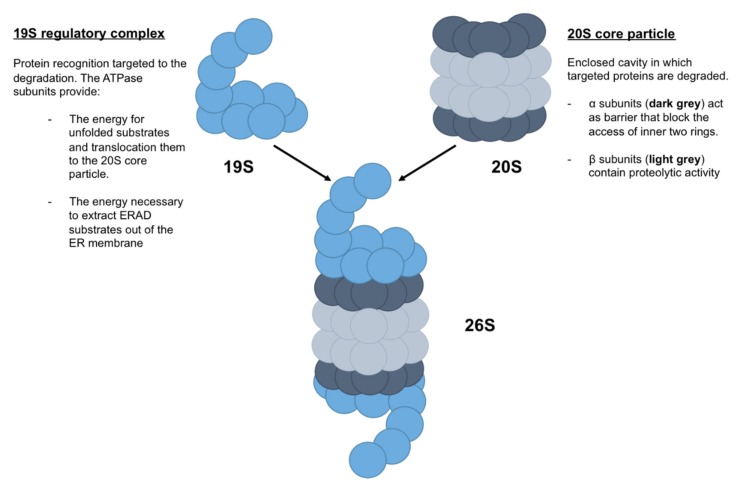
Schematic representation of proteasome 26S. Proteasome 26S, named due to its Svedberg (S) sedimentation coefficient, is formed by a 19S regulatory complex, which recognized proteins targeted to the degradation, and a 20S core particle, which degraded targeted proteins.

References

    1. Hipp M.S., Kasturi P., Hartl F.U. The proteostasis network and its decline in ageing. Nat. Rev. Mol. Cell Biol. 2019;20:421–435. doi: 10.1038/s41580-019-0101-y. - DOI - PubMed
    1. Balch W.E., Morimoto R.I., Dillin A., Kelly J.W. Adapting proteostasis for disease intervention. Science. 2008;319:916–919. doi: 10.1126/science.1141448. - DOI - PubMed
    1. Klaips C.L., Jayaraj G.G., Hartl F.U. Pathways of cellular proteostasis in aging and disease. J. Cell Biol. 2018;217:51–63. - PMC - PubMed
    1. Bouchecareilh M., Balch W.E. Proteostasis: A new therapeutic paradigm for pulmonary disease. Proc. Am. Thorac. Soc. 2011;8:189–195. - PMC - PubMed
    1. Oakes S.A. Endoplasmic reticulum proteostasis: A key checkpoint in cancer. Am. J. Physiol. Cell Physiol. 2017;312:C93–C102. doi: 10.1152/ajpcell.00266.2016. - DOI - PMC - PubMed

MeSH terms