


PET Radiopharmaceuticals for Alzheimer's Disease and Parkinson's Disease Diagnosis, the Current and Future Landscape
- PMID: 32098280
- PMCID: PMC7070523
- DOI: 10.3390/molecules25040977
PET Radiopharmaceuticals for Alzheimer's Disease and Parkinson's Disease Diagnosis, the Current and Future Landscape
Abstract
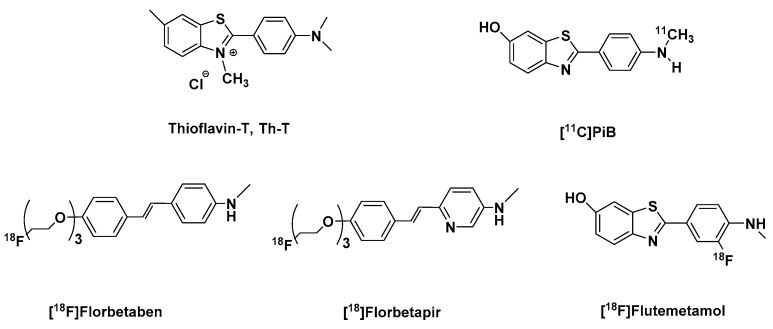
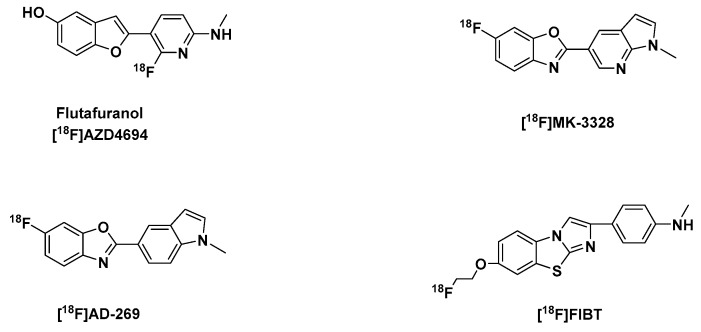
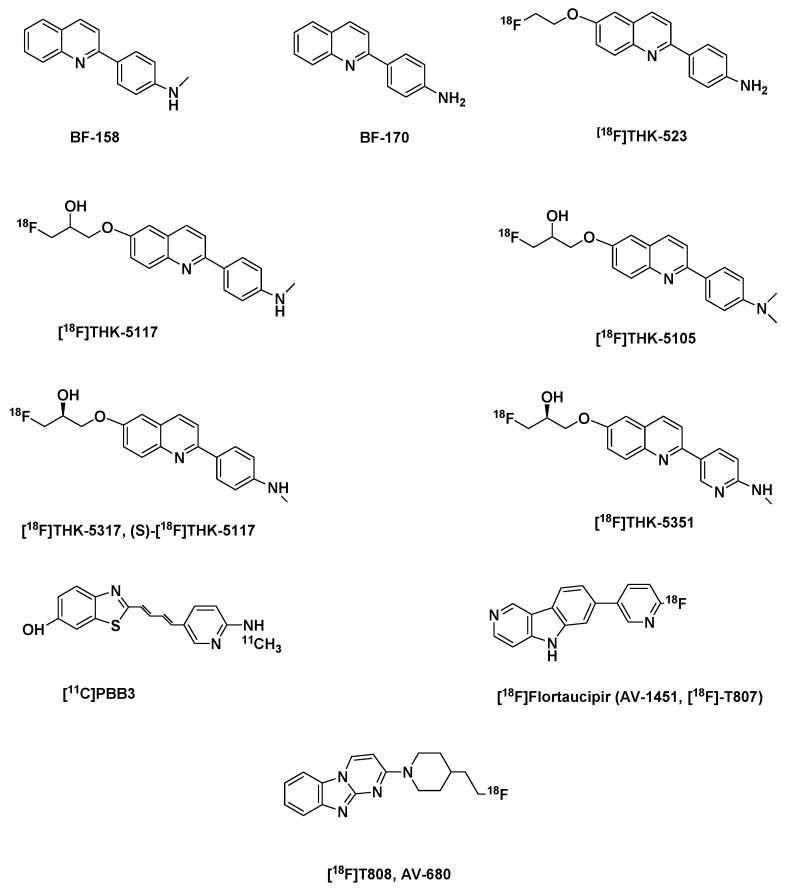
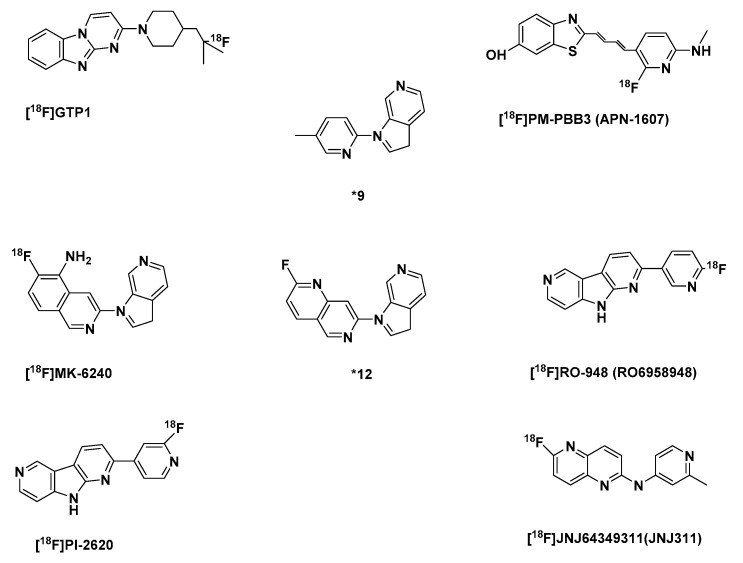
Ironically, population aging which is considered a public health success has been accompanied by a myriad of new health challenges, which include neurodegenerative disorders (NDDs), the incidence of which increases proportionally to age. Among them, Alzheimer's disease (AD) and Parkinson's disease (PD) are the most common, with the misfolding and the aggregation of proteins being common and causal in the pathogenesis of both diseases. AD is characterized by the presence of hyperphosphorylated τ protein (tau), which is the main component of neurofibrillary tangles (NFTs), and senile plaques the main component of which is β-amyloid peptide aggregates (Aβ). The neuropathological hallmark of PD is α-synuclein aggregates (α-syn), which are present as insoluble fibrils, the primary structural component of Lewy body (LB) and neurites (LN). An increasing number of non-invasive PET examinations have been used for AD, to monitor the pathological progress (hallmarks) of disease. Notwithstanding, still the need for the development of novel detection tools for other proteinopathies still remains. This review, although not exhaustively, looks at the timeline of the development of existing tracers used in the imaging of Aβ and important moments that led to the development of these tracers.
Keywords: Alzheimer’s disease; Parkinson’s disease; diagnostic imaging probes; neurofibrillary tangles; positron emission tomography (PET); α-synucleinopathy; β-amyloid plaques.
Conflict of interest statement
The authors declare no conflict of interest.
Figures


References
-
- Alzheimer’s Disease International . The Global Impact of Dementia: An Analysis of Prevalence, Incidence, Cost and Trends. Alzheimer’s Disease International; London, UK: 2015. World Alzheimer Report 2015.
-
- Alzheimer’s Disease International . World Alzheimer Report 2018—The State of the Art of Dementia Research: New Frontiers. Alzheimer’s Disease International; London, UK: 2018.
-
- World Health Organisation-Alzheimer’s Disease International . Dementia: A Public Health Priority. WHO; Geneva, Switzerland: 2012.
Publication types
MeSH terms
Substances
LinkOut - more resources
Full Text Sources
Medical
Miscellaneous
