


Personality, Behavior Characteristics, and Life Quality Impact of Children with Dyslexia
- PMID: 32098297
- PMCID: PMC7068303
- DOI: 10.3390/ijerph17041415
Personality, Behavior Characteristics, and Life Quality Impact of Children with Dyslexia
Abstract
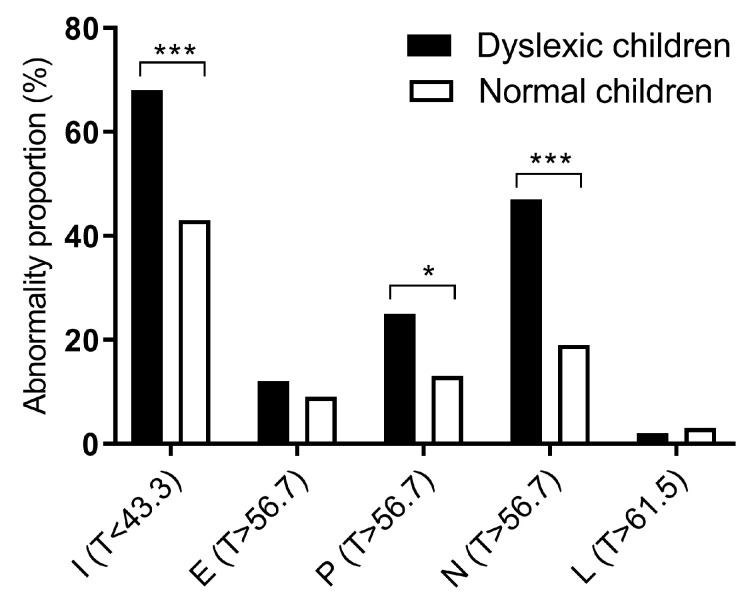
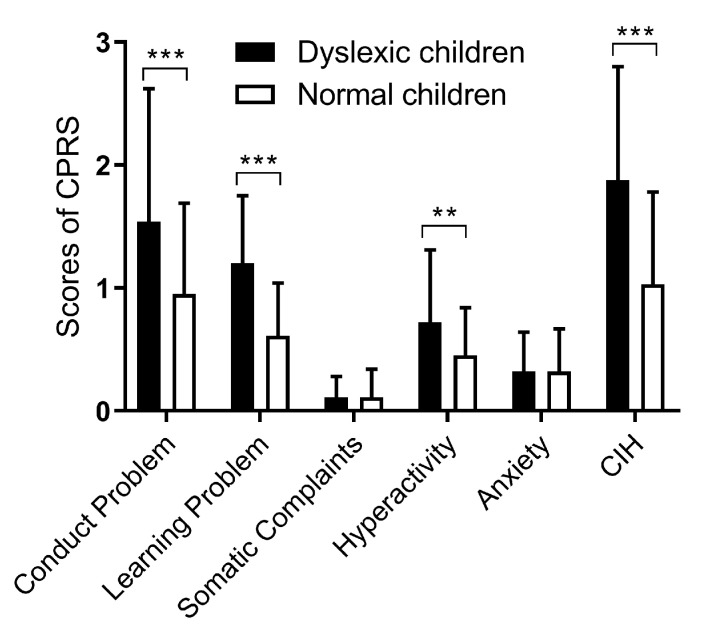
Dyslexia is one of the most common neurobehavioral disorders. Children with dyslexia usually suffer from negative, behavior personality problems, and impacted life quality. We aimed to identify family environment factors for dyslexia, and to evaluate the personality, behavior characteristics and life quality of children with dyslexia. A total of 60 children diagnosed with dyslexia and 180 normal children that were aged 7-12 who speak Chinese were recruited from four primary schools in Shantou City, China. Self-designed questionnaire, children's edition of the Eysenck Personality Questionnaire (EPQ), Conners' Parent Rating Scale (CPRS), and Quality of Life scale for children and adolescents (QLSCA) were employed for investigation. Multiple logistic regressions show that antenatal training (OR = 0.36), higher household income, higher parents' educational levels, and parents engaging in white-collar jobs were negatively associated with dyslexia; while, family members also suffering from dyslexia (OR = 12.17), lower frequency of communication between parents and children, and worse parent-child relationship were positively associated with dyslexia. Children with dyslexia scored higher in psychoticism and neuroticism (p = 0.040, 0.008), but lower in extroversion and dissimulation than normal children (p = 0.025, 0.007) in the EPQ test. They tended to be more introversion (68.3% vs. 43.0%), psychoticism (25.0% vs. 13.3%), and neuroticism (46.7% vs. 18.8%) than the controls. In addition, children with dyslexia had higher scores in conduct problem, learning problem, hyperactivity, and Conners' index of hyperactivity (CIH) in CPRS test; and, lower scores of psychosocial function, physical and mental health, and satisfaction of living quality in QLSCA test (all p < 0.05). Several family environment and parenting factors were associated with children's dyslexia significantly. Children with dyslexia had the personality of psychoticism, neuroticism, introversion, and more behavioral problems. Dyslexia significantly impacted the children's quality of life. Our findings provide multiple perspectives for early intervention of dyslexia in children, particularly in family factors and the parenting environment.
Keywords: behavior problem; children; dyslexia; life quality; personality; risk factors.
Conflict of interest statement
The authors declare no conflict of interest.
Figures
References
-
- APA . Diagnostic and Statistical Manual of Mental Disorders (DSM-5®) American Psychiatric Association; Washington, DC, USA: 2013.
-
- Habib M., Giraud K. Dyslexia. Handb. Clin. Neurol. 2012;111:229–235. - PubMed
Publication types
MeSH terms
LinkOut - more resources
Full Text Sources
Medical
