


Revisiting the Radiosynthesis of [18F]FPEB and Preliminary PET Imaging in a Mouse Model of Alzheimer's Disease
- PMID: 32098347
- PMCID: PMC7070414
- DOI: 10.3390/molecules25040982
Revisiting the Radiosynthesis of [18F]FPEB and Preliminary PET Imaging in a Mouse Model of Alzheimer's Disease
Abstract
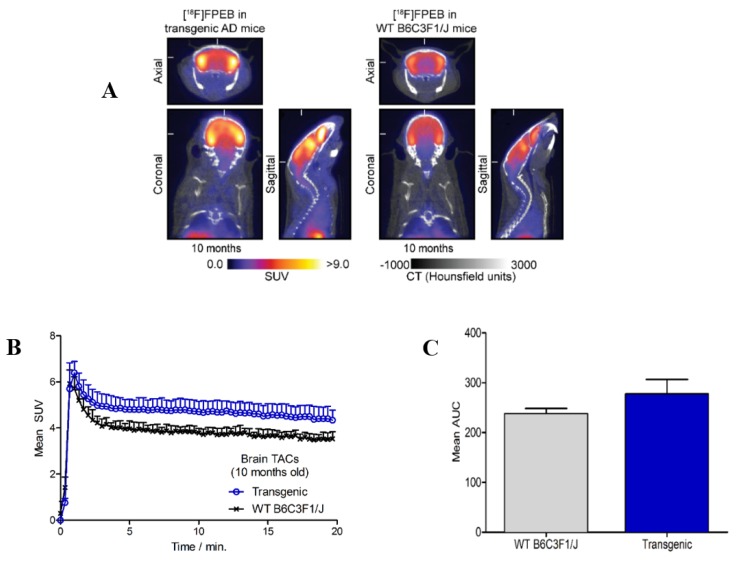
[18F]FPEB is a positron emission tomography (PET) radiopharmaceutical used for imaging the abundance and distribution of mGluR5 in the central nervous system (CNS). Efficient radiolabeling of the aromatic ring of [18F]FPEB has been an ongoing challenge. Herein, five metal-free precursors for the radiofluorination of [18F]FPEB were compared, namely, a chloro-, nitro-, sulfonium salt, and two spirocyclic iodonium ylide (SCIDY) precursors bearing a cyclopentyl (SPI5) and a new adamantyl (SPIAd) auxiliary. The chloro- and nitro-precursors resulted in a low radiochemical yield (<10% RCY), whereas both SCIDY precursors and the sulfonium salt precursor produced [18F]FPEB in the highest RCYs of 25% and 36%, respectively. Preliminary PET/CT imaging studies with [18F]FPEB were conducted in a transgenic model of Alzheimer's Disease (AD) using B6C3-Tg(APPswe,PSEN1dE9)85Dbo/J (APP/PS1) mice, and data were compared with age-matched wild-type (WT) B6C3F1/J control mice. In APP/PS1 mice, whole brain distribution at 5 min post-injection showed a slightly higher uptake (SUV = 4.8 ± 0.4) than in age-matched controls (SUV = 4.0 ± 0.2). Further studies to explore mGluR5 as an early biomarker for AD are underway.
Keywords: Alzheimer’s Disease (AD); [18F]FPEB; iodonium-ylide; mGluR5; positron emission tomography (PET).
Conflict of interest statement
N.A.S., S.H.L. and N.V. have an issued patent entitled, “Iodine(III)-Mediated Radiofluorination; US 9.434,699 B2, that is licensed to a third party; S.H.L. and N.V. have a patent entitled, “Method of Fluorination Using Iodonium Ylides, US 9.434,699 B2. The authors declare no other conflicts of interest.
Figures
References
-
- Terbeck S., Akkus F., Chesterman L.P., Hasler G. The role of metabotropic glutamate receptor 5 in the pathogenesis of mood disorders and addiction: Combining preclinical evidence with human Positron Emission Tomography (PET) studies. Front. Mol. Neurosci. 2015 doi: 10.3389/fnins.2015.00086. - DOI - PMC - PubMed
-
- Rook J.M., Tantawy M.N., Ansari M.S., Felts A.S., Stauffer S.R., Emmitte K.A., Kessler R.M., Niswender C.M., Daniels J.S., Jones C.K., et al. Relationship between In Vivo Receptor Occupancy and Efficacy of Metabotropic Glutamate Receptor Subtype 5 Allosteric Modulators with Different In Vitro Binding Profiles. Neuropsychopharmacology. 2014;40:755–765. doi: 10.1038/npp.2014.245. - DOI - PMC - PubMed
MeSH terms
Substances
Grants and funding
LinkOut - more resources
Full Text Sources
Medical
Molecular Biology Databases
Miscellaneous
