Improving urinary catheterisation practices in a rural hospital in Ontario
- PMID: 32098774
- PMCID: PMC7047472
- DOI: 10.1136/bmjoq-2019-000703
Improving urinary catheterisation practices in a rural hospital in Ontario
Abstract
Introduction: A urinary catheter constitutes a one-point patient restraint, can induce deconditioning and may lead to patient mortality. An audit performed at Winchester District Memorial Hospital revealed that 20% of patients had a urinary catheter, of whom 31% did not meet the criteria for catheterisation. The main objective of this study was to use the Influencer Change Model and the Choosing Wisely Canada toolkit to create a bundle of interventions that would reduce the unnecessary use of urinary catheters in hospitalised patients.
Methods: In a rural teaching hospital, a time-series quasi-experiment was employed to decrease inappropriate use of urinary catheters. Both the Choosing Wisely Canada toolkit for appropriate use of urinary catheters and the Influencer change management approach were used to create effective interventions.
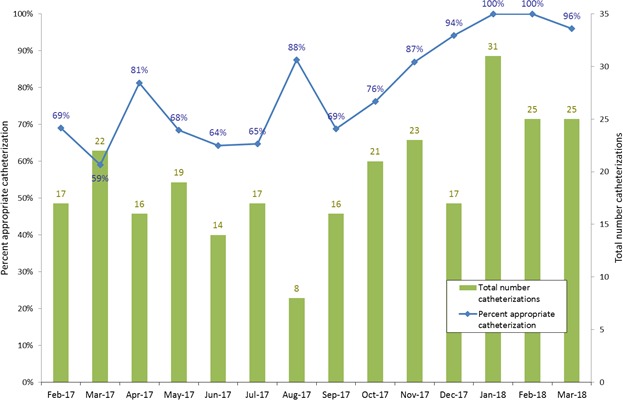
Results: This study revealed that there was no improvement in appropriate urinary catheter use during Plan-Do-Study-Act (PDSA) cycle 1. There was gradual improvement during PDSA cycle 2, with the percentage of inappropriate urinary catheter use dropping from an initial 31% before any interventions to less than 5% by the end of this study.
Discussion/conclusion: This study aimed to reduce the inappropriate use of urinary catheters in a rural hospital with limited resources. The findings indicate that by using a change model, such as the Influencer Change Model, it is possible to promote better patient care through empowering healthcare staff to implement accepted protocols more stringently and thereby to decrease the inappropriate use of urinary catheters to 0%.
Keywords: hospital medicine; quality improvement; unnecessary procedures.
© Author(s) (or their employer(s)) 2020. Re-use permitted under CC BY-NC. No commercial re-use. See rights and permissions. Published by BMJ.
Conflict of interest statement
Competing interests: None declared.
Figures
References
-
- Felix K, Bellush MJ, Bor B. Association for professionals in infection control and epidemiology (APIC): guide to preventing catheter-associated urinary tract infections (CAUTIs), 2014. Available: http://apic.org/Resource_/EliminationGuideForm/0ff6ae59-0a3a-4640-97b5-e... [Accessed 2 Apr 2019].
Publication types
MeSH terms
LinkOut - more resources
Full Text Sources