. 2020 Feb 25;10(1):3391.
doi: 10.1038/s41598-020-60361-3.

Dual-molecular barcode sequencing detects rare variants in tumor and cell free DNA in plasma

Affiliations

Dual-molecular barcode sequencing detects rare variants in tumor and cell free DNA in plasma

Yosuke Hirotsu et al. Sci Rep. .

Abstract

Conventional next generation sequencing analysis has provided important insights into cancer genetics. However, the detection of rare (low allele fraction) variants remains difficult because of the error-prone nucleotide changes derived from sequencing/PCR errors. To eliminate the false-positive variants and detect genuine rare variants, sequencing technology combined with molecular barcodes will be useful. Here, we used the newly developed dual-molecular barcode technology (Ion AmpliSeq HD) to analyze somatic mutations in 24 samples (12 tumor tissues and 12 plasma) from 12 patients with biliary-pancreatic and non-small cell lung cancers. We compared the results between next generation sequencing analysis with or without molecular barcode technologies. The variant allele fraction (VAF) between non-molecular barcode and molecular barcode sequencing was correlated in plasma DNA (R2 = 0.956) and tumor (R2 = 0.935). Both methods successfully detected high VAF mutations, however, rare variants were only identified by molecular barcode sequencing and not by non-molecular barcode sequencing. Some of these rare variants in tumors were annotated as pathogenic, and therefore subclonal driver mutations could be observed. Furthermore, the very low VAF down to 0.17% were identified in cell free DNA in plasma. These results demonstrate that the dual molecular barcode sequencing technologies can sensitively detect rare somatic mutations, and will be important in the investigation of the clonal and subclonal architectures of tumor heterogeneity.


Conflict of interest statement

The authors declare no competing interests.

Figures
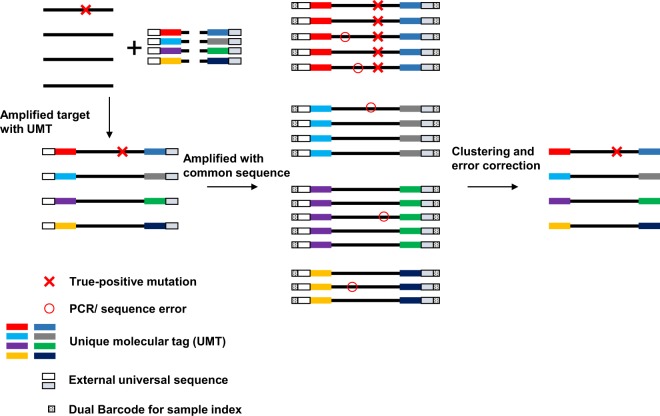
Figure 1
Figure 1
Workflow of library construction and molecular barcode sequencing. Primers harboring the unique molecular tag (UMT) were used to amplify the target regions of interest. UMT is a DNA sequence and serves as a molecular barcode that distinguish each template DNA. UMT is tagged the 5′ and 3′ end of template DNA. After the first amplification, second amplification is performed using an external universal sequence. Molecular barcodes are used to cluster multiple reads that originated from the same template DNA for error correction. Sequence/PCR errors are eliminated for subsequent mutational calling analysis.
Figure 2
Figure 2
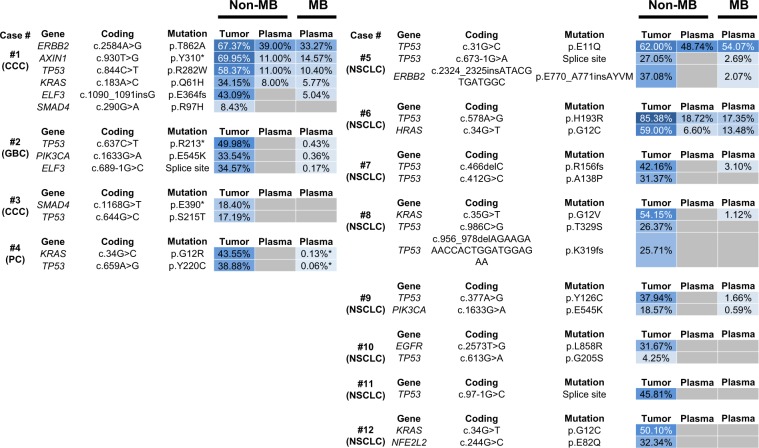
Molecular barcode sequencing sensitively detects the tumor-derived mutations in plasma cell free DNA (cfDNA). Heat map shows the mutation profiles in tumors and plasma cfDNA using both sequencing methods. Samples were collected from 12 patients with biliary-pancreatic (Case #1–4) and non-small cell lung cancers (Case #5–12). Sequencing was performed with non-molecular barcode (Non-MB) and molecular barcode (MB) technologies. Identical mutations in plasma cfDNA corresponding to mutations in tumor samples were detected. Variant allele fraction (%) is shown in each box and is indicated by the graduated color scale from 1% (light blue) to 100% (dark blue). Gray box indicates no identified alterations. Tumor types (CCC, cholangiocarcinoma; GBC, gallbladder cancer; PC, pancreatic cancer, NSCLC, non-small cell lung cancer) were denoted under the case number. Variant with asterisk (*) shows the mutations which are detected by visual inspection of Binary SAM (BAM) files by Ion Reporter Genomic Viewer.
Figure 3
Figure 3
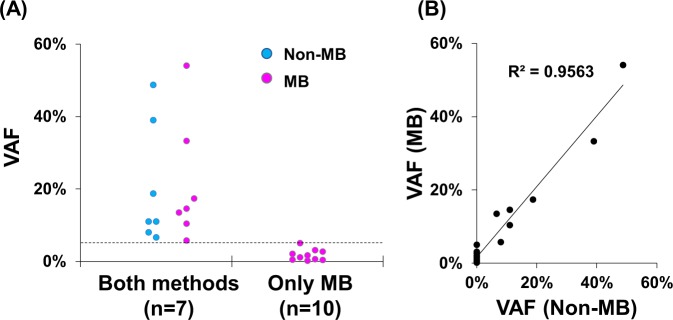
Molecular barcode sequencing detects low levels of mutated allele in plasma cfDNA. (A) Graph of variant allele fraction (VAF) of each mutation according to sequencing method. Both molecular barcode (MB) and non-molecular barcode (Non-MB) detected 7 mutations in plasma cfDNA. Ten mutations were detected by only MB sequencing. Dot line shows 5% VAF which is the detection limit of Non-MB seq. (B) Dot plot of the VAF in plasma cfDNA between MB and Non-MB sequencing. Mutations were detected with a high level of accuracy and concordance (decision coefficient, R2 = 0.9563).
Figure 4
Figure 4
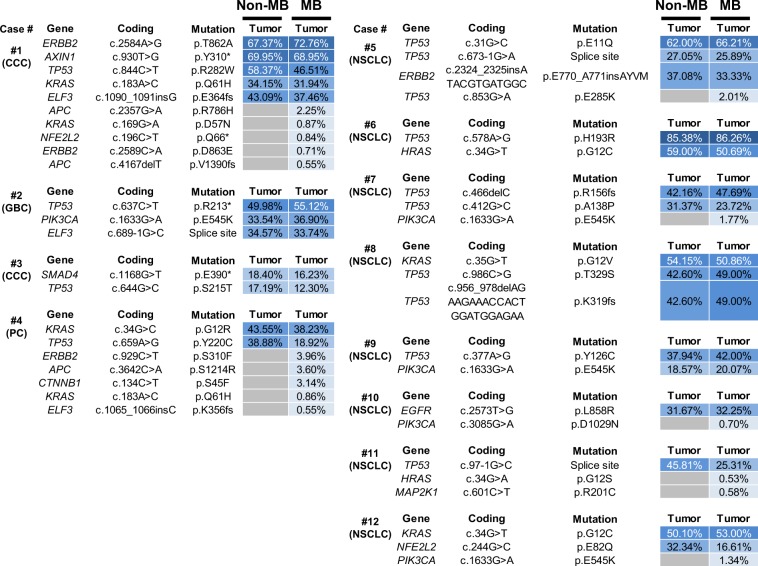
Molecular barcode sequencing revealed mutations in clonal and subclonal tumor population. Heat map shows the mutation profiles in tumors according to sequencing method. Samples were collected from the same patients described in Fig. 2. MB sequencing identified clonal and subclonal mutations in tumors. MB and Non-MB sequencing identified the same mutations with high variant allele fraction (VAF). VAF (%) is indicated in each box. Variant allele fractions are indicated in the graduated color scale from 1% (light blue) to 100% (dark blue). Gray box indicates no identified alterations. Tumor types (CCC, cholangiocarcinoma; GBC, gallbladder cancer; PC, pancreatic cancer, NSCLC, non-small cell lung cancer) were denoted under the case number.
Figure 5
Figure 5
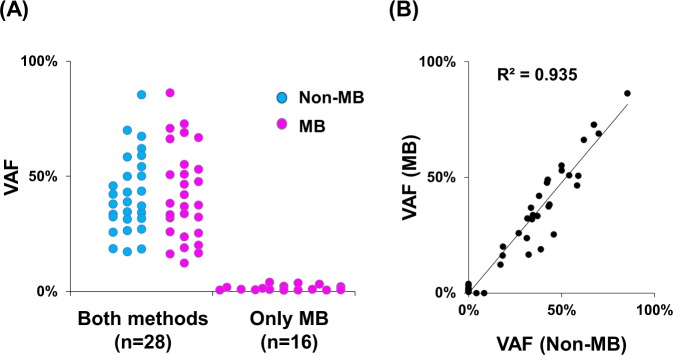
Molecular barcode sequencing detects low mutated allele in tumor DNA. (A) Plot of the variant allele fraction (VAF) of each mutation according to sequencing method. Twenty-eight mutations were detected by both molecular barcode (MB) and non-molecular barcode (Non-MB) sequencing, whereas 16 mutations were identified by only MB sequencing. (B) Dot plot of VAF in tumors between MB and Non-MB sequencing. Mutations were detected with correlation after refining the mapping condition (decision coefficient, R2 = 0.935).

References

    1. McGranahan N, Swanton C. Clonal Heterogeneity and Tumor Evolution: Past, Present, and the Future. Cell. 2017;168:613–628. doi: 10.1016/j.cell.2017.01.018. - DOI - PubMed
    1. McGranahan N, et al. Clonal status of actionable driver events and the timing of mutational processes in cancer evolution. Sci. Transl. Med. 2015;7:283ra254. doi: 10.1126/scitranslmed.aaa1408. - DOI - PMC - PubMed
    1. Bettegowda C, et al. Detection of circulating tumor DNA in early- and late-stage human malignancies. Sci. Transl. Med. 2014;6:224ra224. doi: 10.1126/scitranslmed.3007094. - DOI - PMC - PubMed
    1. Salk JJ, Schmitt MW, Loeb LA. Enhancing the accuracy of next-generation sequencing for detecting rare and subclonal mutations. Nat. Rev. Genet. 2018;19:269–285. doi: 10.1038/nrg.2017.117. - DOI - PMC - PubMed
    1. Luthra R, et al. A Targeted High-Throughput Next-Generation Sequencing Panel for Clinical Screening of Mutations, Gene Amplifications, and Fusions in Solid Tumors. J. Mol. Diagn. 2017;19:255–264. doi: 10.1016/j.jmoldx.2016.09.011. - DOI - PubMed

Publication types

MeSH terms

Substances