Review
. 2020 Feb 20:11:24.
doi: 10.1186/s40104-019-0402-1. eCollection 2020.

Clostridium species as probiotics: potentials and challenges

Affiliations
Review

Clostridium species as probiotics: potentials and challenges

Pingting Guo et al. J Anim Sci Biotechnol. .

Abstract

Clostridium species, as a predominant cluster of commensal bacteria in our gut, exert lots of salutary effects on our intestinal homeostasis. Up to now, Clostridium species have been reported to attenuate inflammation and allergic diseases effectively owing to their distinctive biological activities. Their cellular components and metabolites, like butyrate, secondary bile acids and indolepropionic acid, play a probiotic role primarily through energizing intestinal epithelial cells, strengthening intestinal barrier and interacting with immune system. In turn, our diets and physical state of body can shape unique pattern of Clostridium species in gut. In view of their salutary performances, Clostridium species have a huge potential as probiotics. However, there are still some nonnegligible risks and challenges in approaching application of them. Given this, this review summarized the researches involved in benefits and potential risks of Clostridium species to our health, in order to develop Clostridium species as novel probiotics for human health and animal production.

Keywords: Clostridium species; Intestinal homeostasis; Metabolites; Probiotics.


Conflict of interest statement

Competing interestsThe authors declare that they have no competing interests.

Figures
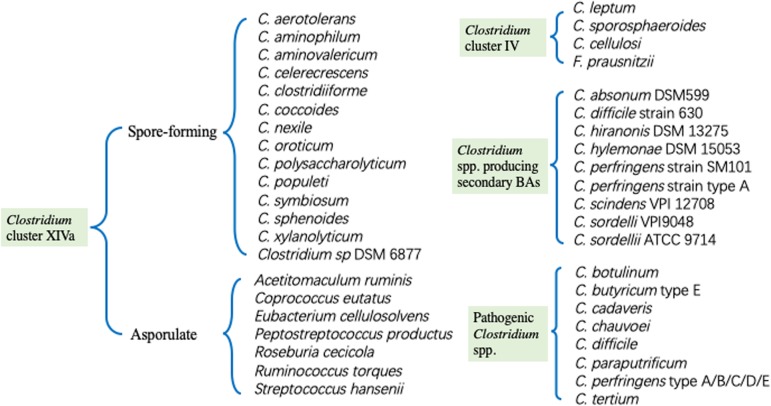
Fig. 1
Fig. 1
Clostridium cluster IV and XIVa species, Clostridium spp. producing secondary BAs and pathogenic Clostridium spp.. According to the novel taxonomic arrangement criterion, the species of Clostridium cluster IV and XIVa are listed. What’s more, Clostridium spp. that can convert primary BAs to secondary BAs are presented here. Pathogenic Clostridium spp. listed in Fig. 1 also have some non-pathogenic strains, and most of them are commensal bacteria in gut.
Fig. 2
Fig. 2
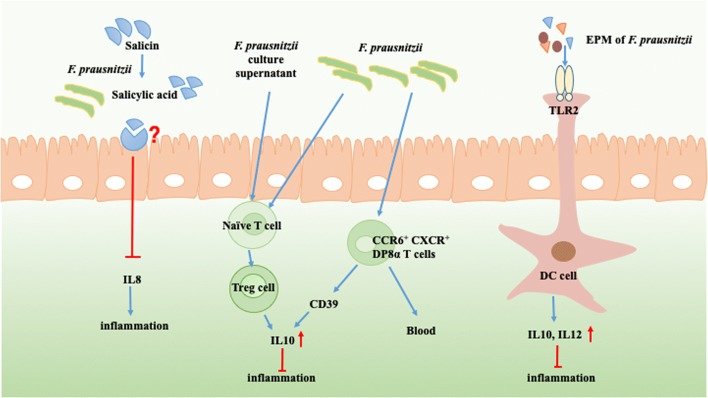
The interaction between F. prausnitzii and colonic immune. F. prausnitzii could exert anti-inflammation effects to our health dependent on its interaction with colonic immune to a great extent. 1) Salicylic acid could be produced from salicin fermentation by 40% F. prausnitzii and block the production of IL8 [28]. 2) F. prausnitzii and its culture supernatant could exhibit anti-inflammatory effects via IL10 production from Treg cells [19]. 3) CCR6+ CXCR6+ DP8α T cells are a new gut-derived TREG cell subpopulation. They can particularly response to F. prausnitzii and exert anti-inflammation effect by promoting the IL10 production dependent on CD39 [23]. 4) Extracellular polymeric matrix (EPM) of F. prausnitzii strain HTF-F induced the TLR2-dependent secretion of IL10 and IL12 in human monocyte-derived dendritic cells (DC cells) to attenuate inflammation [24]

References

    1. Amitay EL, Krilaviciute A, Brenner H. Systematic review: gut microbiota in fecal samples and detection of colorectal neoplasms. Gut Microbes. 2018;9:293–307. - PMC - PubMed
    1. Arnoldini M, Cremer J, Hwa T. Bacterial growth, flow, and mixing shape human gut microbiota density and composition. Gut Microbes. 2018;9:559–566. - PMC - PubMed
    1. Flemer B, Herlihy M, O'Riordain M, Shanahan F, O'Toole PW. Tumour-associated and non-tumour-associated microbiota: addendum. Gut Microbes. 2018;9:369–373. - PMC - PubMed
    1. Gomes AC, Hoffmann C, Mota JF. The human gut microbiota: metabolism and perspective in obesity. Gut Microbes. 2018;9:308–325. - PMC - PubMed
    1. Nagano Y, Itoh K, Honda K. The induction of Treg cells by gut-indigenous Clostridium. Curr Opin Immunol. 2012;24:392–397. doi: 10.1016/j.coi.2012.05.007. - DOI - PubMed

LinkOut - more resources