


Causes and consequences of individual variation in animal movement
- PMID: 32099656
- PMCID: PMC7027015
- DOI: 10.1186/s40462-020-0197-x
Causes and consequences of individual variation in animal movement
Abstract
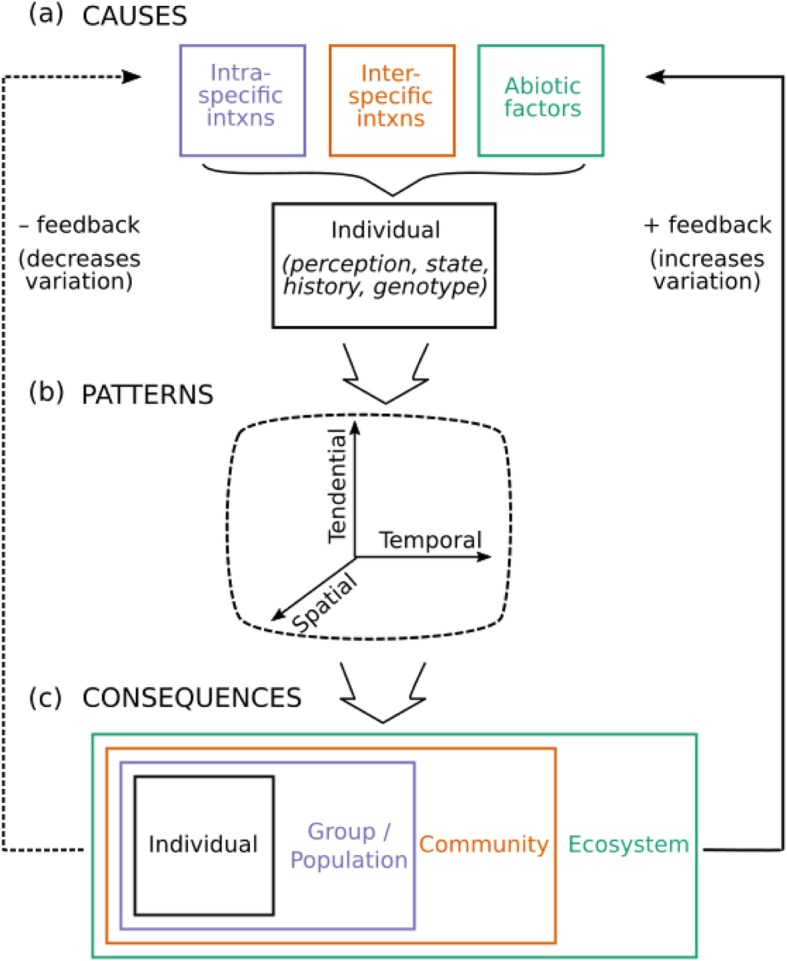
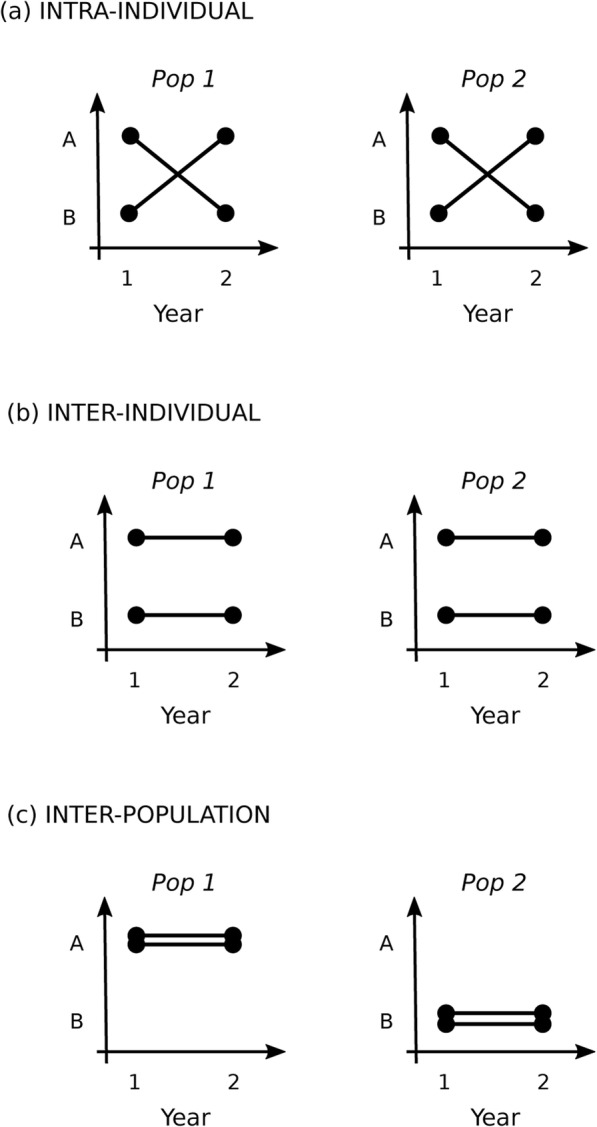
Animal movement comes in a variety of 'types' including small foraging movements, larger one-way dispersive movements, seasonally-predictable round-trip migratory movements, and erratic nomadic movements. Although most individuals move at some point throughout their lives, movement patterns can vary widely across individuals within the same species: differing within an individual over time (intra-individual), among individuals in the same population (inter-individual), or among populations (inter-population). Yet, studies of movement (theoretical and empirical alike) more often focus on understanding 'typical' movement patterns than understanding variation in movement. Here, I synthesize current knowledge of movement variation (drawing parallels across species and movement types), describing the causes (what factors contribute to individual variation), patterns (what movement variation looks like), consequences (why variation matters), maintenance (why variation persists), implications (for management and conservation), and finally gaps (what pieces we are currently missing). By synthesizing across scales of variation, I span across work on plasticity, personality, and geographic variation. Individual movement can be driven by factors that act at the individual, population, community and ecosystem level and have ramifications at each of these levels. Generally the consequences of movement are less well understood than the causes, in part because the effects of movement variation are often nested, with variation manifesting at the population level, which in turn affects communities and ecosystems. Understanding both cause and consequence is particularly important for predicting when variation begets variation in a positive feedback loop, versus when a negative feedback causes variation to be dampened successively. Finally, maintaining standing variation in movement may be important for facilitating species' ability to respond to future environmental change.
Keywords: Context-dependent; Dispersal kernel; Environmental change; Foraging ecology; Movement ecology; Nomadism; Partial migration; Personality; Plasticity; Population dynamics; Range expansion; Sex-biased dispersal.
© The Author(s). 2020.
Conflict of interest statement
Competing interestsThe author has no competing interests.
Figures
References
-
- Heape W. Emigration, migration and nomadism. Cambridge: Heffer and Sons; 1931.
-
- Mueller T, Fagan WF. Search and navigation in dynamic environments-from individual behaviors to population distributions. Oikos. 2008;117:654–664. doi: 10.1111/j.0030-1299.2008.16291.x. - DOI
Publication types
LinkOut - more resources
Full Text Sources
