Review
. 2019 Dec 6:21:73-80.
doi: 10.1016/j.jot.2019.10.012. eCollection 2020 Mar.

Extracellular vesicles: Potential role in osteoarthritis regenerative medicine

Affiliations
Review

Extracellular vesicles: Potential role in osteoarthritis regenerative medicine

Xiaoxin Wu et al. J Orthop Translat. .

Abstract

Osteoarthritis (OA) is a prevalent whole joint disease characterised by cartilage degradation, subchondral bone sclerosis and bone remodelling, and synovium inflammation, leading to pain, deformity, and cartilage dysfunction. Currently, there is no appropriate therapy for OA, and available treatments simply aim to reduce pain and swelling. Exosomes are membrane-bound extracellular vesicles secreted by almost all cells, receiving increasing interest because of their effect in cell-to-cell communication. Increasing evidence suggests that exosomes play an important role in cartilage physiological and pathological effects. This article reviews the potential role of exosomes in OA regenerative medicine. Special attention is given to mesenchymal stem cells-derived exosomes due to the extensive research on their cartilage repair property and their function as miRNA cargo. More investigations are needed for the effects of exosomes from synovial fluid and chondrocytes in joints. A better understanding of the mechanisms will contribute to a novel and promising therapy for OA patients.

The translational potential of this article: A better understanding of the role of extracellular vesicles in regenerative medicine will contribute to a novel and promising therapy for OA patients.

Keywords: Chondrocytes; Exosomes; Mesenchymal stem cells; MicroRNA; Osteoarthritis; Synovial inflammation.


Conflict of interest statement

The authors declare no competing interests.

Figures
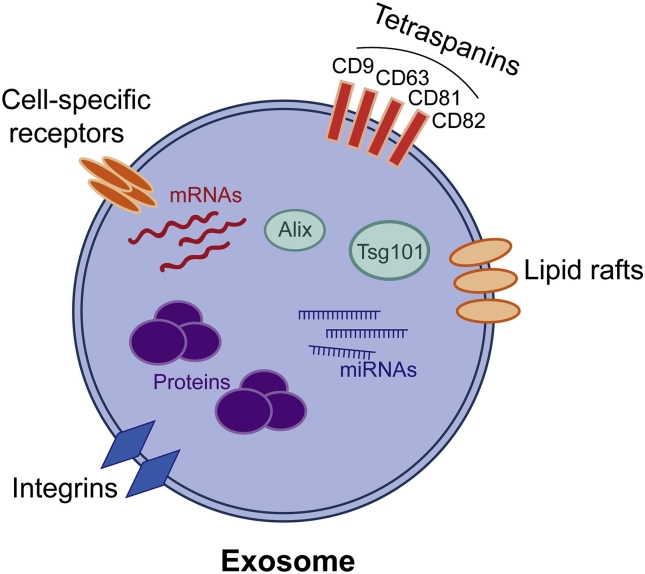
Figure 1
Figure 1
Diagram of the exosome. Exosomes are membrane-bound extracellular vesicles and have an endosome origin, with a size ranging from 30 ​nm to 100 ​nm. Cell-specific receptors, integrins, and lipid rafts can be found in the phospholipid bilayer of the membrane, participating in cell-to-cell communication. Almost all exosomes contain tetraspanins (CD9, CD63, CD81, CD82), multivesicular body biogenesis-related proteins (Alix, Tsg101), heat shock proteins, and some phospholipases. Besides proteins, exosomes also contain mRNAs as well as miRNAs. The composition of exosomes not only reflects the biological state of their parent cells but also affects their functions.
Figure 2
Figure 2
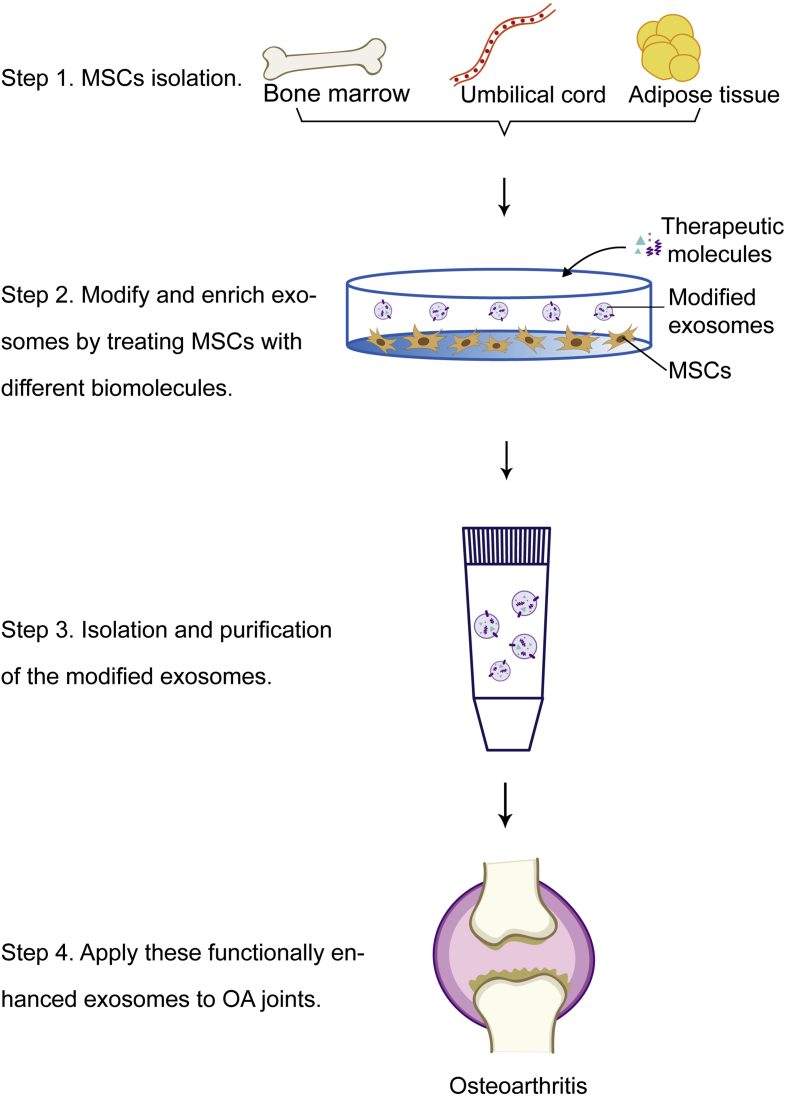
Schematic diagram of modified MSC-derived exosomes production and their application in treating OA.
Figure 3
Figure 3
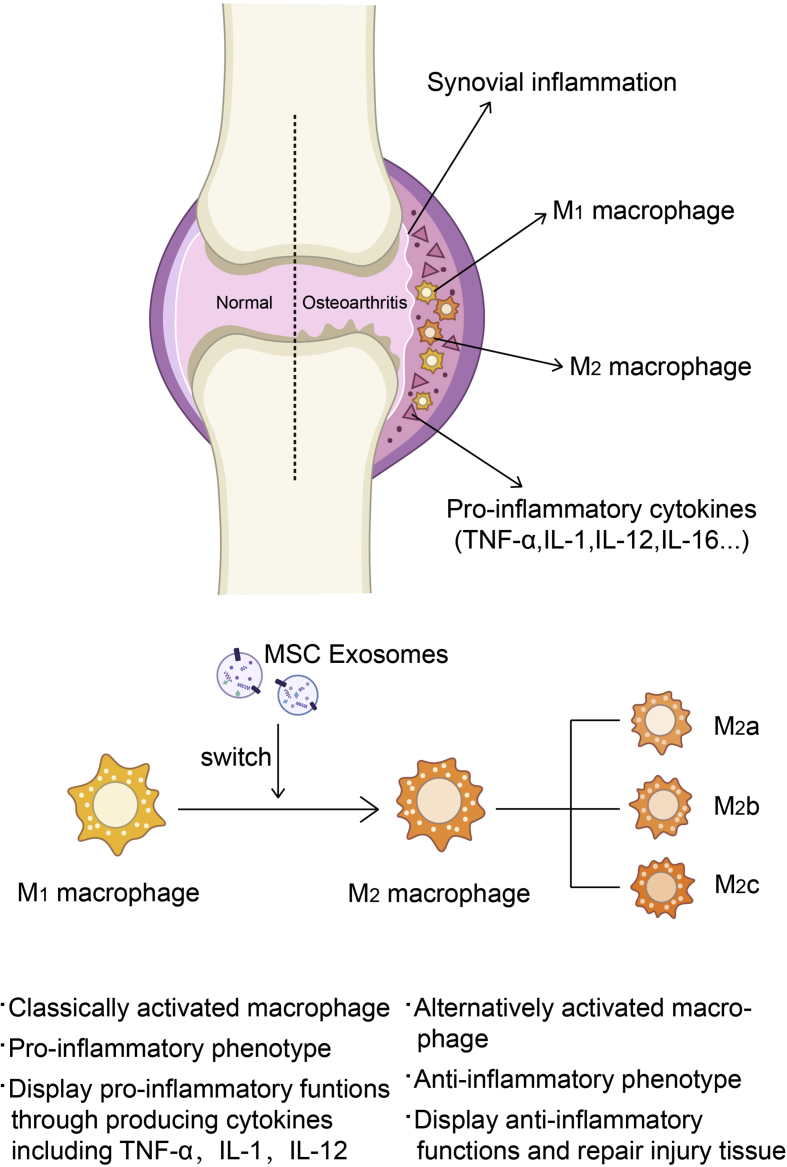
Macrophage cell ​accumulation in the synovial lining is one of the characteristics of synovial inflammation. Synovial inflammation promotes the polarisation of macrophages into the M1 phenotype, and they could produce pro-inflammatory cytokines. TNF-α, IL-1, IL-12, and IL-16 abound in inflamed synovium. Previous studies showed that MSCs could change the phenotype of macrophage. Consistent with this, exosomes derived from MSCs may also be macrophage polarisation switchers. Polarised from the M1 phenotype into the M2 phenotype (subdivided into M2a, M2b, and M2c), macrophages could display anti-inflammatory functions and repair the injured tissue.
Figure 4
Figure 4
FLS-derived exosomes induce the gene expression patterns related to OA. Exosomes secreted by IL-1β-stimulated FLS promote MMP-13 and TNF-α expression while inhibiting ACAN and COL2A1 expression. MMP-13 is the most important collagenase that causes type Ⅱ collagen degradation. The upregulation or aberrant activation of MMP-13 contributes to the progression of different stages of OA. TNF-α is also involved in the cartilage degradation process. Simultaneously, the expression of anabolic genes (ACAN and COL2A1) is decreased.

References

    1. Loeser R.F., Goldring S.R., Scanzello C.R., Goldring M.B. Osteoarthritis: a disease of the joint as an organ. Arthritis Rheum. 2012;64(6):1697–1707. - PMC - PubMed
    1. Domenis R., Zanutel R., Caponnetto F., Toffoletto B., Cifu A., Pistis C. Characterization of the proinflammatory profile of synovial fluid-derived exosomes of patients with osteoarthritis. Mediat Inflamm. 2017;2017:4814987. - PMC - PubMed
    1. Steinert A.F., Ghivizzani S.C., Rethwilm A., Tuan R.S., Evans C.H., Noth U. Major biological obstacles for persistent cell-based regeneration of articular cartilage. Arthritis Res Ther. 2007;9(3):213. - PMC - PubMed
    1. Okoro T., Morrison V., Maddison P., Lemmey A.B., Andrew J.G. An assessment of the impact of behavioural cognitions on function in patients partaking in a trial of early home-based progressive resistance training after total hip replacement surgery. Disabil Rehabil. 2013;35(23):2000–2007. - PubMed
    1. Colombo M., Raposo G., Thery C. Biogenesis, secretion, and intercellular interactions of exosomes and other extracellular vesicles. Annu Rev Cell Dev Biol. 2014;30:255–289. - PubMed