. 2020 Feb 6;4(2):nzaa018.
doi: 10.1093/cdn/nzaa018. eCollection 2020 Feb.

Maternal Prenatal Psychosocial Stress and Prepregnancy BMI Associations with Fetal Iron Status

Affiliations

Maternal Prenatal Psychosocial Stress and Prepregnancy BMI Associations with Fetal Iron Status

Rebecca K Campbell et al. Curr Dev Nutr. .

Abstract

Background: Iron accrued in utero is critical for fetal and infant neurocognitive development. Psychosocial stress and obesity can each suppress fetal iron accrual. Their combined effects and differences by fetal sex are not known. In an observational pregnancy cohort study in Mexico City, we investigated associations of maternal prenatal life stressors, psychological dysfunction, and prepregnancy BMI with fetal iron status at delivery.

Objectives: We hypothesized that greater maternal prenatal psychosocial stress and prepregnancy overweight and obesity are associated with lower cord blood ferritin and hemoglobin (Hb), with stronger associations in boys than girls.

Methods: Psychosocial stress in multiple domains of life stress (negative life events, perceived stress, exposure to violence) and psychological dysfunction symptoms (depression, generalized anxiety, and pregnancy-specific anxiety) were assessed with validated questionnaires during pregnancy. Prepregnancy BMI was predicted with a validated equation and categorized as normal/overweight/obese. Cord blood ferritin and Hb associations with prenatal psychosocial stress and BMI were modeled in multivariable linear regressions adjusted for maternal age, socioeconomic status, child sex, and prenatal iron supplementation. Interactions with child sex and 3-way stress-overweight/obesity-sex interactions were tested with product terms and likelihood ratio tests.

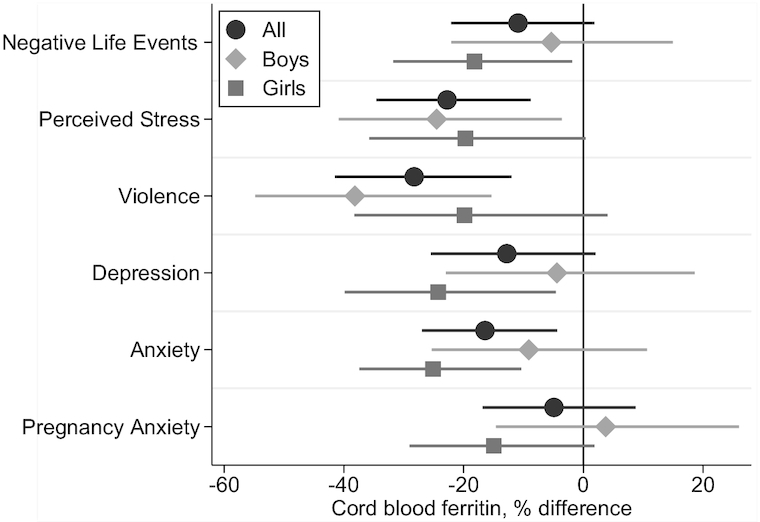
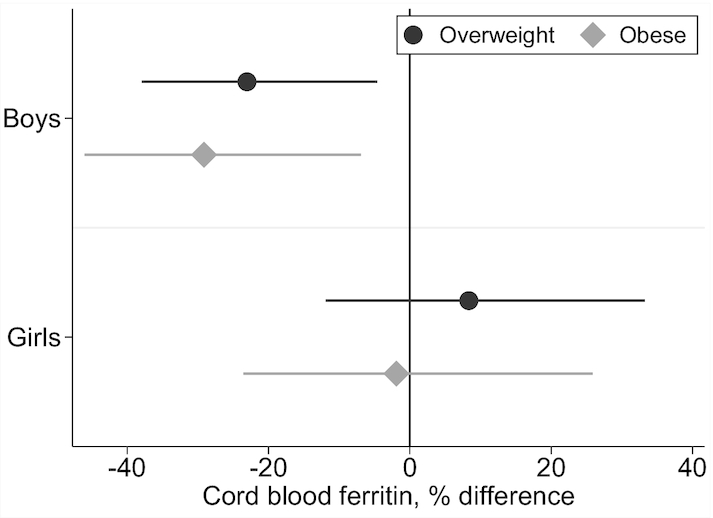
Results: In 493 dyads, median (IQR) cord blood ferritin and Hb concentrations were 185 µg/L (126-263 g/dL) and 16 g/dL (14.7-17.1 g/dL), respectively. Ferritin was lower in infants of mothers with higher prenatal perceived stress (-23%; 95% CI: -35%, -9%), violence exposure (-28%; 95% CI: -42%, -12%), anxiety symptoms (-16%; 95% CI: -27%, -4%), and obesity (-17%; 95% CI: -31%, 0.2%). Interaction models suggested sex differences and synergism between maternal stress and overweight/obesity. No associations were observed between stress or BMI and Hb.

Conclusions: Multiple prenatal psychosocial stressors and excess prepregnancy BMI were each inversely associated with fetal iron status at birth. Pregnancies and infants at elevated risk of impaired fetal iron accrual may be identifiable according to observed synergism between maternal stress and obesity and differential associations with fetal iron status by infant sex.

Keywords: Mexico; anxiety; depression; developmental origins of health and disease (DOHAD); exposure to violence; iron deficiency; maternal health; negative life events; pregnancy.


Figures

FIGURE 1
FIGURE 1
Percentage difference in cord blood ferritin at delivery in infants of mothers with high vs. low prenatal stress (negative life events, perceived stress, and lifetime exposure to violence) or psychological dysfunction (symptoms of depression, generalized anxiety, and pregnancy anxiety), overall and stratified by infant sex. Coefficients and 95% CIs are from linear regression models with log cord-blood-ferritin as the dependent variable. Models are adjusted for maternal age, socioeconomic status, iron supplement intake, and child sex (overall models only). Associations between stress and ferritin were statistically significantly different from zero (P  < 0.05) for perceived stress in boys and girls combined, for depression and anxiety in girls, and for exposure to violence overall and in boys. Interaction terms for stress by infant sex did not reach statistical significance. The stress and psychological dysfunction cutoffs and scales used were: negative life event domains ≥3 on the Crisis in Family Systems (CRISYS) questionnaire; >4th quartile (= 7) on the Perceived Stress Scale-4; >85th percentile (= 0.63) on the lifetime Exposure to Violence questionnaire; depression symptoms, ≥13 on the Edinburgh Depression Scale; anxiety symptoms, greater than the median (= 18) on the Spielberger Trait Anxiety Inventory; pregnancy anxiety symptoms, greater than the median (= 19) on the Pregnancy Anxiety Scale.
FIGURE 2
FIGURE 2
Percentage difference in cord blood ferritin at delivery in infants of mothers with prepregnancy overweight or obesity vs. normal weight. Prepregnancy BMI was calculated from height measured during pregnancy and prepregnancy weight predicted using a validated algorithm using weight(s) measured during pregnancy and other maternal characteristics (60). Coefficients and 95% CIs are from linear regression models with log cord blood ferritin as the dependent variable, indicator variables for maternal prepregnancy overweight and obesity (reference category: normal weight), and product terms for interactions between prepregnancy weight status and infant sex. Models were adjusted for maternal age, socioeconomic status, and iron supplement intake. The interaction terms between prepregnancy weight status and infant sex were statistically significant (likelihood ratio χ2P value = 0.032).
FIGURE 3
FIGURE 3
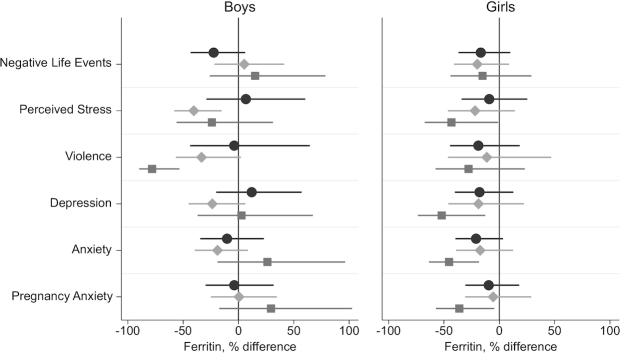
Percentage difference in cord blood ferritin at delivery in infants of mothers with high vs. low prenatal stress (negative life events, perceived stress, and lifetime exposure to violence) or psychological dysfunction (symptoms of depression, generalized anxiety, and pregnancy anxiety) by prepregnancy weight status and infant sex. Coefficients and 95% CIs are from sex-stratified linear regression models with log cord blood ferritin as the dependent variable and interaction terms between dichotomous stress and psychological dysfunction measures and categorical prepregnancy BMI. Models were adjusted for maternal age, socioeconomic status, and iron supplement intake. Stress-by-BMI interactions were significant for perceived stress in boys and girls combined (likelihood ratio χ2P value = 0.0951) and exposure to violence in boys only (P value = 0.0058). The 3-way interaction terms were statistically significant for exposure to violence (P value = 0. 048) and generalized anxiety (P value = 0.0646). The stress and psychological dysfunction cutoffs and scales used were: negative life event domains ≥3 on the Crisis in Family Systems (CRISYS) questionnaire; >4th quartile (= 7) on the Perceived Stress Scale-4; >85th percentile (= 0.63) on the lifetime Exposure to Violence questionnaire; depression symptoms, ≥13 on the Edinburgh Depression Scale; anxiety symptoms, greater than the median (= 18) on the Spielberger Trait Anxiety Inventory; pregnancy anxiety symptoms, greater than the median (= 19) on the Pregnancy Anxiety Scale. Prepregnancy BMI was calculated from height measured during pregnancy and prepregnancy weight predicted using a validated algorithm using weight(s) measured during pregnancy and other maternal characteristics (60).

References

    1. Black MM, Quigg AM, Hurley KM, Pepper MR. Iron deficiency and iron-deficiency anemia in the first two years of life: strategies to prevent loss of developmental potential. Nutr Rev. 2011;69(Suppl 1):S64–70. - PubMed
    1. Black MM, Walker SP, Fernald LCH, Andersen CT, DiGirolamo AM, Lu C, McCoy DC, Fink G, Shawar YR, Shiffman J et al.. Early childhood development coming of age: science through the life course. Lancet. 2017;389:77–90. - PMC - PubMed
    1. Siddappa AM, Rao R, Long JD, Widness JA, Georgieff MK. The assessment of newborn iron stores at birth: a review of the literature and standards for ferritin concentrations. Neonatology. 2007;92:73–82. - PMC - PubMed
    1. Rao R, Georgieff MK. Iron in fetal and neonatal nutrition. Semin Fetal Neonatal Med. 2007;12:54–63. - PMC - PubMed
    1. Fisher AL, Nemeth E. Iron homeostasis during pregnancy. Am J Clin Nutr. 2017;106:1567S–74S. - PMC - PubMed

LinkOut - more resources