


The human factor: does the operator performing the embryo transfer significantly impact the cycle outcome?
- PMID: 32100020
- PMCID: PMC7048715
- DOI: 10.1093/humrep/dez290
The human factor: does the operator performing the embryo transfer significantly impact the cycle outcome?
Abstract
Study question: Is Ongoing Pregnancy Rate (OPR) operator-dependent, and can experience improve embryo transfer efficiency?
Summary answer: OPR is influenced by the operators who perform the embryo transfer (ET), and experience does not assure proficiency for everyone.
What is known already: ET remains the critical step in assisted reproduction. Although many other factors such as embryo quality and uterine receptivity impact embryo implantation, the proper ET technique is clearly an operator-dependent variable and as such it should be objectively standardized.
Study design, size, duration: Retrospective comparative analysis including all fresh ETs performed between January 1996 and December 2016 at the Humanitas Fertility Center after IVF-ICSI cycles.
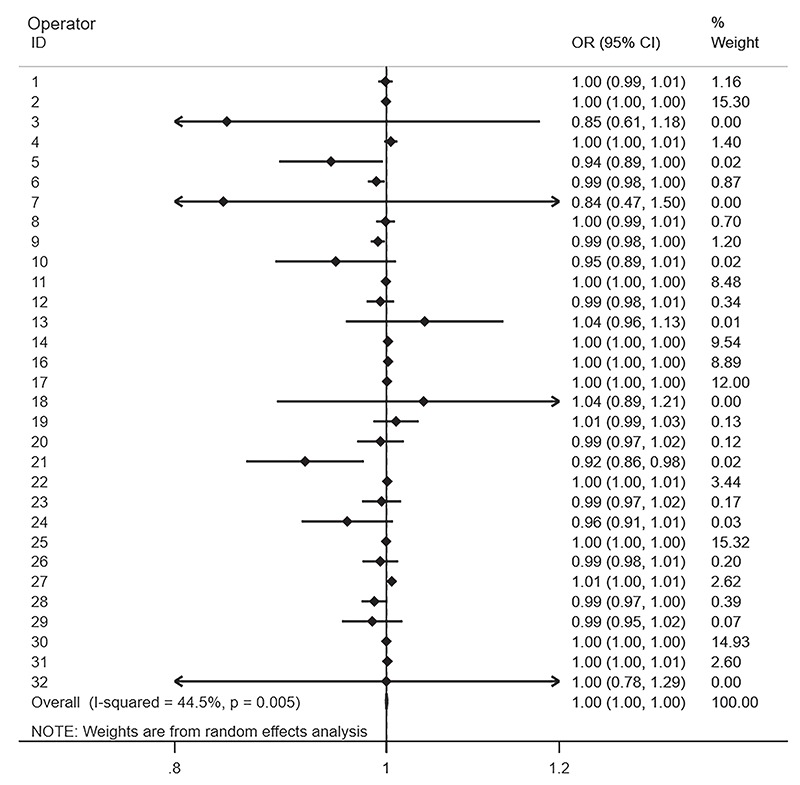
Participants/materials, setting, methods: IVF/ICSI fresh ETs performed by 32 operators, 19 824 cycles in all, were analyzed. All transfers consisting of freehand insertion of a preloaded soft catheter into the uterine cavity under transabdominal ultrasound guidance were considered. Two different statistical analyses were performed. First, a logistic regression model with a random intercept for the operator was used to estimate the heterogeneity of the rate of success among operators, accounting for woman age, FSH, number of oocytes retrieved, fertilization rate, year of the procedure, number and stage of transferred embryos and operator's experience. Second, the relationship between experience and pregnancy rate was estimated separately for each operator by logistic regression, and operator-specific results were combined and compared in a random-effects meta-analysis. In both analyses, the operator's experience at time t was measured in terms of number of embryo transfers performed before t.
Main results and the role of chance: The heterogeneity among operators was highly significant (P value <0.001) and explained 44.5% of the total variability. The odds ratio of success of the worst operator in respect to the mean was equal to 0.84. For the best operator, the odds ratio of success was equal to 1.13 in respect to the mean. Based on the meta-analysis of the relationship between operator's experience and success rate, it resulted that, on average, the operators' performance did not improve with additional transfers.
Limitations, reasons for caution: At our center, operators become independent for ET's after performing between 30 and 50 transfers under supervision. It is also possible that other relevant factors, such as embryologists on duty for the ET, have not been included in the present analysis and this may represent a potential bias. Among these, it should be mentioned that the embryologists on duty for the ET were not taken into consideration.
Wider implications of the findings: Continued performance analysis and the use of a digital simulator could help operators to test their expertise over time and either correct poor performance or avoid doing transfers.
Study funding/competing interest(s): None.
Trial registration number: NCT03561129.
Keywords: IVF success rate; embryo transfer; experience; learning curve; operator.
© The Author(s) 2020. Published by Oxford University Press on behalf of the European Society of Human Reproduction and Embryology.
Figures
References
-
- Abou-Setta AM, Al-Inany HG, Mansour RT, Serour GI, Aboulghar MA. Soft versus firm embryo transfer catheters for assisted reproduction: a systematic review and meta-analysis. Hum Reprod 2005;20:3114–3121. - PubMed
-
- Alvero R, Hearns-Stokes RM, Catherino WH, Leondires MP, Segars JH. The presence of blood in the transfer catheter negatively influences outcome at embryo transfer. Hum Reprod 2003;18:1848–1852. - PubMed
-
- Bjuresten K, Hreinsson JG, Fridstrom M, Rosenlund B, Ek I, Hovatta O. Embryo transfer by midwife or gynecologist: a prospective randomized study. Acta Obstet Gynecol Scand 2003;82:462–466. - PubMed
-
- Buckett WM. A review and meta-analysis of prospective trials comparing different catheters used for embryo transfer. Fertil Steril 2006;85:728–734. - PubMed
-
- Coroleu B, Barri PN, Carreras O, Martinez F, Veiga A, Balasch J. The usefulness of ultrasound guidance in frozen-thawed embryo transfer: a prospective randomized clinical trial. Hum Reprod 2002;17:2885–2890. - PubMed
Publication types
MeSH terms
Associated data
LinkOut - more resources
Full Text Sources
Medical
