Malaria Elimination in China: Improving County-Level Malaria Personnel Knowledge of the 1-3-7 Strategy through Tabletop Exercises
- PMID: 32100680
- PMCID: PMC7124899
- DOI: 10.4269/ajtmh.19-0560
Malaria Elimination in China: Improving County-Level Malaria Personnel Knowledge of the 1-3-7 Strategy through Tabletop Exercises
Abstract
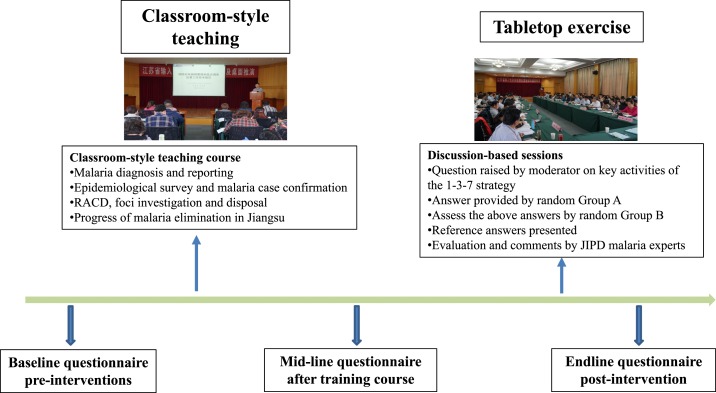
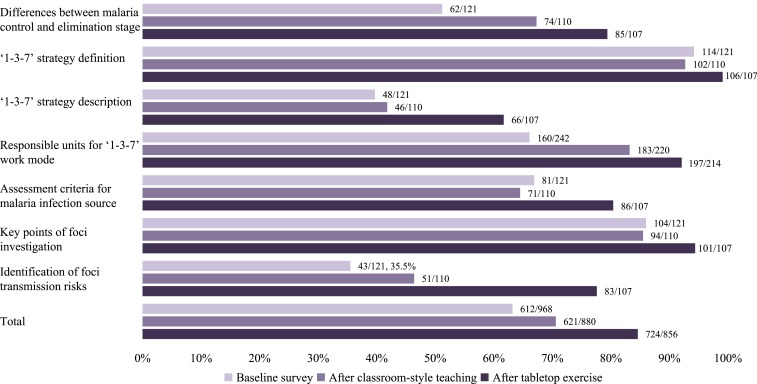
As China moves to the prevention of reestablishment of malaria, maintaining skills for malaria in county personnel on the "1-3-7" surveillance and response strategy is critical. China's "1-3-7" strategy defines targets used to guide and monitor malaria case reporting, investigation, and response, respectively: reporting of malaria cases within 1 day, their confirmation and investigation within 3 days, and the appropriate public health response to prevent further transmission within 7 days. Assessing the knowledge of local CDC malaria personnel on the "1-3-7" surveillance and response strategy is urgently needed. In June 2016, two different training modules (classroom-style teaching and tabletop exercises) were conducted for 125 CDC staff in Jiangsu Province, China, to determine the effectiveness of the two training modules on CDC staff knowledge and learning of the "1-3-7" strategy. The classroom-style training module just imparted the malaria knowledge to participants through teaching. Tabletop exercises were carried out through discussion-based scenarios using questions and answers on the "1-3-7" strategy. Questionnaires assessing knowledge improvement were designed and administered to personnel responsible for malaria surveillance and response activities, including at baseline and end line. Overall, knowledge of the "1-3-7" strategy for malaria elimination was 63.2% correct at baseline, 70.6% after implementing a classroom-style teaching module (χ2 = 11.20, P = 0.001), and 84.6% after the tabletop exercise module (χ2 = 48.82, P < 0.001). The knowledge of each component of the "1-3-7" strategy improved significantly after the tabletop exercise module. The total proportion of respondents with a high score (greater than or equal to 75%) was 82.7% in the classroom-style module and 95.2% in the tabletop exercise module. The proportion of respondents with a high score significantly increased after tabletop exercises in the stratified demographic groups of men who work at the county CDC level, have a bachelor's degree, hold a professional title as professor or assistant, are aged 31-50 years, and have attained 11-20 years of service with the CDC compared with the classroom-style module. Acceptability of the classroom-style module (78.2%) compared with tabletop exercises (94.4%) by the CDC malaria personnel increased significantly (χ2 = 11.96, P = 0.004). Feedback from participants on the modules suggest the tabletop exercises were an effective training method, which could maintain and improve the knowledge and capacity for malaria surveillance and response in basic CDC level personnel in China.
Figures
References
-
- World Health Organization , 2018. World Malaria Report 2018. Geneva, Switzerland: WHO, 6.
-
- Tang LH, 1999. Achievements of malaria control and research in China [in Chinese]. Chin J Parasitol Parasitic Dis 17: 257–259. - PubMed
-
- Zhou SS, Wang Y, Xia ZG, 2011. Malaria situation in the People’s Republic of China in 2009 [in Chinese]. Chin J Parasitol Parasitic Dis 29: 1–3. - PubMed
-
- Lei ZL, Wang LY, 2012. Control situation and primary task of key parasitic diseases in China [in Chinese]. Chin J Parasitol Parasitic Dis 30: 1–5. - PubMed
MeSH terms
Substances
LinkOut - more resources
Full Text Sources
Medical
Research Materials