


Pharmacogenomics in Asian Subpopulations and Impacts on Commonly Prescribed Medications
- PMID: 32100936
- PMCID: PMC7485947
- DOI: 10.1111/cts.12771
Pharmacogenomics in Asian Subpopulations and Impacts on Commonly Prescribed Medications
Abstract
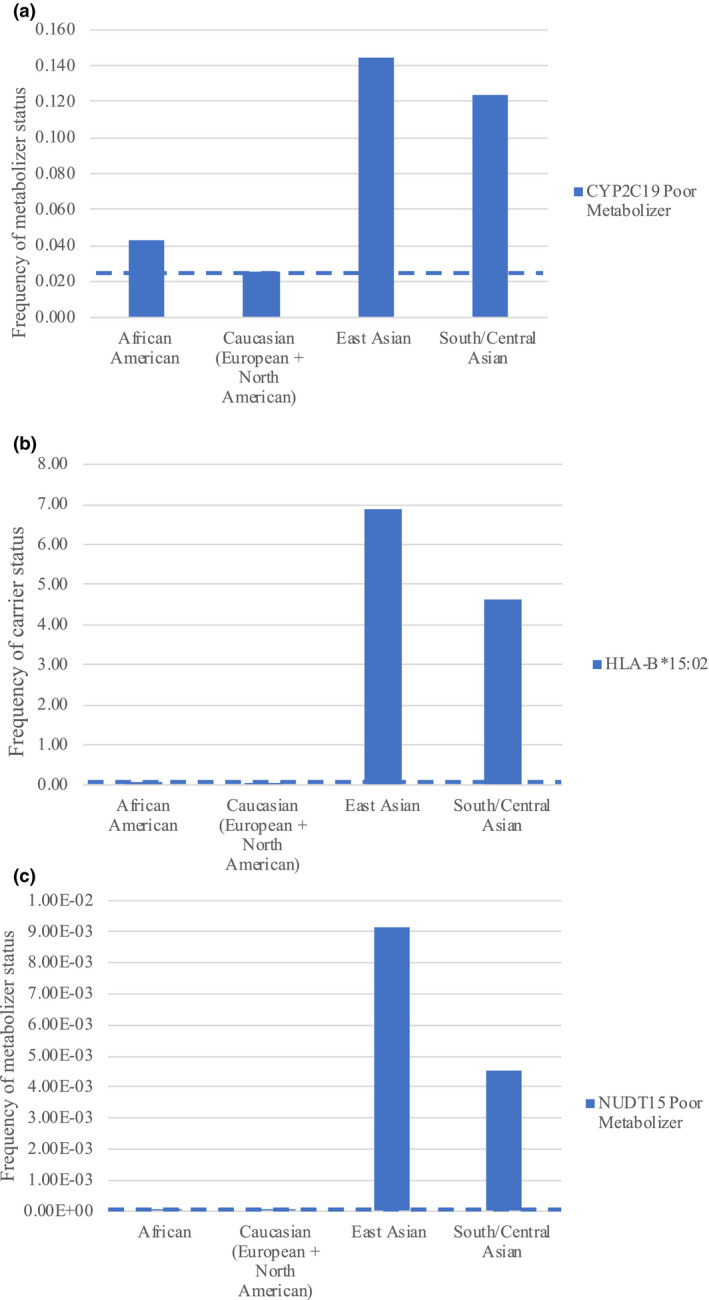
Asians as a group comprise > 60% the world's population. There is an incredible amount of diversity in Asian and admixed populations that has not been addressed in a pharmacogenetic context. The known pharmacogenetic differences in Asian subgroups generally represent previously known variants that are present at much lower or higher frequencies in Asians compared with other populations. In this review we summarize the main drugs and known genes that appear to have differences in their pharmacogenetic properties in certain Asian populations. Evidence-based guidelines and summary statistics from the US Food and Drug Administration and the Clinical Pharmacogenetics Implementation Consortium were analyzed for ethnic differences in outcomes. Implicated drugs included commonly prescribed drugs such as warfarin, clopidogrel, carbamazepine, and allopurinol. The majority of these associations are due to Asians more commonly being poor metabolizers of cytochrome P450 (CYP) 2C19 and carriers of the human leukocyte antigen (HLA)-B*15:02 allele. The relative risk increase was shown to vary between genes and drugs, but could be > 100-fold higher in Asians. Specifically, there was a 172-fold increased risk of Stevens-Johnson syndrome and toxic epidermal necrolysis with carbamazepine use among HLA-B*15:02 carriers. The effects ranged from relatively benign reactions such as reduced drug efficacy to severe cutaneous skin reactions. These reactions are severe and prevalent enough to warrant pharmacogenetic testing and appropriate changes in dose and medication choice for at-risk populations. Further studies should be done on Asian cohorts to more fully understand pharmacogenetic variants in these populations and to clarify how such differences may influence drug response.
© 2020 The Authors. Clinical and Translational Science published by Wiley Periodicals, Inc. on behalf of the American Society of Clinical Pharmacology and Therapeutics.
Conflict of interest statement
R.B.A is a board member of Youscript and advisor to Personalis. All other authors declared no competing interests for this work.
Figures
References
-
- Chen, P. et al Carbamazepine‐induced toxic effects and HLA‐B*1502 screening in Taiwan. N. Engl. J. Med. 364, 1126–1133 (2011). - PubMed
-
- Man, C.B.L. et al Association between HLA‐B*1502 allele and antiepileptic drug‐induced cutaneous reactions in Han Chinese. Epilepsia 48, 1015–1018 (2007). - PubMed
-
- Ramamoorthy, A. , Pacanowski, M.A. , Bull, J. & Zhang, L. Racial/ethnic differences in drug disposition and response: review of recently approved drugs. Clin. Pharmacol. Ther. 97, 263–273 (2015). - PubMed
Publication types
MeSH terms
Substances
Grants and funding
LinkOut - more resources
Full Text Sources
Research Materials
