


Impact of nonphysician providers on spatial accessibility to primary care in Iowa
- PMID: 32101334
- PMCID: PMC7240764
- DOI: 10.1111/1475-6773.13280
Impact of nonphysician providers on spatial accessibility to primary care in Iowa
Abstract
Objective: To assess the impact of nonphysician providers on measures of spatial access to primary care in Iowa, a state where physician assistants and advanced practice registered nurses are considered primary care providers.
Data sources: 2017 Iowa Health Professions Inventory (Carver College of Medicine), and minor civil division (MCD) level population data for Iowa from the American Community Survey.
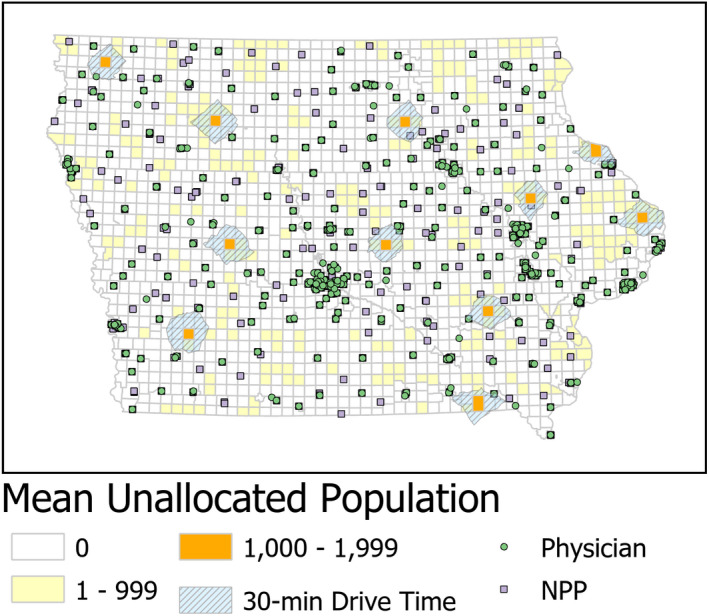
Study design: We used a constrained optimization model to probabilistically allocate patient populations to nearby (within a 30-minute drive) primary care providers. We compared the results (across 10 000 scenarios) using only primary care physicians with those including nonphysician providers (NPPs). We analyze results by rurality and compare findings with current health professional shortage areas.
Data collection/extraction methods: Physicians and NPPs practicing in primary care in 2017 were extracted from the Iowa Health Professions Inventory.
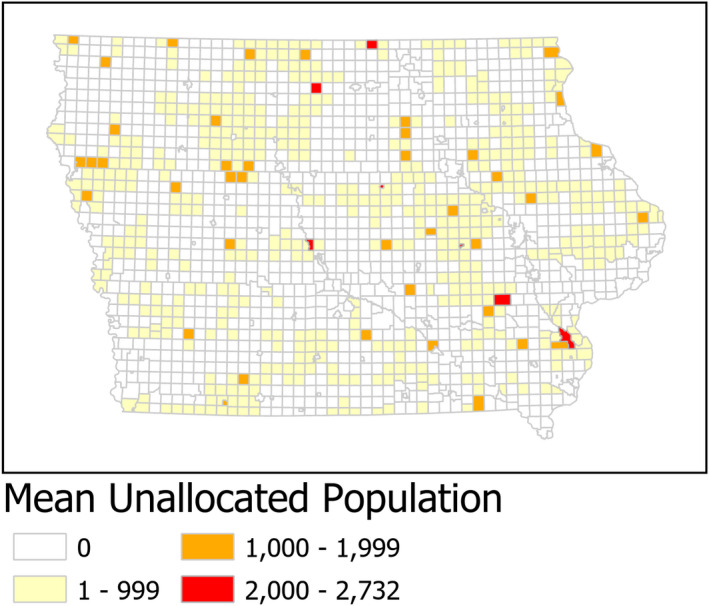
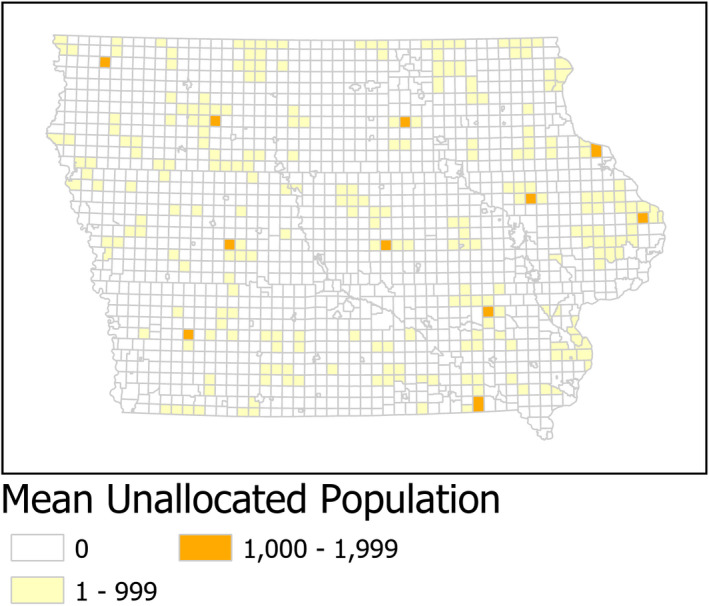
Principal findings: Considering only primary care physicians, the average unallocated population for primary care was 222 109 (7 percent of Iowa's population). Most of the unallocated population (86 percent) was in rural areas with low population density (< 50/square mile). The addition of NPPs to the primary care workforce reduced unallocated population by 65 percent to 78 252 (2.5 percent of Iowa's population). Despite the majority of NPPs being located in urban areas, most of the improvement in spatial accessibility (78 percent) is associated with sparsely populated rural areas.
Conclusions: The inclusion of nonphysician providers greatly reduces but does not eliminate all areas of inadequate spatial access to primary care.
Keywords: advance nurse practitioners; physician assistants; primary care; spatial access.
© 2020 The Authors. Health Services Research published by Wiley Periodicals, Inc. on behalf of Health Research and Educational Trust.
Conflict of interest statement
The authors report no other disclosures.
Figures
References
-
- Colwill JM, Cultice JM, Kruse RL. Will generalist physician supply meet demands of an increasing and aging population? Health Aff (Millwood). 2008;27(3):w232‐w241. - PubMed
-
- Dall T, Reynolds R, Jones K, Chakrabarti R, Iacobucci W, Association of American Medical Colleges . The Complexities of Physician Supply and Demand: Projections from 2017 to 2032. Washington, DC: Association of American Medical Colleges; 2019:86.
-
- Shanafelt TD, West CP, Sinsky C, et al. Changes in burnout and satisfaction with work‐life integration in physicians and the general US working population between 2011 and 2017. Mayo Clin Proc. 2019;94(9):1681‐1694. - PubMed
Publication types
MeSH terms
LinkOut - more resources
Full Text Sources
Miscellaneous
