


Comparison of woman-picked, expert-picked, and computer-picked Peak Day of cervical mucus with blinded urine luteinising hormone surge for concurrent identification of ovulation
- PMID: 32101336
- PMCID: PMC8495767
- DOI: 10.1111/ppe.12642
Comparison of woman-picked, expert-picked, and computer-picked Peak Day of cervical mucus with blinded urine luteinising hormone surge for concurrent identification of ovulation
Abstract
Background: Previous research has demonstrated that women instructed in fertility awareness methods can identify the Peak Day of cervical mucus discharge for each menstrual cycle, and the Peak Day has high agreement with other indicators of the day of ovulation. However, previous studies enrolled experienced users of fertility awareness methods or were not fully blinded.
Objective: To assess the agreement between cervical mucus Peak Day identified by fertile women without prior experience on assessing cervical mucus discharge with the estimated day of ovulation (1 day after urine luteinising hormone surge).
Methods: This study is a secondary analysis of data from a randomised trial of the Creighton Model FertilityCareTM System (CrM), conducted 2003-2006, for women trying to conceive. Women who had no prior experience tracking cervical mucus recorded vulvar observations daily using a standardised assessment of mucus characteristics for up to seven menstrual cycles. Four approaches were used to identify the Peak Day. The referent day was defined as one day after the first identified day of luteinising hormone (LH) surge in the urine, assessed blindly. The percentage of agreement between the Peak Day and the referent day of ovulation was calculated.
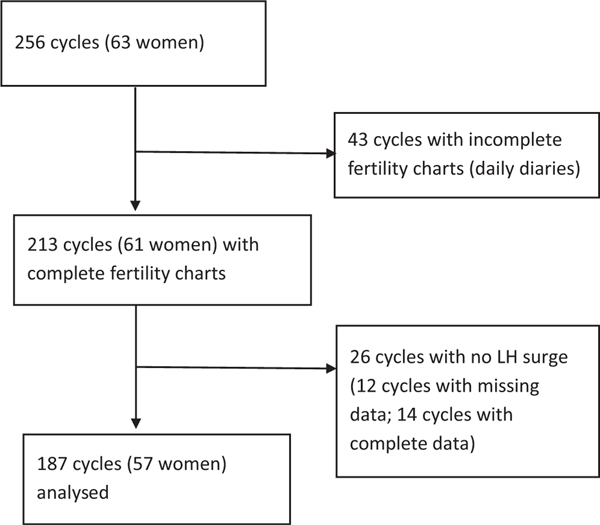
Results: Fifty-seven women with 187 complete cycles were included. A Peak Day was identified in 117 (63%) cycles by women, 185 (99%) cycles by experts, and 187 (100%) by computer algorithm. The woman-picked Peak Day was the same as the referent day in 25% of 117 cycles, within ±1 day in 58% of cycles, ±2 days in 84%, ±3 days in 87%, and ±4 days in 92%. The ±1 day and ± 4 days' agreement was 50% and 90% for the expert-picked and 47% and 87% for the computer-picked Peak Day, respectively.
Conclusions: Women's daily tracking of cervical mucus is a low-cost alternative for identifying the estimated day of ovulation.
Keywords: biomonitoring; cervical mucus; creighton model fertilitycare system; fertility; ovulation.
© 2020 John Wiley & Sons Ltd.
Conflict of interest statement
CONFLICT OF INTERESTS
Joseph B. Stanford has served as a scientific consultant for Swiss Precision Diagnostics GmbH, which manufactures the Clearblue™ Fertility Monitor. The other authors declare they have no conflict of interest.
References
-
- Colombo B, Masarotto G. Daily fecundability: first results from a new data base. Demogr Res. 2000;3:39. - PubMed
-
- Vollman RF. The menstrual cycle. In: Friedman EA ed. Major Problems in Obstetrics Gynecology. Philadelphia, PA: Saunders WB; 1977:7, 1–193. It is volume 7 of a series of monographs, titled, series editor. - PubMed
-
- Chandra A, Copen CE, Stephen EH. Infertility service use in the United States: data from the National Survey of Family Growth, 1982–2010. Natl Health Stat Report. 2014;73:1–21. - PubMed
Publication types
MeSH terms
Substances
Grants and funding
LinkOut - more resources
Full Text Sources
