


Scalable Hybrid Synthetic/Biocatalytic Route to Psilocybin
- PMID: 32101345
- PMCID: PMC7383583
- DOI: 10.1002/chem.202000134
Scalable Hybrid Synthetic/Biocatalytic Route to Psilocybin
Abstract
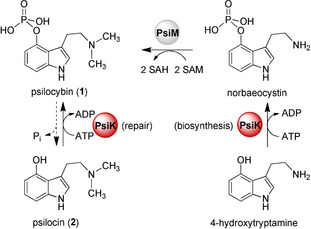
Psilocybin, the principal indole alkaloid of Psilocybe mushrooms, is currently undergoing clinical trials as a medication against treatment-resistant depression and major depressive disorder. The psilocybin supply for pharmaceutical purposes is met by synthetic chemistry. We replaced the problematic phosphorylation step during synthesis with the mushroom kinase PsiK. This enzyme was biochemically characterized and used to produce one gram of psilocybin from psilocin within 20 minutes. We also describe a pilot-scale protocol for recombinant PsiK that yielded 150 mg enzyme in active and soluble form. Our work consolidates the simplicity of tryptamine chemistry with the specificity and selectivity of enzymatic catalysis and helps provide access to an important drug at potentially reasonable cost.
Keywords: bioorganic chemistry; biosynthesis; enzymes; fermentation; kinase; phosphorylation.
© 2020 The Authors. Published by Wiley-VCH Verlag GmbH & Co. KGaA.
Conflict of interest statement
The authors declare no conflict of interest.
Figures
References
-
- None
-
- Hofmann A., Heim R., Brack A., Kobel H., Experientia 1958, 14, 107–109; - PubMed
-
- Hofmann A., Heim R., Brack A., Kobel H., Frey A., Ott H., Petrzilka T., Troxler F., Helv. Chim. Acta 1959, 42, 1557–1572.
-
- Geiger H. A., Wurst M. G., Daniels R. N., ACS Chem. Neurosci. 2018, 9, 2438–2447. - PubMed
-
- Vollenweider F. X., Kometer M., Nat. Rev. Neurosci. 2010, 11, 642–651. - PubMed
MeSH terms
Substances
Grants and funding
LinkOut - more resources
Full Text Sources
Other Literature Sources
Miscellaneous
