


Editorial
doi: 10.1165/rcmb.2020-0049ED.
"T"eeing Up A Novel Therapy for Lymphangioleiomyomatosis
Affiliations
- PMID: 32101457
- PMCID: PMC7258823
- DOI: 10.1165/rcmb.2020-0049ED
Item in Clipboard
Editorial
"T"eeing Up A Novel Therapy for Lymphangioleiomyomatosis
Am J Respir Cell Mol Biol.
2020 Jun.
No abstract available
Figures
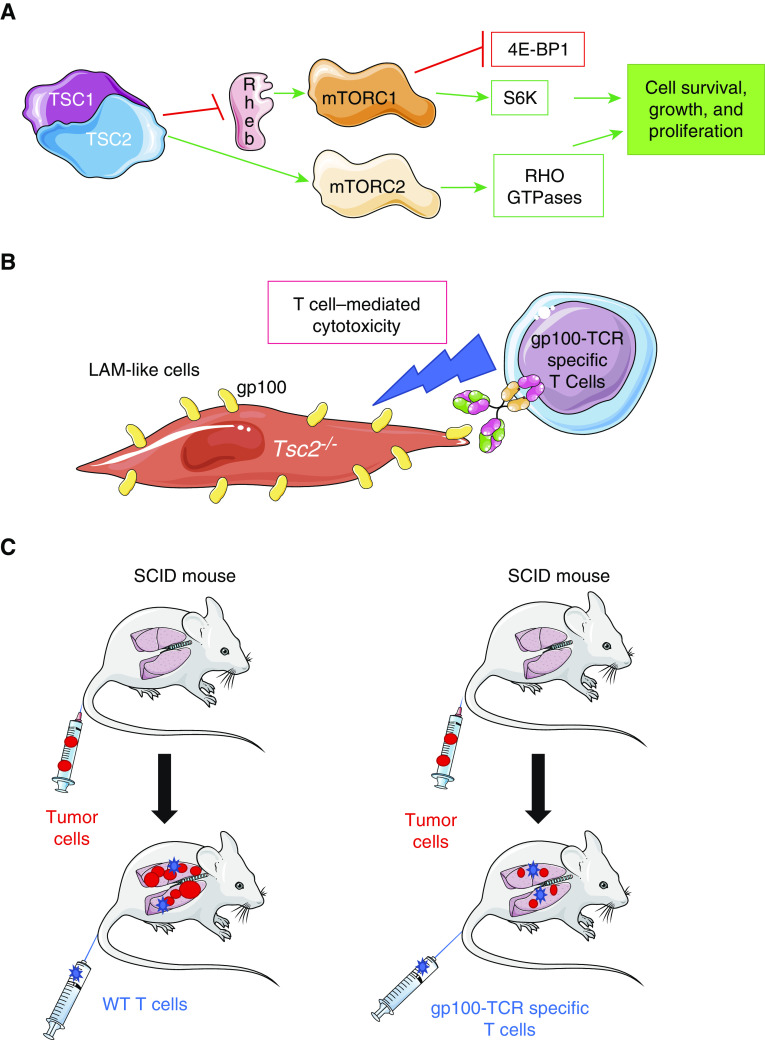
(A) mTOR is an important homeostatic factor that controls different cellular functions depending on how it is coupled. mTORC1 (mTOR complex 1) is composed of mTOR, raptor (a regulatory protein), and other complementary proteins. mTORC1 promotes cellular proliferation and growth by regulating the activity of other proteins, including 1) inhibiting eukaryotic translation initiation factor 4E-BP1 (4E-binding protein 1), which is a repressor of protein translation; and 2) activating S6K (S6 kinase), a serine/threonine-protein kinase that promotes cell proliferation and growth, and cell cycle progression. mTORC2 is composed of mTOR and rictor (a rapamycin-insensitive compound), and this complex promotes cell proliferation and migration, and cytoskeletal remodeling, in part by activating RHO GTPases. TSC (tuberous sclerosis complex) functions as an inhibitor of mTORC1. Loss-of-function mutations in the genes encoding two components of TSC (TSC1 [hamartin] and TSC2 [tuberin]) result in excessive activation of mTOR, the formation of lymphangioleiomyomatosis (LAM) cells, and the seeding and growth of these cells within the lungs and other organs, where they form tumors. (B) Han and colleagues transduced Tsc2-deficient kidney tumor cells with a lentiviral vector to induce high-level and stable expression of gp100 by the cells to generate LAM-like cells in vitro (Tsc2−/− gp100+ cells) (9). T cells expressing a TCR specific for gp100 protein were isolated from pmel-1 transgenic mice, and these T cells were shown to have cytotoxic activity against Tsc2−/− gp100+ LAM-like cells in vitro. (C) Severe combined immunodeficiency (SCID/beige) mice (which lack an adaptive immune response) were injected via the intravenous route with Tsc2−/− gp100+ LAM-like cells, and LAM-like tumors developed in the lungs of the mice over 1–2 weeks. One group of mice was then treated with a single dose of wild-type (WT) T cells, and another group of mice received gp100-TCR–specific T cells by the intravenous route. The group that received the gp100-TCR–specific T cells developed fewer and smaller lung lesions 3 weeks later than the group that was treated with WT T cells. gp100 = glycoprotein 100; Rheb = Ras homolog enriched in brain.
Comment on
-
Adoptive T-Cell Transfer to Treat Lymphangioleiomyomatosis.Am J Respir Cell Mol Biol. 2020 Jun;62(6):793-804. doi: 10.1165/rcmb.2019-0117OC. Am J Respir Cell Mol Biol. 2020. PMID: 32078336 Free PMC article.
References
-
- Johnson SR. Lymphangioleiomyomatosis. Eur Respir J. 2006;27:1056–1065. - PubMed
Publication types
MeSH terms
Grants and funding
LinkOut - more resources
Full Text Sources
Medical
