. 2020 Feb 24;25(4):996.
doi: 10.3390/molecules25040996.

Phytochemical Characterization and Chemotherapeutic Potential of Cinnamomum verum Extracts on the Multiplication of Protozoan Parasites In Vitro and In Vivo

Affiliations

Phytochemical Characterization and Chemotherapeutic Potential of Cinnamomum verum Extracts on the Multiplication of Protozoan Parasites In Vitro and In Vivo

Gaber El-Saber Batiha et al. Molecules. .

Abstract

Cinnamomum verum is a commonly used herbal plant that has several documented properties against various diseases. The existing study evaluated the inhibitory effect of acetonic extract of C. verum (AECV) and ethyl acetate extract of C. verum (EAECV) against piroplasm parasites in vitro and in vivo. The drug-exposure viability assay was tested on Madin-Darby bovine kidney (MDBK), mouse embryonic fibroblast (NIH/3T3) and human foreskin fibroblast (HFF) cells. Qualitative phytochemical estimation revealed that AECV and EAECV containing multiple bioactive constituents namely alkaloids, tannins, saponins, terpenoids and remarkable amounts of polyphenols and flavonoids. AECV and EAECV inhibited B. bovis, B. bigemina, B. divergens, B. caballi, and T. equi multiplication at half-maximal inhibitory concentrations (IC50) of 23.1 ± 1.4, 56.6 ± 9.1, 33.4 ± 2.1, 40.3 ± 7.5, 18.8 ± 1.6 µg/mL, and 40.1 ± 8.5, 55.6 ± 1.1, 45.7 ± 1.9, 50.2 ± 6.2, and 61.5 ± 5.2 µg/mL, respectively. In the cytotoxicity assay, AECV and EAECV affected the viability of MDBK, NIH/3T3 and HFF cells with half-maximum effective concentrations (EC50) of 440 ± 10.6, 816 ± 12.7 and 914 ± 12.2 µg/mL and 376 ± 11.2, 610 ± 7.7 and 790 ± 12.4 µg/mL, respectively. The in vivo experiment showed that AECV and EAECV were effective against B. microti in mice at 150 mg/kg. These results showed that C. verum extracts are potential antipiroplasm drugs after further studies in some clinical cases.

Keywords: Cinnamomum verum; antipiroplasm drugs; bioactive constituents; phytochemical estimation.


Conflict of interest statement

The authors declare that they have no competing interests.

Figures
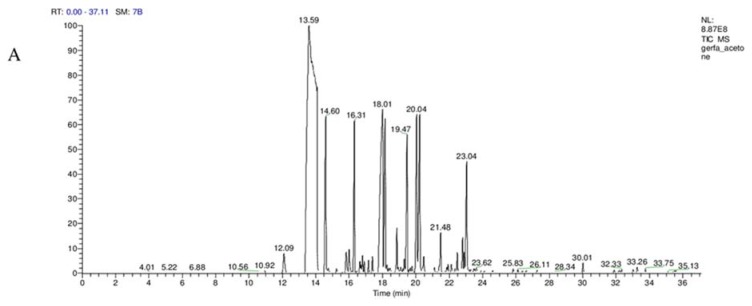
Figure 1
Figure 1
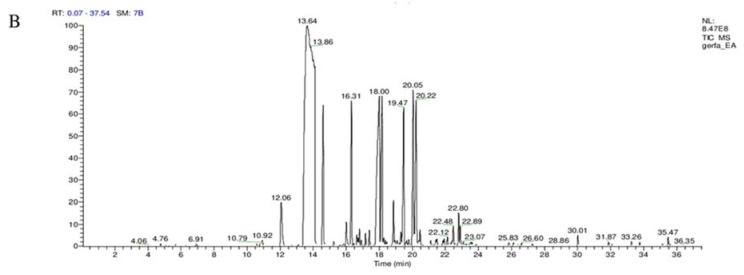
Gas chromatography-mass spectrometry analysis in the AECV (A) and EAECV (B).
Figure 1
Figure 1
Gas chromatography-mass spectrometry analysis in the AECV (A) and EAECV (B).
Figure 2
Figure 2
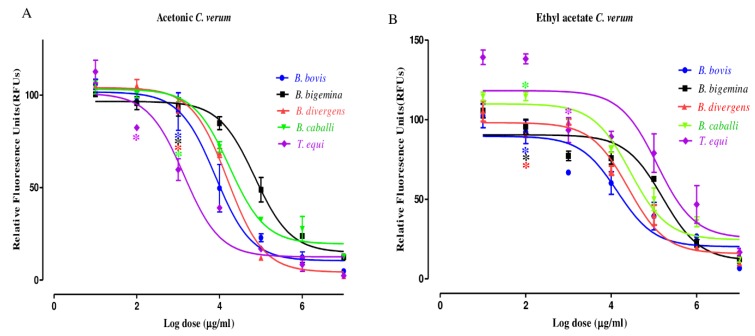
The dose-response curves acetonic extract of C. verum (AECV) (A) and ethyl acetate extract of C. verum (EAECV) (B) against Babesia and Theileria parasites in vitro. The curves showing the growth inhibition of B. bovis, B. bigemina, B. divergens, B. caballi and T. equi treated with various concentrations of AECV and EAECV. The result was determined by the fluorescence assay after 96 h of incubation. The values obtained from three separate trials were used to determine the IC50s using the non-linear regression (curve fit analysis) in GraphPad Prism software (GraphPad Software Inc. San Diego, CA, USA).
Figure 3
Figure 3
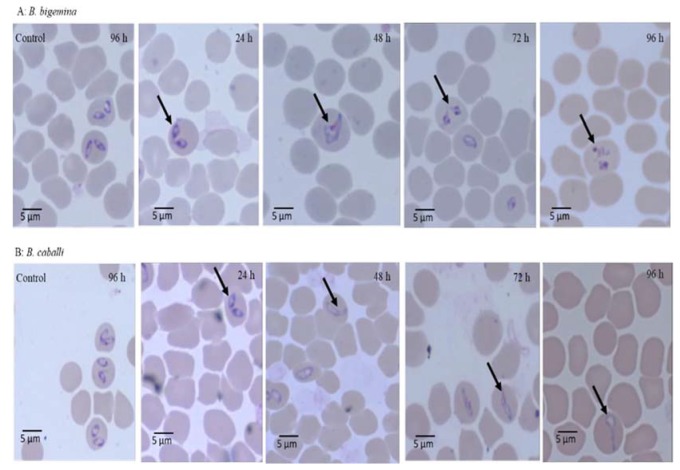
Morphological changes observed in ethyl acetate C. verum extract-treated B. bigemina and B. caballi. Light micrographs of ethyl acetate C. verum extract-treated B. bigemina and B. caballi in an in vitro culture taken after 24, 48, 72, and 96 h. The arrows show the spindle shapes of dividing parasites at 24 and 48 h, while at 72 and 96 h, dot-shaped remnants of dying parasites were observed as compared to the piriform shape of normal B. bigemina and B. caballi (control).
Figure 4
Figure 4
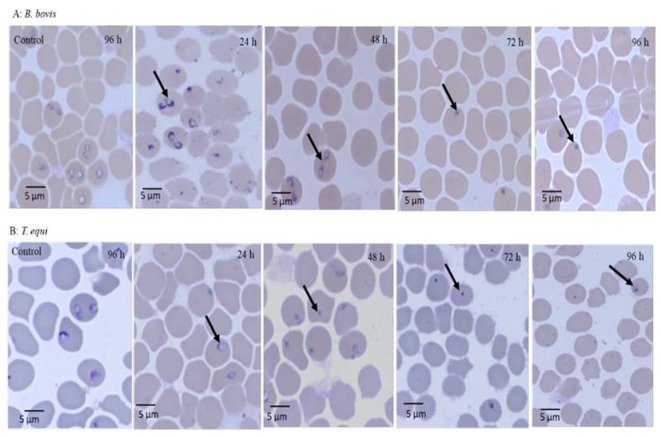
Morphological changes observed in acetonic C. verum extract-treated B. bovis and T. equi. Light micrographs of acetonic C. verum extract-treated B. bovis and T. equi in an in vitro culture taken after 24, 48, 72, and 96 h. B. bovis–treated parasites at 24 and 48 h appear spindle-shaped, while at 72 and 96 h, they appear dot-shaped as compared to the normal piriform shape of B. bovis (control). T. equi–treated parasites at 24 and 48 h appear smaller and pyknotic, while at 72 and 96 h, the dying parasites appeared dot-shaped as compared to the oval shape of T. equi (control).
Figure 5
Figure 5
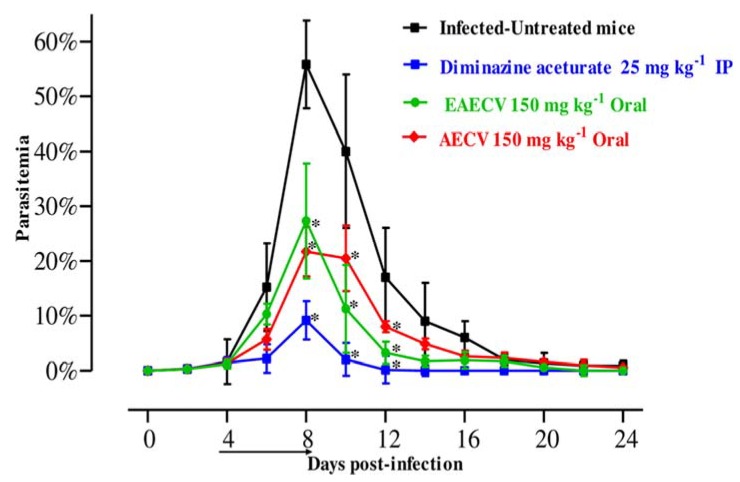
Growth inhibition of C. verum extracts on B. microti in mice. Inhibitory effect of C. verum extracts on the growth of B. microti in mice, based on observations taken from five mice per experimental group. EAECV, ethyl acetate C. verum extract; AECV, acetonic C. verum extract. The arrow indicates 5 consecutive days of treatment. Asterisks indicate statistically significant (p < 0.05) differences of parasitemia between treated groups and the untreated control group based on one-way ANOVA Tukey’s test, available in the GraphPad Prism software. Parasitemia was calculated by counting infected RBCs among 2000 RBCs using Giemsa-stained thin blood smears. The data were the mean and standard deviation from two separate experiments.
Figure 6
Figure 6
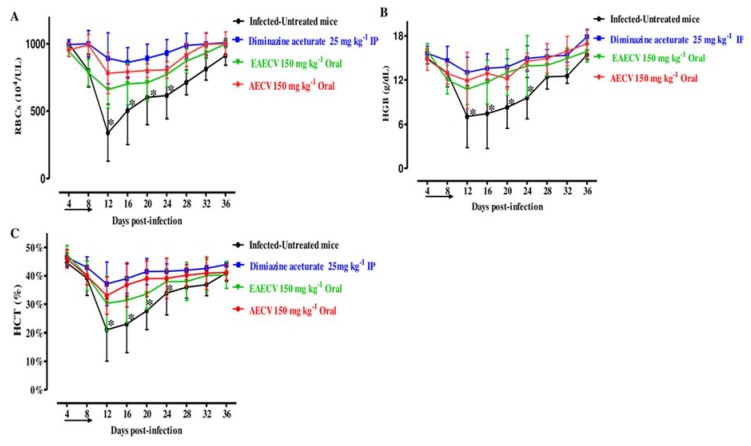
RBCs, hemoglobin, and hematocrit changes in C. verum extract-treated mice. Graphs showing changes in the number of red blood cells (RBCs) (A), hemoglobin concentration (HGB) (B), and hematocrit percentage (HCT) (C) in mice treated with diminazene aceturate and two C. verum extracts. EAECA, ethyl acetate C. verum extract; AECA, acetonic C. verum extract. The arrow indicates 5 consecutive days of treatment. Asterisks indicate statistical significance (p < 0.05) based on one-way ANOVA Tukey’s test, available in the GraphPad Prism software. The data were the mean and standard deviation from two separate experiments (five mice per group).

References

    1. Batiha G.-S., Beshbishy A.M., Adeyemi O.S., Nadwa E.H., Rashwan E.M., Alkazmi L.M., Elkelish A.A., Igarashi I. Phytochemical screening and antiprotozoal effects of the methanolic Berberis vulgaris and acetonic Rhus coriaria extracts. Molecules. 2020;25:550. doi: 10.3390/molecules25030550. - DOI - PMC - PubMed
    1. Beshbishy A.M., Batiha G.E.S., Alkazmi L., Nadwa E., Rashwan E., Abdeen A., Yokoyama N., Igarashi I. Therapeutic Effects of Atranorin towards the Proliferation of Babesia and Theileria Parasites. Pathogens. 2020;9:127. doi: 10.3390/pathogens9020127. - DOI - PMC - PubMed
    1. Uilenberg G. Babesia—A historical overview. Vet. Parasitol. 2006;138:3–10. doi: 10.1016/j.vetpar.2006.01.035. - DOI - PubMed
    1. Batiha G.E., El-Far A.H., El-Mleeh A.A., Alsenosy A.A., Abdelsamei E.K., Abdel-Daim M.M., El-Sayed Y.S., Shaheen H.M. In vitro study of ivermectin efficiency against the cattle tick, Rhipicephalus (Boophilus) annulatus, among cattle herds in El-Beheira, Egypt. Vet. World. 2019;12:1319–1326. doi: 10.14202/vetworld.2019.1319-1326. - DOI - PMC - PubMed
    1. Vial H.J., Gorenflot A. Chemotherapy against babesiosis. Vet. Parasitol. 2006;138:147–160. doi: 10.1016/j.vetpar.2006.01.048. - DOI - PubMed

MeSH terms

LinkOut - more resources