


The Impact of Population Aging and Public Health Support on EU Labor Markets
- PMID: 32102277
- PMCID: PMC7068414
- DOI: 10.3390/ijerph17041439
The Impact of Population Aging and Public Health Support on EU Labor Markets
Abstract
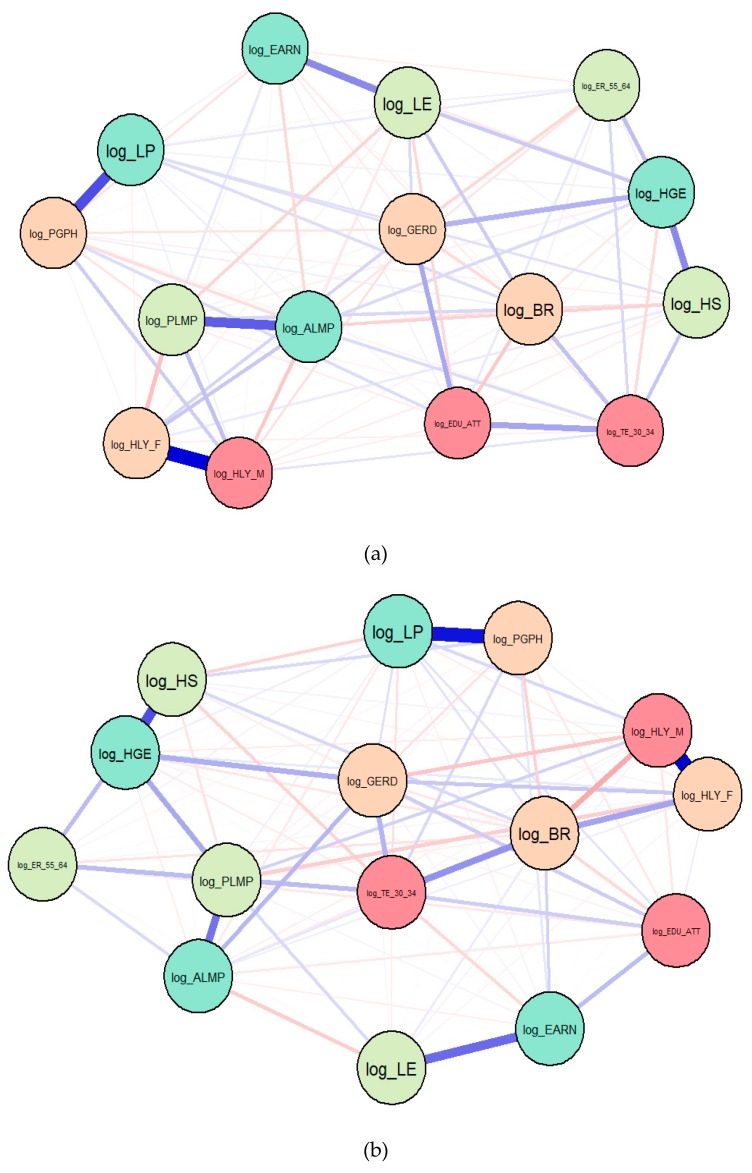
Population aging and public health expenditure mainly dedicated to older dependent persons present major challenges for the European Union (EU) Member States, with profound implications for their economies and labor markets. Sustainable economic development relies on a well-balanced workforce of young and older people. As this balance shifts in favor of older people, productivity tends to suffer, on the one hand, and the older group demands more from health services, on the other hand. These requisites tend to manifest differently within developed and developing EU countries. This research aimed to assess population aging impacts on labor market coordinates (employment rate, labor productivity), in the framework of several health dimensions (namely, health government expenditure, hospital services, healthy life years, perceived health) and other economic and social factors. The analytical approach consisted of applying structural equation models, Gaussian graphical models, and macroeconometric models (robust regression and panel corrected standard errors) to EU panel data for the years 1995-2017. The results show significant dissimilarities between developed and developing EU countries, suggesting the need for specific policies and strategies for the labor market integration of older people, jointly with public health expenditure, with implications for EU labor market performance.
Keywords: European Union; econometric procedures; health expenditure; labor market policies; labor productivity; older workers.
Conflict of interest statement
The authors declare no conflicts of interest.
Figures
References
-
- Börsch-Supan A., Chiappori P.A. Aging population: Problems and policy options in the US and Germany. Econ. Policy. 1991;6:104–139. doi: 10.2307/1344450. - DOI
-
- Coleman D. Population ageing: An unavoidable future. In: Pierson C., Castles F.G., editors. The Welfare State Reader. 2nd ed. Polity Press; Cambridge, UK: Malden, MA, USA: 2006. pp. 298–308.
-
- Káčerová M., Mladek J. Population ageing as generation substitutions: Economic and social aspects. Ekon. Cas. 2012;60:259–276.
-
- Cristea M., Mitrica A. Global ageing: Do privately managed pension funds represent a long term alternative for the Romanian Pension system? Empirical research. Rom. J. Polit. Sci. 2016;16:63–106.
-
- Song J., Ryu D. Aging effects on consumption risk-sharing channels in European countries. Zb. Rad. Ekon. Fak. U Rijeci Časopis Za Ekon. Teor. Praksu. 2018;36:585–617.
Publication types
MeSH terms
LinkOut - more resources
Full Text Sources
Research Materials
