


Assessing the Impact of Reduced Travel on Exportation Dynamics of Novel Coronavirus Infection (COVID-19)
- PMID: 32102279
- PMCID: PMC7073579
- DOI: 10.3390/jcm9020601
Assessing the Impact of Reduced Travel on Exportation Dynamics of Novel Coronavirus Infection (COVID-19)
Abstract
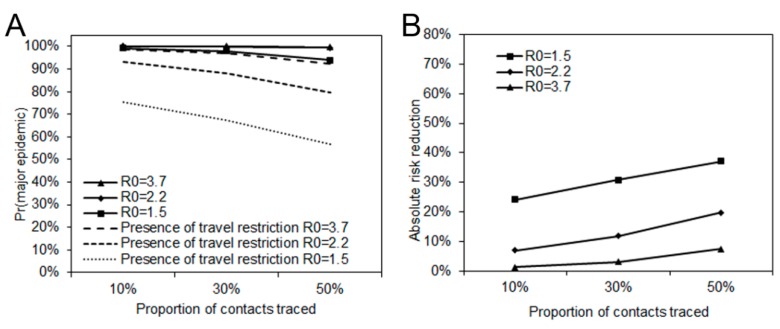
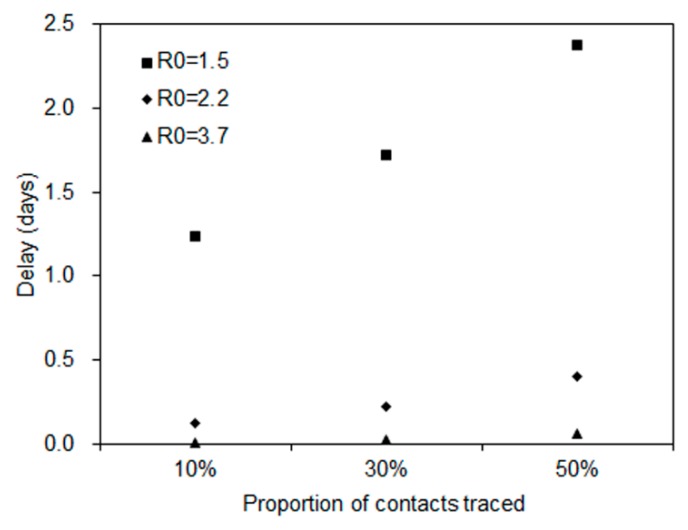
The impact of the drastic reduction in travel volume within mainland China in January and February 2020 was quantified with respect to reports of novel coronavirus (COVID-19) infections outside China. Data on confirmed cases diagnosed outside China were analyzed using statistical models to estimate the impact of travel reduction on three epidemiological outcome measures: (i) the number of exported cases, (ii) the probability of a major epidemic, and (iii) the time delay to a major epidemic. From 28 January to 7 February 2020, we estimated that 226 exported cases (95% confidence interval: 86,449) were prevented, corresponding to a 70.4% reduction in incidence compared to the counterfactual scenario. The reduced probability of a major epidemic ranged from 7% to 20% in Japan, which resulted in a median time delay to a major epidemic of two days. Depending on the scenario, the estimated delay may be less than one day. As the delay is small, the decision to control travel volume through restrictions on freedom of movement should be balanced between the resulting estimated epidemiological impact and predicted economic fallout.
Keywords: emerging infectious diseases; imported case; migration; quarantine; travel.
Conflict of interest statement
The authors declare no conflicts of interest.
Figures
References
-
- World Health Organization Novel Coronavirus—China, 2020. [(accessed on 11 February 2020)]; Available online: https://www.who.int/csr/don/12-january-2020-novel-coronavirus-china/en/
-
- World Health Organization Novel Coronavirus (2019-nCoV) Situation Report-21, 2020. [(accessed on 11 February 2020)]; Available online: https://www.who.int/docs/default-source/coronaviruse/situation-reports/2....
-
- Center for Disease Central and Prevention 2019 Novel Coronavirus, Wuhan, China, 2020. [(accessed on 11 February 2020)]; Available online: https://www.cdc.gov/coronavirus/2019-nCoV/summary.html.
-
- Chan F.J., Yuan S., Kok K.H., To K.K., Chu H., Yang J., Xing F., Liu J., Yip C.C., Poon R.W., et al. A familial cluster of pneumonia associated with the 2019 novel coronavirus indicating person-to-person transmission: A study of a family cluster. Lancet. 2020 doi: 10.1016/S0140-6736(20)30154-9. (In Press) - DOI - PMC - PubMed
Grants and funding
- JP18fk0108050/Japan Agency for Medical Research and Development
- H.N.: 17H04701, 17H05808, 18H04895 and 19H01074; R.K.: 18J21587; AS.: 19K24159/Japan Society for the Promotion of Science
- NA/Inamori Foundation
- JPMJCR1413/Core Research for Evolutional Science and Technology
- NA/Ministry of Education, Culture, Sports, Science and Technology
LinkOut - more resources
Full Text Sources
Research Materials
