


Frequent Karaoke Training Improves Frontal Executive Cognitive Skills, Tongue Pressure, and Respiratory Function in Elderly People: Pilot Study from a Randomized Controlled Trial
- PMID: 32102472
- PMCID: PMC7068312
- DOI: 10.3390/ijerph17041459
Frequent Karaoke Training Improves Frontal Executive Cognitive Skills, Tongue Pressure, and Respiratory Function in Elderly People: Pilot Study from a Randomized Controlled Trial
Abstract
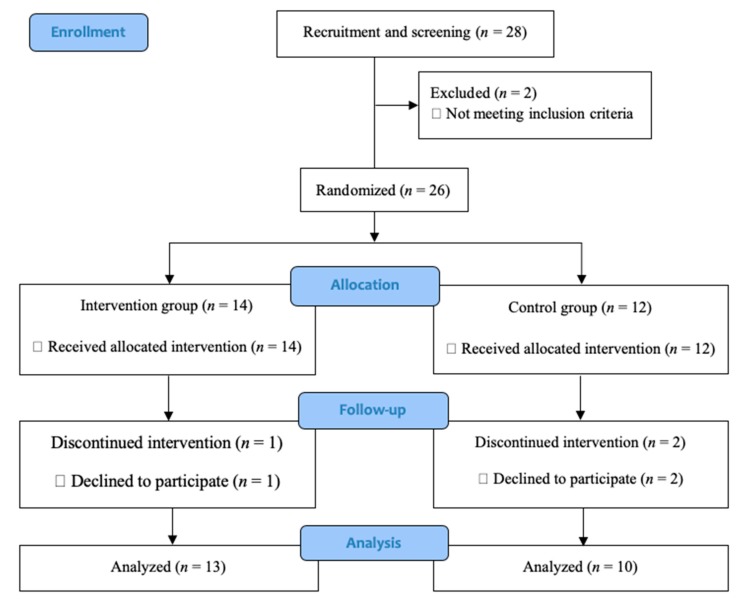
We tested whether karaoke training improves cognitive skills and reduces the risk of physical function impairments. We conducted a single-blinded randomized controlled trial in 26 elderly participants at residential care facilities, who were generally healthy or required the lowest level of care. Participants were near the threshold for mild cognitive impairment with the Montreal Cognitive Assessment (MoCA) and close to the sarcopenia cut-off with the skeletal muscle mass index. Pulmonary function as measured with spirometry and tongue strength were used as markers for physical functions affected by sarcopenia. Karaoke training occurred once a week for two hours, with an hour of homework assigned weekly. Karaoke training significantly improved the Frontal Assessment Battery at bedside (FAB) compared with an active control group receiving scratch art training (F = 8.04, permutation p-value = 0.013). Subscore improved with inhibitory control (F = 7.63, permutation p-value = 0.015) and sensitivity to interference (F = 11.98, permutation p-value = 0.001). We observed improved tongue pressure (F = 4.49, permutation p-value = 0.040) and pulmonary function by a greater increase in FIV1 (F = 5.22, permutation p-value = 0.047). Engaging elderly people, especially those in care homes, with karaoke training exercises that are moderately physically challenging may be a key to slowing cognitive decline and preventing dysphagia by sarcopenia.
Keywords: cognitive training; elderly; frontal executive functioning; karaoke; randomized controlled trial; respiratory function; sarcopenia; tongue pressure.
Conflict of interest statement
PDMHD Co., LTD. developed The Karaoke Book. Funding sources for the trial were not involved in the study design, collection, analysis, interpretation of data, or writing of papers. AM derives no income from PDMHD Co. Ltd. and has no other competing interests. All other authors have declared no competing interests.
Figures
References
-
- Mosconi L., Tsui W.H., Herholz K., Pupi A., Drzezga A., Lucignani G., Reiman E.M., Holthoff V., Kalbe E., Sorbi S., et al. Multicenter standardized 18F-FDG PET diagnosis of mild cognitive impairment, Alzheimer’s disease, and other dementias. J. Nucl. Med. 2008;49:390–398. doi: 10.2967/jnumed.107.045385. - DOI - PMC - PubMed
-
- Heyn P., Abreu B.C., Ottenbacher K.J. The effects of exercise training on elderly persons with cognitive impairment and dementia: A meta-analysis. Arch. Phys. Med. Rehabil. 2004;85:1694–1704. - PubMed
Publication types
MeSH terms
LinkOut - more resources
Full Text Sources
