Review
. 2020 Jun;69(6):1127-1138.
doi: 10.1136/gutjnl-2019-318843. Epub 2020 Feb 26.

Albumin in decompensated cirrhosis: new concepts and perspectives

Affiliations
Review

Albumin in decompensated cirrhosis: new concepts and perspectives

Mauro Bernardi et al. Gut. 2020 Jun.

Abstract

The pathophysiological background of decompensated cirrhosis is characterised by a systemic proinflammatory and pro-oxidant milieu that plays a major role in the development of multiorgan dysfunction. Such abnormality is mainly due to the systemic spread of bacteria and/or bacterial products from the gut and danger-associated molecular patterns from the diseased liver triggering the release of proinflammatory mediators by activating immune cells. The exacerbation of these processes underlies the development of acute-on-chronic liver failure. A further mechanism promoting multiorgan dysfunction and failure likely consists with a mitochondrial oxidative phosphorylation dysfunction responsible for systemic cellular energy crisis. The systemic proinflammatory and pro-oxidant state of patients with decompensated cirrhosis is also responsible for structural and functional changes in the albumin molecule, which spoil its pleiotropic non-oncotic properties such as antioxidant, scavenging, immune-modulating and endothelium protective functions. The knowledge of these abnormalities provides novel targets for mechanistic treatments. In this respect, the oncotic and non-oncotic properties of albumin make it a potential multitarget agent. This would expand the well-established indications to the use of albumin in decompensated cirrhosis, which mainly aim at improving effective volaemia or preventing its deterioration. Evidence has been recently provided that long-term albumin administration to patients with cirrhosis and ascites improves survival, prevents complications, eases the management of ascites and reduces hospitalisations. However, variant results indicate that further investigations are needed, aiming at confirming the beneficial effects of albumin, clarifying its optimal dosage and administration schedule and identify patients who would benefit most from long-term albumin administration.

Keywords: liver cirrhosis.


Conflict of interest statement

Competing interests: PG is recipient of an ICREA Academia Award. MB: personal fees from CLS Behring GmbH, personal fees from Grifols SA, personal fees from Takeda, personal fees from Martin Pharmaceuticals, personal fees from PPTA, personal fees from Octapharma, outside the submitted work. PA: personal fees from Grifols, grants from CLS Behring, outside the submitted work. PG: grants and personal fees from GILEAD, grants and personal fees from Mallinckrodt, grants and personal fees from Grifols, personal fees from Intercept, personal fees from Martin Phamaceuticals, personal fees from Sequana, personal fees from Promethera, outside the submitted work. RJ: other from Yaqrit Limited, grants from Takeda, other from Kaleido, from Akaza, from Mallinkrodt, other from Prometic, grants and other from Theoris, during the conduct of the study; other from Yaqrit Limited, grants from Takeda, other from Kaleido, other from Akaza, other from Prometic, other from Mallinkrodt, grants and other from Theoris, outside the submitted work. PC: personal fees from Grifols SA, grants and personal fees from Octapharma SA, personal fees from Kedrion SpA, personal fees from Takeda SA, personal fees from Alphasigma SA, outside the submitted work. JF: personal fees and other from Grifols, outside the submitted work. ALG: personal fees from CLS Behring, personal fees from Grifols, outside the submitted work. JT: personal fees from Gore, personal fees from Bayer, personal fees from Alexion, personal fees from MSD, personal fees from Gilead, personal fees from Intercept, personal fees from Norgine, personal fees from Grifols, personal fees from Versantis, personal fees from Martin Pharmaceutical outside submitted work. VA: personal fees from Grifols, outside the submitted work; VA has a patent 'method for diagnostic and/or prognostic of acute on-chronic liver failure syndrome in patients with liver disorders' pending.

Figures
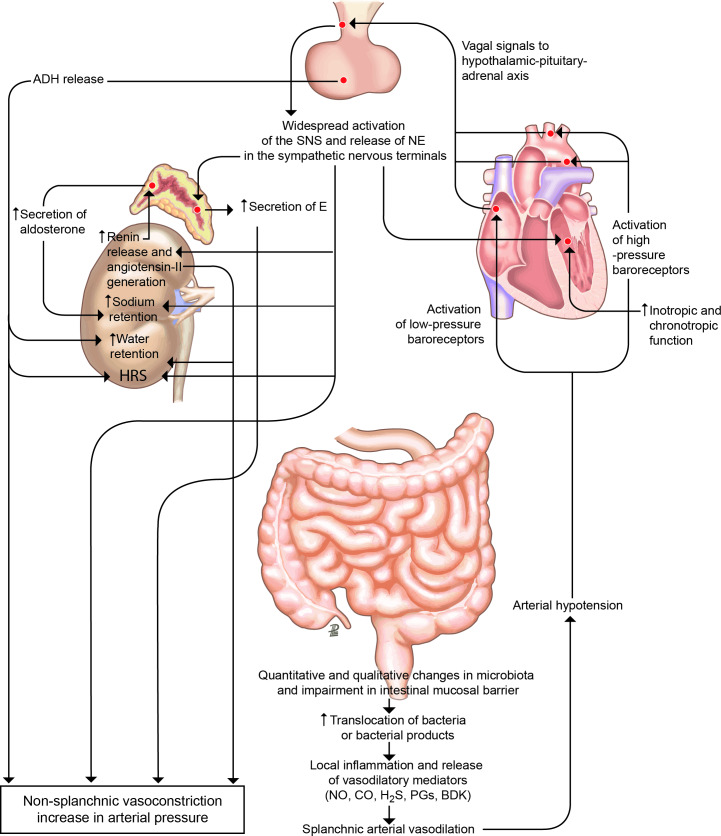
Figure 1
Figure 1
Peripheral arterial vasodilation hypothesis. In patients with cirrhosis and portal hypertension, a peripheral arterial vasodilation, mainly occurring in the splanchnic circulatory area, endangers effective volaemia. Qualitative and quantitative changes in the intestinal microbiota and impairment in intestinal mucosal barrier, translocation of bacteria or bacterial products, and local inflammation and release of inflammatory vasoactive mediators is likely the initial sequence of events leading to splanchnic arterial vasodilation in cirrhosis. With the progression of the disease, bacterial translocation increases, inflammation become systemic and effective hypovolaemia worsens. Activation of the hypothalamic–pituitary–adrenal axis, widespread release of norepinephrine (NE) in the sympathetic nervous system terminals, increased adrenal secretion of epinephrine (E), activation of the renin–aldosterone system and increased release of antidiuretic hormone (ADH) are the main homeostatic responses to restore arterial pressure, leading to renal fluid retention, which accumulates as ascites, dilutional hyponatraemia and hepatorenal syndrome (HRS) as the most relevant consequences. The well-established indications for the use of albumin in patients with decompensated cirrhosis rely on this pathophysiological background and mainly aim at restoring effective volaemia. No, CO, H2S, PGs and BDK are the abbreviations of nitric oxide, carbon oxide, hydrogen sulfide, prostaglandins and bradykinin, respectively. SNS, sympathetic nervous system.
Figure 2
Figure 2
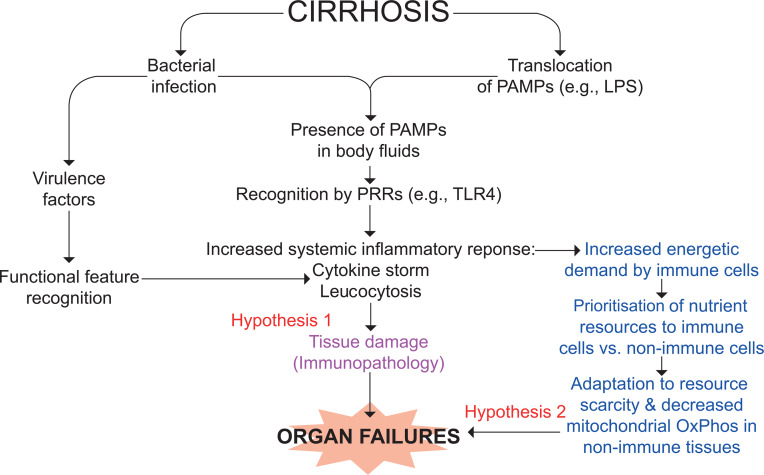
Working hypothesis for the mechanisms of organ failures in ACLF. Pathogen-associated molecular patterns (PAMPS; eg, lipopolysaccharide (LPS)) are specifically recognised by pattern-recognition receptors (PRRs; eg, Toll-like receptor (TLR) 4 for LPS) expressed in innate immune cells and epithelial cells.This process is called structural feature recognition. Damage-associated molecular patterns (DAMPs; eg, high mobility group box 1 (HMGB1), S100A8 (MRP8, calgranulin A) and S100A9 (MRP14, calgranulin B)), are molecules resulting from stressed cells that, once released, follow a similar path. PAMPs are either released by an infecting alive bacterium or ‘translocated’ from the gut lumen to blood, while DAMPs are released from tissues where necroptosis and pyroptosis take place (liver and extrahepatic organs (not shown)). Whichever the origin of these molecular patterns, their recognition by PRRs results in the production of a broad variety of inflammatory molecules (cytokines, chemokines and lipids), vasodilators and of reactive oxygen species, particularly in phagocytes. Intense systemic inflammation may cause collateral tissue damage (a process called immunopathology) and subsequently organ failures (hypothesis 1). Extrahepatic tissue damage can result in the release of DAMPs, which may perpetuate or accentuate PAMP-initiated and DAMP-initiated systemic inflammatory response (not shown). Systemic inflammation is energetically expensive, and the immune tissue can be prioritised for nutrient allocation at the expense of vital non-immune tissues. These may adapt to nutrient scarcity by reducing mitochondrial oxidative phosphorylation (OxPhos) and therefore ATP production, which would contribute to the development of organ failures (hypothesis 2). Of note, the two hypotheses are not mutually exclusive. ACLF, acute-on-chronic liver failure.
Figure 3
Figure 3
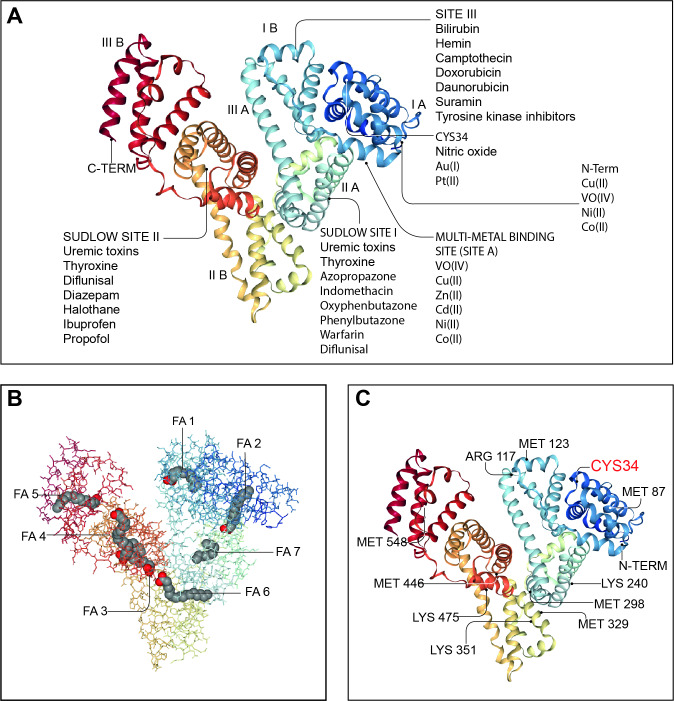
Endogenous and exogenous binding sites in the albumin molecule. Many of the physiological functions of human serum albumin rely on its ability to reversibly bind to an extremely wide range of ligands to increase their solubility in plasma, to transport them to specific tissues or organs or to dispose of them when they are toxic. Since ligands are frequently biologically active, albumin also modulates their pathophysiological effects. Panel A: molecular structure of human serum albumin with an indication of its subdomains (IA, IB, IIA, IIB, IIIA and IIIB), of the N and C termini and the main endogenous and exogenous compounds binding sites including the Sudlow’s sites I and II, the site III, the multimetal binding site (site A) and the CYS34 site. Panel B: albumin molecule shows seven long-chain fatty acid (FA) binding sites (FA1–FA7). In addition to transporting FAs, these sites also transport and inactivate biological active lipids involved in systemic inflammation including prostaglandins and PAMPs (lipopolysaccharide and lipoteichoic acid). Panel C: albumin is the most important regulator of extracellular oxidative stress and presents many binding sites for reactive oxidative species. The most important binding site is the Cys-34 residue, which can be reversible or irreversible oxidised giving rise to two molecular forms of oxidised albumin (HNA1 and HNA2). Albumin images from: RCSB PDB (rcsb.org) of PDB ID 1E7I. PAMPs, pathogen-associated molecular patterns.
Figure 4
Figure 4
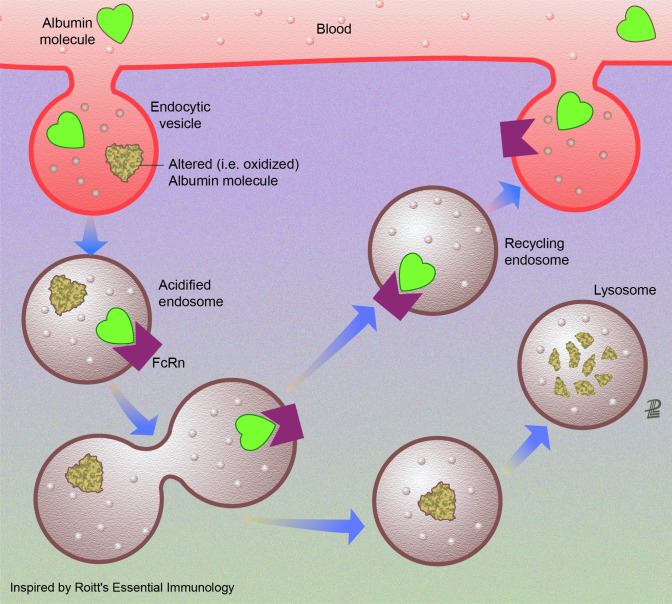
Albumin recycling by endothelial cells. Endothelial cell recycling is the mechanism maintaining high concentrations of healthy albumin within the systemic circulation. Albumin is synthesised by the liver and rapidly released to the intravascular compartment. The total amount of albumin in humans is approximately 360 g, 120 g being in the intravascular and 240 g in the extravascular compartment. intravascular albumin is constantly being exchanged (4%–5%/hour through the endothelium with the extravascular pool. In organs having sinusoids or capillaries with fenestrated endothelium, albumin can pass through the large capillary gaps. In the remaining capillaries with continuous endothelium, albumin is transported by an active transcytotic mechanism mediated by the gp60 receptor albondin (not shown). There is a second group of receptors (gp18 and gp30) expressed in many tissues that governs degradation of albumin. These surface cell receptors (not drawn in the figure) show 1000-fold higher affinity for chemically modified albumin (ie, oxidised albumin). Once internalised, this modified albumin is degraded in the lysosomes. Finally, a third type of albumin receptor (FcRn) that rescues albumin from lysosomal degradation contributes to extend the albumin half-life. The low endosomal pH promotes the link of healthy albumin and FcRn in the acidified endosome. When the recycling endosome contacts the higher plasma pH, healthy albumin is released to the systemic circulation.
Figure 5
Figure 5
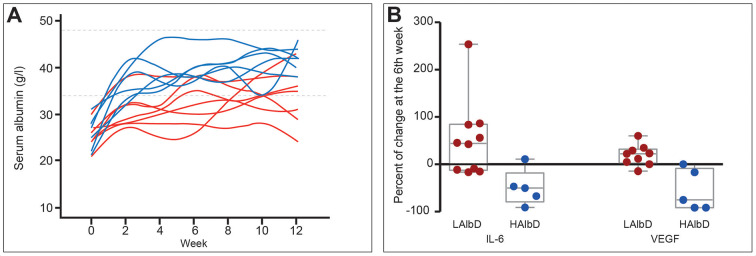
Effect of long-term albumin treatment on serum albumin concentration and inflammatory cytokines. Albumin was given at high dosage (HAlbD: 1.5 g/kg body weight (BW) every week) or low dosage (LAlbD: 1 g/kg BW every 2 weeks) during 12 weeks to two groups of patients with decompensated cirrhosis. High albumin but not low albumin dosage was associated with normalisation of serum albumin concentration and significant decrease in the plasma levels of the inflammatory cytokines interleukin-6 (IL-6) and vascular endothelial growth factor (VEGF). This figure was published in gastroenterology, vol 157, Fernández J et al, Effects of albumin treatment on systemic and portal haemodynamics and systemic inflammation in patients with decompensated cirrhosis, page 149, Copyright Elsevier (2019).

References

    1. Rockey DC, Bell PD, Hill JA. Fibrosis – a common pathway to organ injury and failure. N Engl J Med 2015;372:1138–49. 10.1056/NEJMra1300575 - DOI - PubMed
    1. Ginès P, Graupera I, Lammert F, et al. Screening for liver fibrosis in the general population: a call for action. Lancet Gastroenterol Hepatol 2016;1:256–60. 10.1016/S2468-1253(16)30081-4 - DOI - PubMed
    1. de Franchis R, Baveno V Faculty . Revising consensus in portal hypertension: report of the Baveno V consensus workshop on methodology of diagnosis and therapy in portal hypertension. J Hepatol 2010;53:762–8. 10.1016/j.jhep.2010.06.004 - DOI - PubMed
    1. Ginés P, Quintero E, Arroyo V, et al. Compensated cirrhosis: natural history and prognostic factors. Hepatology 1987;7:122–8. 10.1002/hep.1840070124 - DOI - PubMed
    1. Ginès P, Solà E, Angeli P, et al. Hepatorenal syndrome. Nat Rev Dis Primers 2018;4:23 10.1038/s41572-018-0022-7 - DOI - PubMed