


Formulation of self-nanoemulsifying drug delivery systems containing monoacyl phosphatidylcholine and Kolliphor® RH40 using experimental design
- PMID: 32104428
- PMCID: PMC7037638
- DOI: 10.1016/j.ajps.2017.09.006
Formulation of self-nanoemulsifying drug delivery systems containing monoacyl phosphatidylcholine and Kolliphor® RH40 using experimental design
Abstract
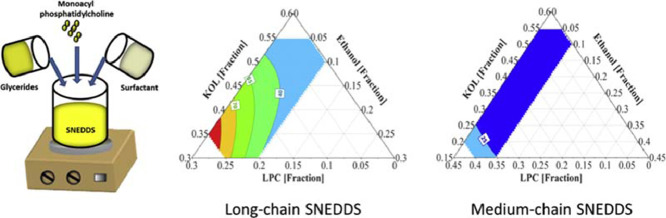
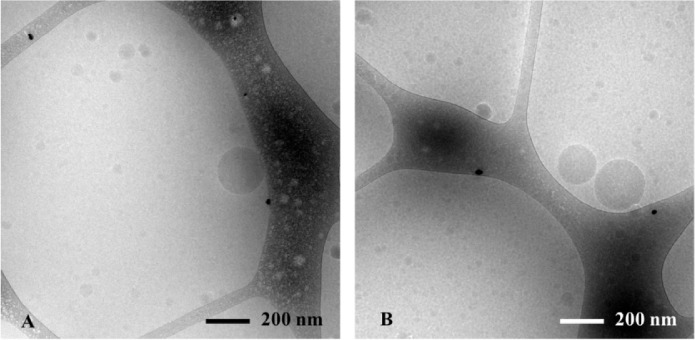
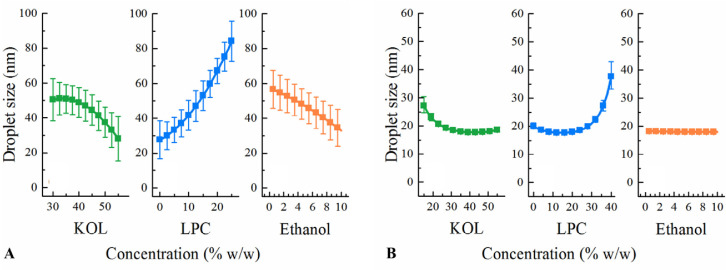
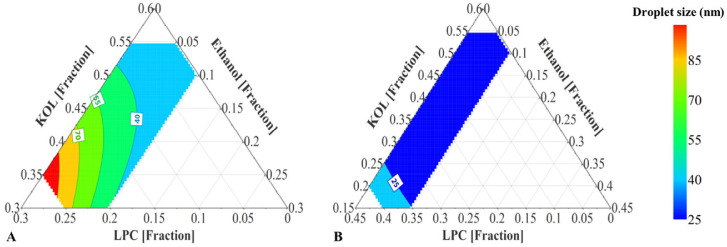
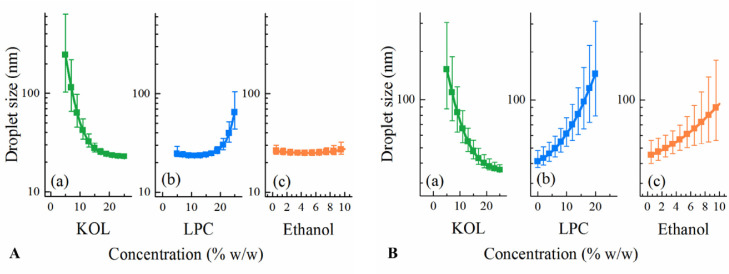
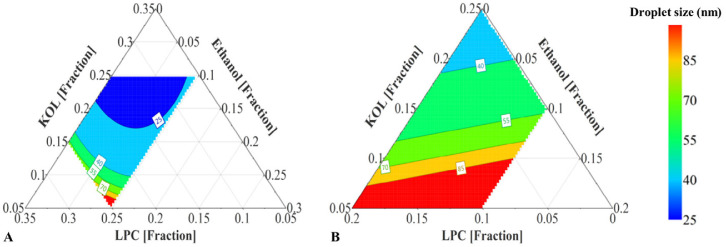
The development of self-nanoemulsifying drug delivery systems (SNEDDS) to enhance the oral bioavailability of lipophilic drugs is usually based on traditional one-factor-at-a-time approaches. These approaches may be inadequate to analyse the effect of each excipient and their potential interactions on the emulsion droplet size formed when dispersing the SNEDDS in an aqueous environment. The current study investigates the emulsion droplet sizes formed from SNEDDS containing different levels of the natural surfactant monoacyl phosphatidylcholine to reduce the concentration of the synthetic surfactant polyoxyl 40 hydrogenated castor oil (Kolliphor® RH40). Monoacyl phosphatidylcholine was used in the form of Lipoid S LPC 80 (LPC, containing approximately 80% monoacyl phosphatidylcholine, 13% phosphatidylcholine and 4% concomitant components). The investigated SNEDDS comprised of long-chain or medium-chain glycerides (40% to 75%), Kolliphor® RH40 (5% to 55%), LPC (0 to 40%) and ethanol (0 to 10%). D-optimal design, multiple linear regression, and partial least square regression were used to screen different SNEDDS within the investigated excipient ranges and to analyse the effect of each excipient on the resulting droplet size of the dispersed SNEDDS measured by dynamic light scattering. All investigated formulations formed nano-emulsions with droplet sizes from about 20 to 200 nm. The use of medium-chain glycerides was more likely to result in smaller and more monodisperse droplet sizes compared to the use of long-chain glycerides. Kolliphor® RH40 exhibited the most significant effect on reducing the emulsion droplet sizes. Increasing LPC concentration increased the emulsion droplet sizes, possibly because of the reduction of Kolliphor® RH40 concentration. A higher concentration of ethanol resulted in an insignificant reduction of the emulsion droplet size. The study provides different ternary diagrams of SNEDDS containing LPC and Kolliphor® RH40 as a reference for formulation developers.
Keywords: Cryogenic transmission electron microscopy; D-optimal design; Droplet size; Monoacyl phosphatidylcholine; Polyoxyl 40 hydrogenated castor oil (Kolliphor® RH40); Self-nanoemulsifying drug delivery systems.
© 2017 Shenyang Pharmaceutical University. Published by Elsevier B.V.
Conflict of interest statement
The authors declare no conflict of interest.
Figures
References
-
- Stegemann S., Leveiller F., Franchi D. When poor solubility becomes an issue: from early stage to proof of concept. Eur J Pharm Sci. 2007;31:249–261. - PubMed
-
- Müllertz A., Ogbonna A., Ren S. New perspectives on lipid and surfactant based drug delivery systems for oral delivery of poorly soluble drugs. J Pharm Pharmacol. 2010;62:1622–1636. - PubMed
-
- Aungst B.J. Intestinal permeation enhancers. J Pharm Sci. 2000;89:429–442. - PubMed
-
- Kovarik J.M., Mueller E.A., Van Bree J.B. Reduced inter- and intraindividual variability in cyclosporine pharmacokinetics from a microemulsion formulation. J Pharm Sci. 1994;83:444–446. - PubMed
LinkOut - more resources
Full Text Sources
