Review
. 2020 Feb 10:2020:7901270.
doi: 10.1155/2020/7901270. eCollection 2020.

Central Role of Oxidative Stress in Age-Related Macular Degeneration: Evidence from a Review of the Molecular Mechanisms and Animal Models

Affiliations
Review

Central Role of Oxidative Stress in Age-Related Macular Degeneration: Evidence from a Review of the Molecular Mechanisms and Animal Models

Samuel Abokyi et al. Oxid Med Cell Longev. .

Abstract

Age-related macular degeneration (AMD) is a common cause of visual impairment in the elderly. There are very limited therapeutic options for AMD with the predominant therapies targeting vascular endothelial growth factor (VEGF) in the retina of patients afflicted with wet AMD. Hence, it is important to remind readers, especially those interested in AMD, about current studies that may help to develop novel therapies for other stages of AMD. This study, therefore, provides a comprehensive review of studies on human specimens as well as rodent models of the disease, to identify and analyze the molecular mechanisms behind AMD development and progression. The evaluation of this information highlights the central role that oxidative damage in the retina plays in contributing to major pathways, including inflammation and angiogenesis, found in the AMD phenotype. Following on the debate of oxidative stress as the earliest injury in the AMD pathogenesis, we demonstrated how the targeting of oxidative stress-associated pathways, such as autophagy and nuclear factor erythroid 2-related factor 2 (Nrf2) signaling, might be the futuristic direction to explore in the search of an effective treatment for AMD, as the dysregulation of these mechanisms is crucial to oxidative injury in the retina. In addition, animal models of AMD have been discussed in great detail, with their strengths and pitfalls included, to assist inform in the selection of suitable models for investigating any of the molecular mechanisms.


Conflict of interest statement

The authors declare no conflict of interest.

Figures
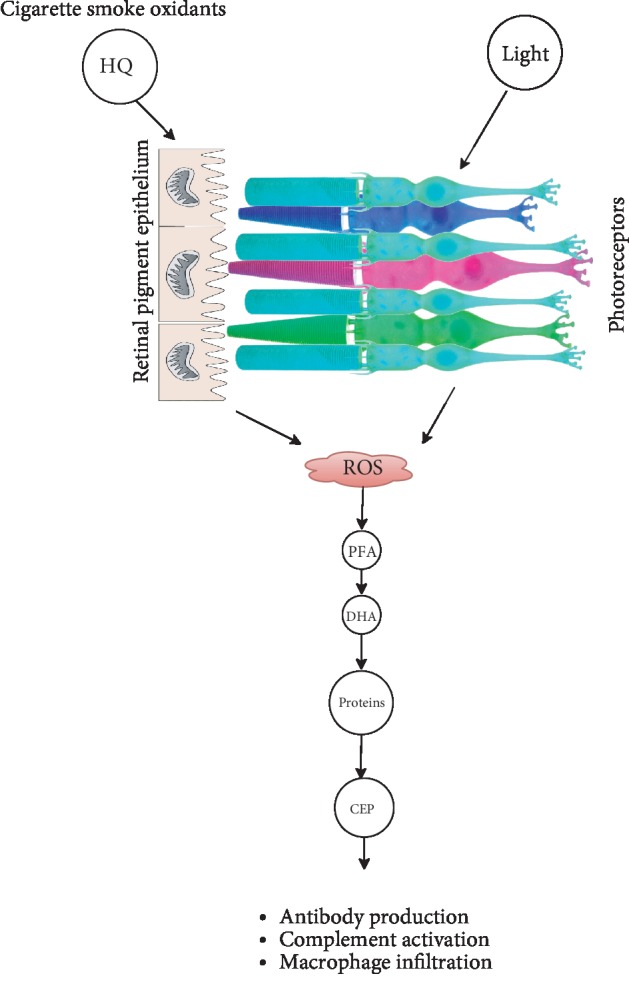
Figure 1
Figure 1
Molecular mechanism in oxidative stress-induced retinal degeneration in mice. ROS levels increase in the retina following (1) exposure to the cigarette smoke prooxidant, hydroquinone (HQ), causing mitochondrial damage in the RPE, and (2) retinal illumination resulting in the photoactivation of rhodopsin. A chain of reactions results in the formation of the carboxyethylpyrrole (CEP) from the docosahexaenoic acid (DHA), a polyunsaturated fatty acid content (PFA) constituent in the retina. CEP is immunogenic, leading to an inflammatory response.
Figure 2
Figure 2
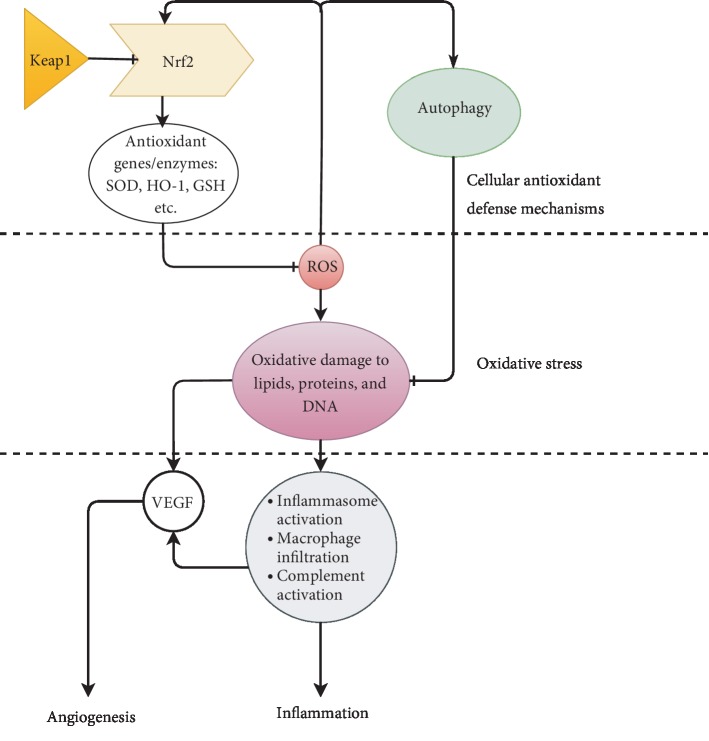
The interrelationships between the molecular mechanisms involved in AMD show the potential therapeutic role of autophagy and Nrf2 activation in the disease. Oxidative damage to lipids, proteins, and DNA is seemingly the primary insult leading to age-related macular degeneration. The accumulation of lipids due to an inhibition of lipid metabolism promotes oxidative stress by increasing lipid peroxidation in the retina. Oxidative stress could initiate inflammation through the activation of the inflammasome, complement, and macrophages. Oxidative stress may also upregulate VEGF expression in the retina and induce choroidal neovascularization. The antioxidant mechanisms, including autophagy and Nrf2, which are upregulated under oxidative stress counteract further oxidative damage and maintain retinal homeostasis.

References

    1. Chou C. F., Frances Cotch M., Vitale S., et al. Age-related eye diseases and visual impairment among U.S. adults. American Journal of Preventive Medicine. 2013;45(1):29–35. doi: 10.1016/j.amepre.2013.02.018. - DOI - PMC - PubMed
    1. Wong W. L., Su X., Li X., et al. Global prevalence of age-related macular degeneration and disease burden projection for 2020 and 2040: a systematic review and meta-analysis. The Lancet Global Health. 2014;2(2):e106–e116. doi: 10.1016/S2214-109X(13)70145-1. - DOI - PubMed
    1. Sobrin L., Seddon J. M. Nature and nurture- genes and environment- predict onset and progression of macular degeneration. Progress in Retinal and Eye Research. 2014;40:1–15. doi: 10.1016/j.preteyeres.2013.12.004. - DOI - PMC - PubMed
    1. Shahid H., Khan J. C., Cipriani V., et al. Age-related macular degeneration: the importance of family history as a risk factor. British Journal of Ophthalmology. 2012;96(3):427–431. doi: 10.1136/bjophthalmol-2011-300193. - DOI - PubMed
    1. Meyer C. H., Holz F. G. Preclinical aspects of anti-VEGF agents for the treatment of wet AMD: ranibizumab and bevacizumab. Eye. 2011;25(6):661–672. doi: 10.1038/eye.2011.66. - DOI - PMC - PubMed

MeSH terms

Substances