


Sicca Symptoms in Parkinson's Disease: Association with Other Nonmotor Symptoms and Health-Related Quality of Life
- PMID: 32104559
- PMCID: PMC7038154
- DOI: 10.1155/2020/2958635
Sicca Symptoms in Parkinson's Disease: Association with Other Nonmotor Symptoms and Health-Related Quality of Life
Abstract
Background: Frequently used nonmotor scales do not cover all aspects of dysautonomia in Parkinson's disease (PD). This study explores the association between autonomic symptoms and sicca symptoms with other nonmotor symptoms and health-related quality of life (QoL) in PD.
Methods: Autonomic symptoms (Survey of Autonomic Symptoms, SASs), motor function (Movement Disorder Society-sponsored revision of the Unified Parkinson's Disease Rating Scale III, MDS-UPDRS III), nonmotor symptoms (nonmotor symptoms questionnaire, NMS-Quest), and QoL (PD Questionnaire-39, PDQ-39) were analysed in 93 PD patients without dementia. Multivariable and multivariate analyses were performed to study the association between clinical parameters and PDQ-39 domains.
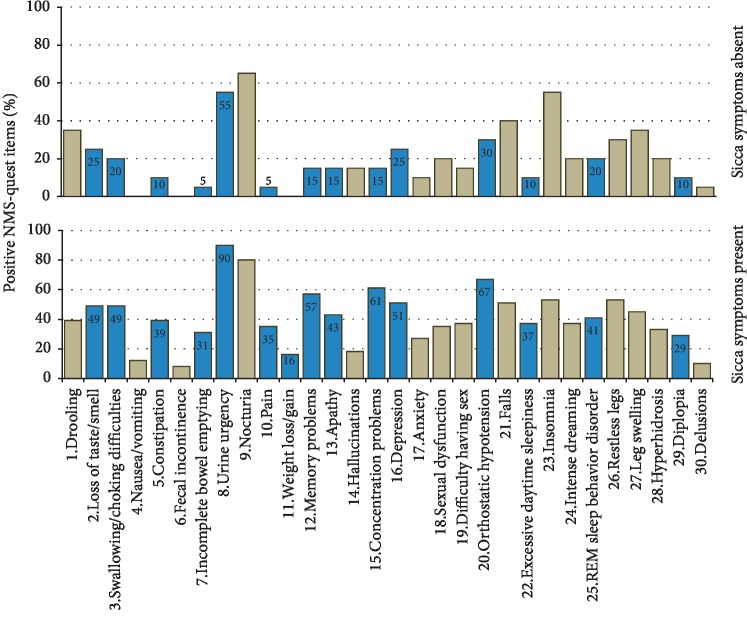
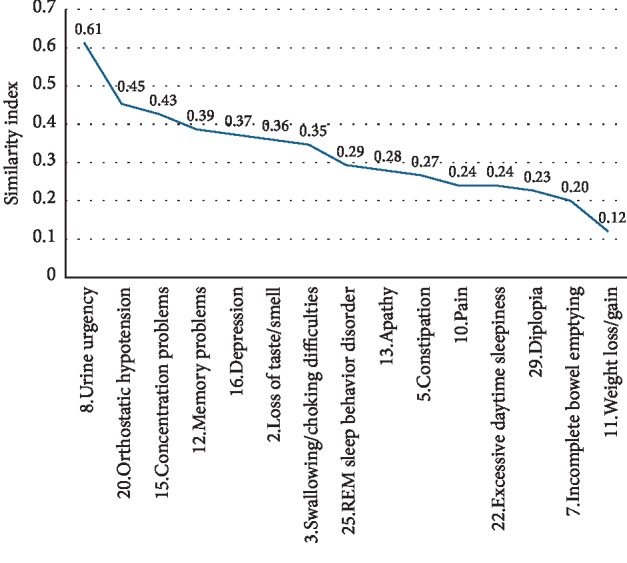
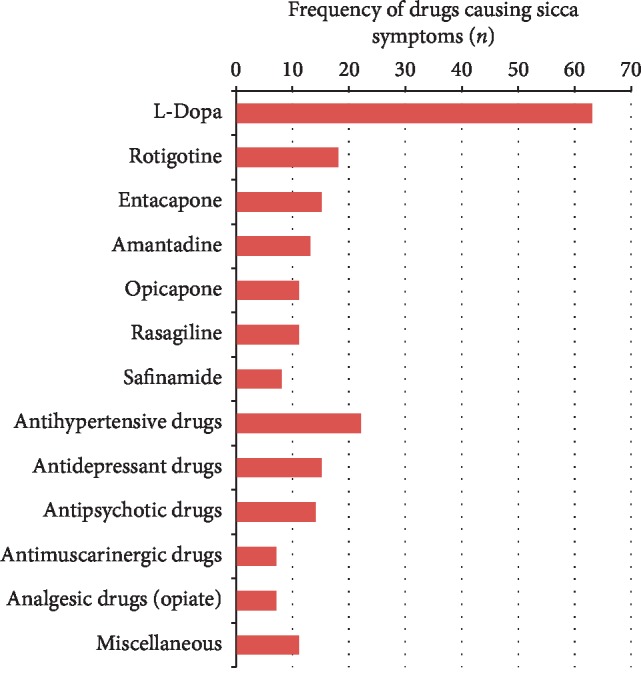
Results: Among the autonomic symptoms, sicca symptoms (xerostomia and dry eyes) were the most commonly reported (69%), followed by sexual dysfunction in men, leaking of urine, vasomotor dysfunction, constipation, sudomotor dysfunction, and orthostatic symptoms. The autonomic symptom burden (SAS total) correlated with the NMS-Quest and Hoehn and Yahr stage, but not with age, levodopa equivalent daily dose, disease duration, and the MDS-UPDRS III. The SAS total score was an independent predictor of the PDQ-39 summary index and mainly affected the PDQ-39 cognition and emotional well-being domains. Sicca symptoms were not associated with age, MDS-UPDRS III, disease duration, Hoehn and Yahr stage, and levodopa equivalent daily dose but aggravated the PDQ-39 domains: cognition, emotional well-being, bodily discomfort, and mobility. Sicca symptoms frequently occur together with other nonmotor symptoms, namely, urine urgency, orthostatic problems, and concentration problems. Overall, 75% of the subjects took at least one drug that can cause sicca symptoms (anti-PD medication, antidepressant drugs, antihypertensive drugs, antipsychotic drugs, antimuscarinic drugs, and analgesic drugs).
Conclusion: Sicca symptoms are common in PD and negatively influence QoL. The observed association between sicca symptoms and other nonmotor symptoms provides further preliminary evidence for the growing recognition of different nonmotor clusters in PD.
Copyright © 2020 Tino Prell et al.
Conflict of interest statement
The authors report that there are no conflicts of interest related to this manuscript.
Figures

References
LinkOut - more resources
Full Text Sources
Research Materials
Miscellaneous
