


Interim thymus and activation regulated chemokine versus interim 18 F-fluorodeoxyglucose positron-emission tomography in classical Hodgkin lymphoma response evaluation
- PMID: 32106342
- PMCID: PMC7383815
- DOI: 10.1111/bjh.16514
Interim thymus and activation regulated chemokine versus interim 18 F-fluorodeoxyglucose positron-emission tomography in classical Hodgkin lymphoma response evaluation
Abstract
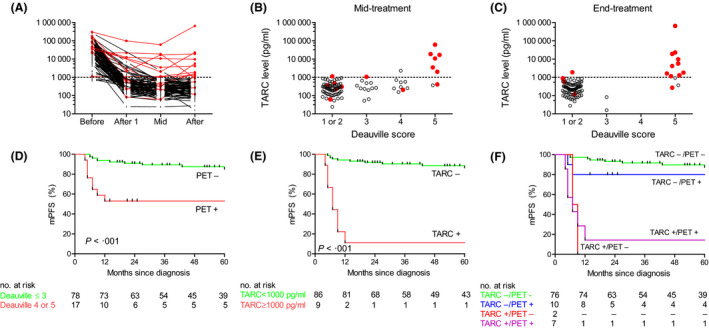
Serum thymus and activation regulated chemokine (TARC) levels reflect classical Hodgkin lymphoma (cHL) disease activity and correspond with treatment response. We compared mid-treatment interim TARC (iTARC) with interim 18 F-fluorodeoxyglucose positron-emission tomography (iPET) imaging to predict modified progression-free survival (mPFS) in a group of 95 patients with cHL. High iTARC levels were found in nine and positive iPET in 17 patients. The positive predictive value (PPV) of iTARC for a 5-year mPFS event was 88% compared to 47% for iPET. The negative predictive value was comparable at 86% for iTARC and 85% for iPET. Serum iTARC levels more accurately reflect treatment response with a higher PPV compared to iPET.
© 2020 The Authors. British Journal of Haematology published by British Society for Haematology and John Wiley & Sons Ltd.
Conflict of interest statement
None.
Figures
References
-
- Andre, M.P.E. , Girinsky, T. , Federico, M. , Reman, O. , Fortpied, C. , Gotti, M. , Casasnovas, O. , Brice, P. , van der Maazen, R. , Re, A. , Edeline, V. , Ferme, C. , van Imhoff, G. , Merli, F. , Bouabdallah, R. , Sebban, C. , Specht, L. , Stamatoullas, A. , Delarue, R. , Fiaccadori, V. , Bellei, M. , Raveloarivahy, T. , Versari, A. , Hutchings, M. , Meignan, M. & Raemaekers, J. (2017) Early positron emission tomography response‐adapted treatment in stage I and II hodgkin lymphoma: final results of the randomized EORTC/LYSA/FIL H10 trial. Journal of Clinical Oncology, 35, 1786–1794. - PubMed
-
- Biggi, A. , Gallamini, A. , Chauvie, S. , Hutchings, M. , Kostakoglu, L. , Gregianin, M. , Meignan, M. , Malkowski, B. , Hofman, M.S. & Barrington, S.F. (2013) International validation study for interim PET in ABVD‐treated, advanced‐stage hodgkin lymphoma: interpretation criteria and concordance rate among reviewers. Journal of Nuclear Medicine, 54, 683–690. - PubMed
-
- Borchmann, P. , Goergen, H. , Kobe, C. , Lohri, A. , Greil, R. , Eichenauer, D.A. , Zijlstra, J.M. , Markova, J. , Meissner, J. , Feuring‐Buske, M. , Huttmann, A. , Dierlamm, J. , Soekler, M. , Beck, H.J. , Willenbacher, W. , Ludwig, W.D. , Pabst, T. , Topp, M.S. , Hitz, F. , Bentz, M. , Keller, U.B. , Kuhnhardt, D. , Ostermann, H. , Schmitz, N. , Hertenstein, B. , Aulitzky, W. , Maschmeyer, G. , Vieler, T. , Eich, H. , Baues, C. , Stein, H. , Fuchs, M. , Kuhnert, G. , Diehl, V. , Dietlein, M. & Engert, A. (2018) PET‐guided treatment in patients with advanced‐stage hodgkin's lymphoma (HD18): final results of an open‐label, international, randomised phase 3 trial by the german hodgkin study group. The Lancet, 390, 2790–2802. - PubMed
-
- Carde, P. , Karrasch, M. , Fortpied, C. , Brice, P. , Khaled, H. , Casasnovas, O. , Caillot, D. , Gaillard, I. , Bologna, S. , Ferme, C. , Lugtenburg, P.J. , Morschhauser, F. , Aurer, I. , Coiffier, B. , Meyer, R. , Seftel, M. , Wolf, M. , Glimelius, B. , Sureda, A. & Mounier, N. (2016) Eight cycles of ABVD versus four cycles of BEACOPPescalated plus four cycles of BEACOPPbaseline in stage III to IV, international prognostic score ≥3, high‐risk hodgkin lymphoma: first results of the phase III EORTC 20012 intergroup trial. Journal of Clinical Oncology, 34, 2028–2036. - PubMed
Publication types
MeSH terms
Substances
Grants and funding
LinkOut - more resources
Full Text Sources
Other Literature Sources
Medical
