Review
. 2020 Feb 25;6(1):27.
doi: 10.3390/jof6010027.

Vulvovaginal Candidiasis: A Current Understanding and Burning Questions

Affiliations
Review

Vulvovaginal Candidiasis: A Current Understanding and Burning Questions

Hubertine M E Willems et al. J Fungi (Basel). .

Abstract

Candida albicans, along with other closely related Candida species, are the primary causative agents of vulvovaginal candidiasis (VVC)-a multifactorial infectious disease of the lower female reproductive tract resulting in pathologic inflammation. Unlike other forms of candidiasis, VVC is a disease of immunocompetent and otherwise healthy women, most predominant during their child-bearing years. While VVC is non-lethal, its high global incidence and profound negative impact on quality-of-life necessitates further understanding of the host and fungal factors that drive disease pathogenesis. In this review, we cover the current state of our understanding of the epidemiology, host response, fungal pathogenicity mechanisms, impact of the microbiome, and novel approaches to treatment of this most prevalent human candidal infection. We also offer insight into the latest advancements in the VVC field and identify important questions that still remain.

Keywords: Candida; VVC; candidiasis; fungal; vagina; vaginitis; vulvovaginal.


Conflict of interest statement

The authors declare no conflict of interest.

Figures
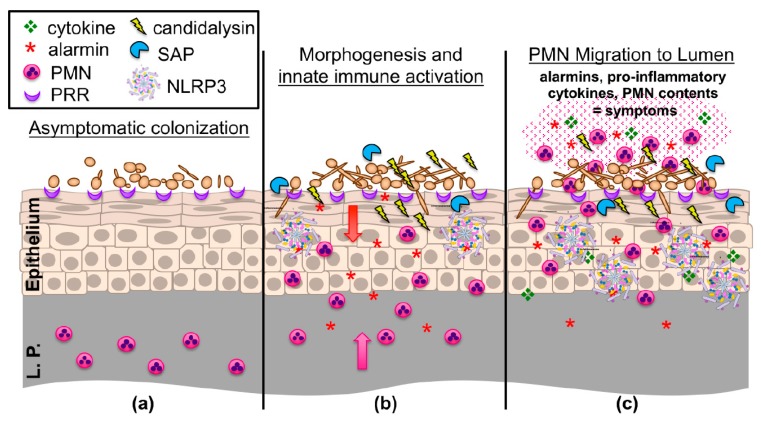
Figure 1
Figure 1
An updated working model of the immunopathogenesis of C. albicans vaginitis. (a) Yeast forms of C. albicans asymptomatically colonize the vaginal epithelium despite the presence of numerous pattern recognition receptors (PRR) on the epithelial surface. (b) C. albicans begins to undergo the yeast-to-hypha switch under morphogenesis-inducing conditions (e.g., increases in estrogen, elevated vaginal pH, and microbiome disruption). Augmented recognition by PRRs, increased hyphal biomass, expression of hypha-associated virulence factors (candidalysin, secreted aspartyl proteinases (SAPs)) activates NLRP3 inflammasome signaling, eliciting inflammatory cytokines and chemokines (e.g., IL-1β, S100A8/9 alarmins) in the vaginal epithelium, resulting in initial migration of polymorphonuclear leukocytes (PMNs) from the lamina propria (L.P.) to the vaginal lumen. (c) Failure to adequately reduce immunopathological triggers results in the continued expression of innate immune effectors by the vaginal epithelium. These initial signals, coupled with the secondary amplification of immune effectors by recruited PMNs, contribute to symptomatic infection and characteristic immunopathology. Figure adapted from: PLoS Pathog. 2014 Apr; 10(4): e1003965 [47].
Figure 2
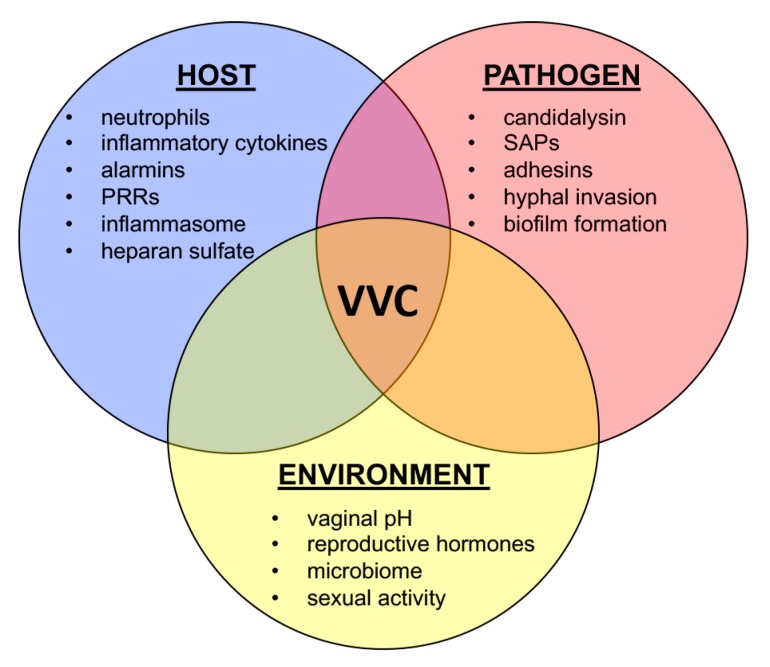
Figure 2
Vulvovaginal candidiasis (VVC) is a multifactorial disease. Multiple inputs from host (blue), pathogen (red), and environment (yellow) are required to drive disease onset and symptomatic infection. Each circle represents major contributing factors to the immunopathogenesis of VVC.

References

    1. Achkar J.M., Fries B.C. Candida infections of the genitourinary tract. Clin. Microbiol. Rev. 2010;23:253–273. doi: 10.1128/CMR.00076-09. - DOI - PMC - PubMed
    1. Sobel J.D. Vaginitis. N. Engl. J. Med. 1997;337:1896–1903. doi: 10.1056/NEJM199712253372607. - DOI - PubMed
    1. Denning D.W., Kneale M., Sobel J.D., Rautemaa-Richardson R. Global burden of recurrent vulvovaginal candidiasis: A systematic review. Lancet Infect. Dis. 2018;18:e339–e347. doi: 10.1016/S1473-3099(18)30103-8. - DOI - PubMed
    1. Sobel J.D., Faro S., Force R.W., Foxman B., Ledger W.J., Nyirjesy P.R., Reed B.D., Summers P.R. Vulvovaginal candidiasis: Epidemiologic, diagnostic, and therapeutic considerations. Am. J. Obstet. Gynecol. 1998;178:203–211. doi: 10.1016/S0002-9378(98)80001-X. - DOI - PubMed
    1. Nyirjesy P., Zhao Y., Ways K., Usiskin K. Evaluation of vulvovaginal symptoms and Candida colonization in women with type 2 diabetes mellitus treated with canagliflozin, a sodium glucose co-transporter 2 inhibitor. Curr. Med. Res. Opin. 2012;28:1173–1178. doi: 10.1185/03007995.2012.697053. - DOI - PubMed

LinkOut - more resources