


Review of Non-invasive Glucose Sensing Techniques: Optical, Electrical and Breath Acetone
- PMID: 32106464
- PMCID: PMC7085605
- DOI: 10.3390/s20051251
Review of Non-invasive Glucose Sensing Techniques: Optical, Electrical and Breath Acetone
Abstract
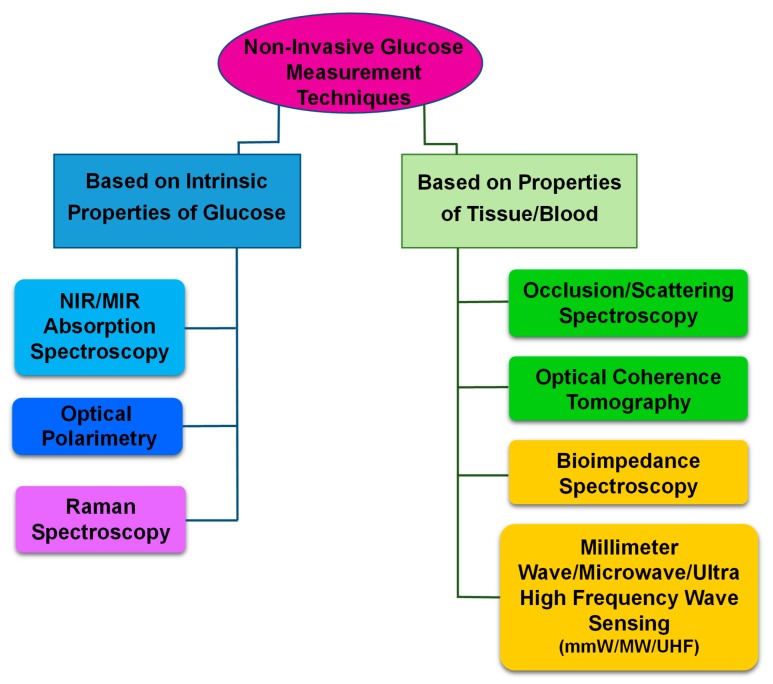
Annual deaths in the U.S. attributed to diabetes are expected to increase from 280,210 in 2015 to 385,840 in 2030. The increase in the number of people affected by diabetes has made it one of the major public health challenges around the world. Better management of diabetes has the potential to decrease yearly medical costs and deaths associated with the disease. Non-invasive methods are in high demand to take the place of the traditional finger prick method as they can facilitate continuous glucose monitoring. Research groups have been trying for decades to develop functional commercial non-invasive glucose measurement devices. The challenges associated with non-invasive glucose monitoring are the many factors that contribute to inaccurate readings. We identify and address the experimental and physiological challenges and provide recommendations to pave the way for a systematic pathway to a solution. We have reviewed and categorized non-invasive glucose measurement methods based on: (1) the intrinsic properties of glucose, (2) blood/tissue properties and (3) breath acetone analysis. This approach highlights potential critical commonalities among the challenges that act as barriers to future progress. The focus here is on the pertinent physiological aspects, remaining challenges, recent advancements and the sensors that have reached acceptable clinical accuracy.
Keywords: Raman; absorption; bioimpedance; breath acetone; diabetes; glucose; non-invasive; optical; polarimetry; scattering.
Conflict of interest statement
The authors declare no conflict of interest.
Figures






References
-
- Roglic G., World Health Organization, editor. Global Report on Diabetes. World Health Organization; Geneva, Switzerland: 2016.
Publication types
MeSH terms
Substances
LinkOut - more resources
Full Text Sources
Other Literature Sources
Medical
