


Barriers and Facilitators for Screening Older Adults on Fall Risk in a Hospital Setting: Perspectives from Patients and Healthcare Professionals
- PMID: 32106465
- PMCID: PMC7084218
- DOI: 10.3390/ijerph17051461
Barriers and Facilitators for Screening Older Adults on Fall Risk in a Hospital Setting: Perspectives from Patients and Healthcare Professionals
Abstract
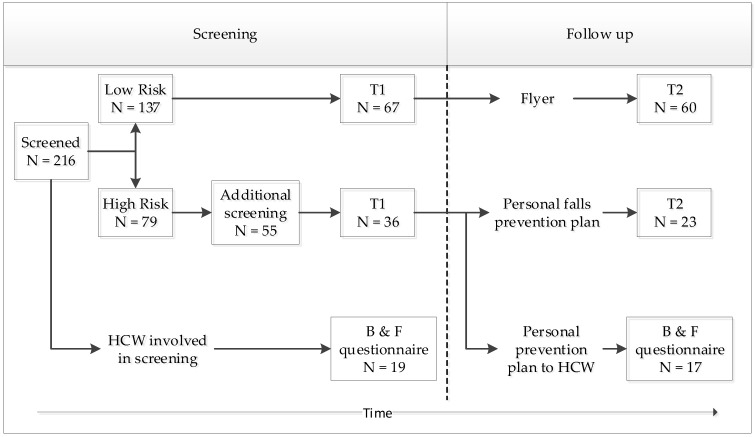
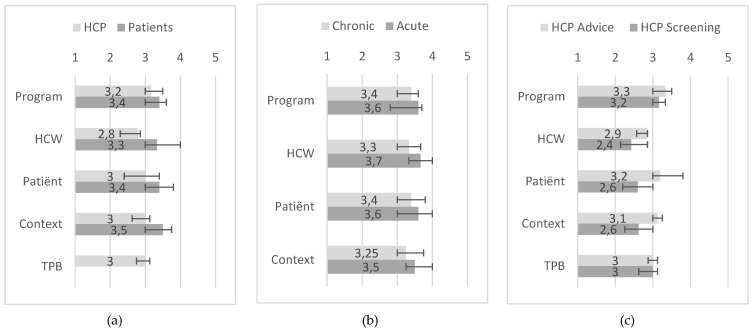
We aimed to gain insight into the barriers and facilitators to fall risk screening of older adults visiting the hospital as experienced by patients and healthcare professionals, and to examine the differences between chronic- and acute-care patients. We invited patients (≥ 70 years) attending the nephrology and emergency department to participate in the screening. Patients and their healthcare professionals were asked to complete a self-administered questionnaire based on the "Barriers and Facilitators Assessment Instrument". Differences in barriers and facilitators between acute- and chronic-care patients were examined with chi-square tests. A total of 216 patients were screened, and 103 completed the questionnaire. They considered many factors as facilitators, and none as barriers. Acute-care patients were more positive than chronic-care patients about healthcare worker characteristics, such as knowledge and skills. After screening, patients were more open to receiving advice regarding fall prevention. The 36 healthcare professionals considered program characteristics to be facilitators and mainly factors regarding healthcare worker characteristics as barriers to implementation. For patients, the outpatient setting seemed to be a good place to be screened for fall risk. Healthcare professionals also suggested that program characteristics could enhance implementation. However, healthcare professionals' mindsets and the changing of routines are barriers that have to be addressed first.
Keywords: Fall prevention; barriers; facilitators; healthcare professionals; implementation; older adults; screening.
Conflict of interest statement
The authors declare no conflict of interest
Figures
References
-
- Haagsma J.A., Graetz N., Bolliger I., Naghavi M., Higashi H., Mullany E.C., Abera S.F., Abraham J.P., Adofo K., Alsharif U., et al. The global burden of injury: Incidence, mortality, disability-adjusted life years and time trends from the Global Burden of Disease study 2013. Inj. Prev. 2016;22:3–18. doi: 10.1136/injuryprev-2015-041616. - DOI - PMC - PubMed
-
- Turner S., Kisser R., Rogmans W. Falls among Older Adults in the EU-28: Key Facts from the Available Statistics. EuroSafe; Amsterdam, The Netherlands: 2015.
Publication types
MeSH terms
LinkOut - more resources
Full Text Sources
Medical
