Review
. 2020 Feb 25;9(3):154.
doi: 10.3390/pathogens9030154.

Orthohepevirus C: An Expanding Species of Emerging Hepatitis E Virus Variants

Affiliations
Review

Orthohepevirus C: An Expanding Species of Emerging Hepatitis E Virus Variants

Bo Wang et al. Pathogens. .

Abstract

Hepatitis E virus (HEV) is an emerging zoonotic pathogen that has received an increasing amount of attention from virologists, clinicians, veterinarians, and epidemiologists over the past decade. The host range and animal reservoirs of HEV are rapidly expanding and a plethora of emerging HEV variants have been recently identified, some of which have the potential for interspecies infection. In this review, the detection of genetically diverse HEV variants, classified into and presumably associated with the species Orthohepevirus C, currently comprising HEV genotypes C1 and C2, by either serological or molecular approach is summarized. The distribution, genomic variability, and evolution of Orthohepevirus C are analyzed. Moreover, the potential risk of cross-species infection and zoonotic transmission of Orthohepevirus C are discussed.

Keywords: Orthohepevirus C; genetic variability; hepatitis E virus; host; molecular evolution; zoonosis.


Conflict of interest statement

The authors declare no conflict of interest.

Figures
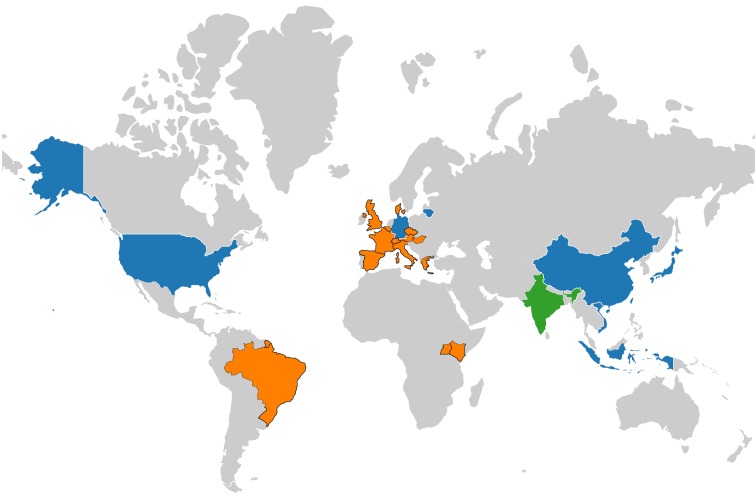
Figure 1
Figure 1
Worldwide detection and distribution of Orthohepevirus C. Countries with both Orthohepevirus C RNA and antibodies detection are in blue; countries with only antibodies detection are in green; countries with only RNA detection are in orange. World map was created by using a free and open source geographic information system Quantum Geographic Information System version 3.10 (http://qgis.osgeo.org) and free vector and raster map data from Natural Earth (http://www.naturalearthdata.com).
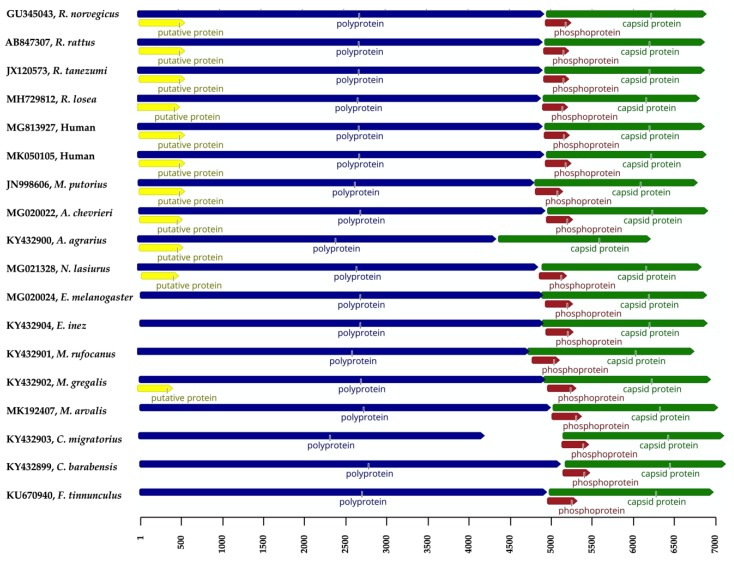
Figure 2
Figure 2
Schematic description of genomic organization of Orthohepevirus C variants. Virus designations including GenBank accession numbers and host information are indicated on the left. HEV open reading frames (ORFs) 1, 2, 3, and the putative ORF4 are represented in blue, green, brown, and yellow, respectively. The scale is in bases.
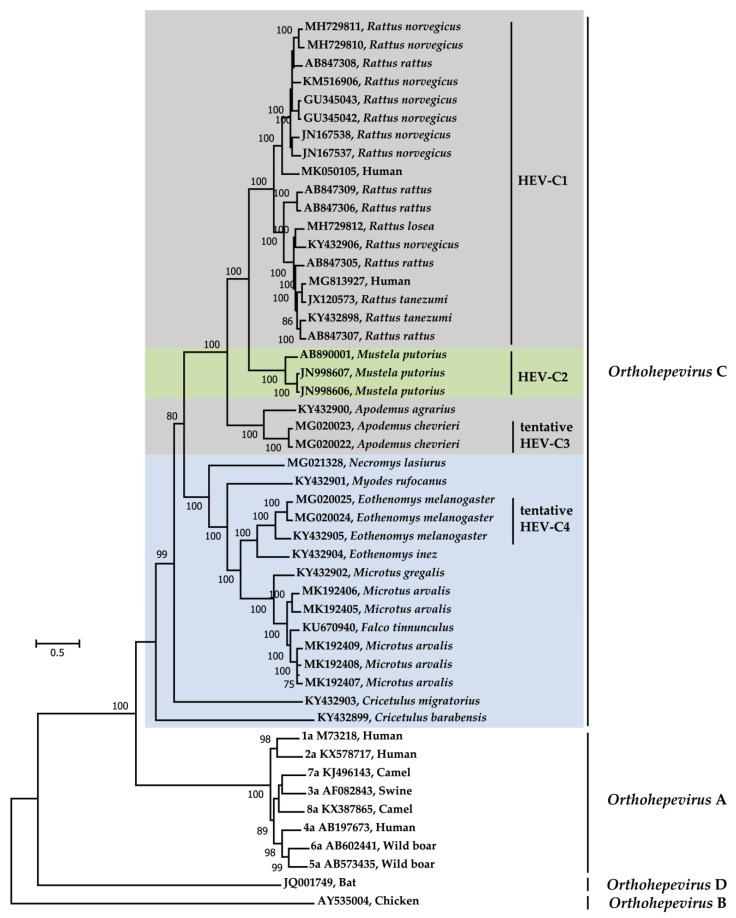
Figure 3
Figure 3
Maximum-likelihood phylogeny of Orthohepevirus C variants within the genus Orthohepevirus. Representatives of Orthohepevirus A, B, and D variants are reference strains according to the International Committee on Taxonomy of Viruses (ICTV) consensus proposals [11]. Virus designations include GenBank accession numbers and host information. Species and genotypes are indicated on the right. Viral strains from rodent families Muridae and Cricetidae and carnivore family Mustelidae are highlighted with grey, blue, and green background, respectively. Complete genome sequences were aligned using the MAFFT algorithm. Phylogenetic reconstructions were performed using MEGA version 7 with 1000 bootstrap replicates. General Time Reversible (GTR) + Gamma Distributed (G) + Invariable Sites (I) nucleotide substitution model was selected based on Find Best-Fit Substitution Model (ML) in MEGA version 7. Bootstrap values (>75%) are indicated at specific nodes. Scale bars indicate the number of nucleotide substitutions per site.

References

    1. Rein D.B., Stevens G.A., Theaker J., Wittenborn J.S., Wiersma S.T. The global burden of hepatitis E virus genotypes 1 and 2 in 2005. Hepatology. 2012;55:988–997. doi: 10.1002/hep.25505. - DOI - PubMed
    1. Bose P.D., Das B.C., Kumar A., Gondal R., Kumar D., Kar P. High viral load and deregulation of the progesterone receptor signaling pathway: Association with hepatitis E-related poor pregnancy outcome. J. Hepatol. 2011;54:1107–1113. doi: 10.1016/j.jhep.2010.08.037. - DOI - PubMed
    1. Pavio N., Meng X.J., Doceul V. Zoonotic origin of hepatitis E. Curr. Opin. Virol. 2015;10:34–41. doi: 10.1016/j.coviro.2014.12.006. - DOI - PubMed
    1. Kamar N., Izopet J., Tripon S., Bismuth M., Hillaire S., Dumortier J., Radenne S., Coilly A., Garrigue V., D’Alteroche L., et al. Ribavirin for chronic hepatitis E virus infection in transplant recipients. N. Engl. J. Med. 2014;370:1111–1120. doi: 10.1056/NEJMoa1215246. - DOI - PubMed
    1. Pischke S., Hartl J., Pas S.D., Lohse A.W., Jacobs B.C., Van der Eijk A.A. Hepatitis E virus: Infection beyond the liver? J. Hepatol. 2017;66:1082–1095. doi: 10.1016/j.jhep.2016.11.016. - DOI - PubMed

LinkOut - more resources