Review
. 2020 Feb 25;9(3):531.
doi: 10.3390/cells9030531.

Memory CD4+ T Cells in Immunity and Autoimmune Diseases

Affiliations
Review

Memory CD4+ T Cells in Immunity and Autoimmune Diseases

Itay Raphael et al. Cells. .

Abstract

CD4+ T helper (Th) cells play central roles in immunity in health and disease. While much is known about the effector function of Th cells in combating pathogens and promoting autoimmune diseases, the roles and biology of memory CD4+ Th cells are complex and less well understood. In human autoimmune diseases such as multiple sclerosis (MS), there is a critical need to better understand the function and biology of memory T cells. In this review article we summarize current concepts in the field of CD4+ T cell memory, including natural history, developmental pathways, subsets, and functions. Furthermore, we discuss advancements in the field of the newly-described CD4+ tissue-resident memory T cells and of CD4+ memory T cells in autoimmune diseases, two major areas of important unresolved questions in need of answering to advance new vaccine design and development of novel treatments for CD4+ T cell-mediated autoimmune diseases.

Keywords: CD4+ T cells; autoimmune disease; central memory T cell; effector memory T cell; memory T cells; tissue-resident T cell.


Conflict of interest statement

The authors declare no conflict of interest.

Figures
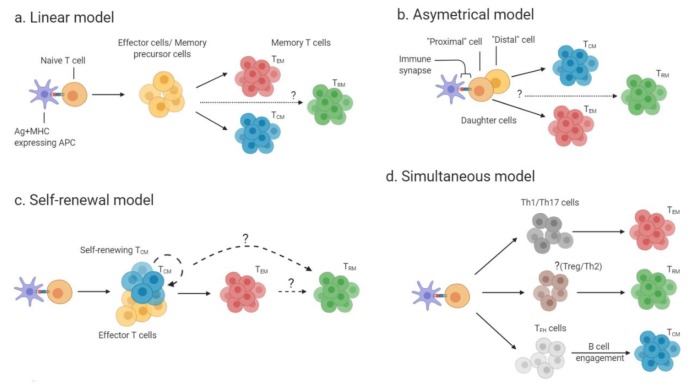
Figure 1
Figure 1
Developmental models of memory T cells: (a) In the linear model, effector T cells or memory precursor cells (yellow) are generated following activation of naïve T cell by antigen-presenting cells (APCs) presenting peptide on major histocompatibility complex (MHC) molecules. The intermediate effectors or memory precursors give rise to mature effector memory T cells (TEM) (red) and central memory T cells (TCM) (blue). It remains to be answered if the intermediate effectors/precursors also give rise to tissue-resident memory T cells (TRM) (b) In the asymmetrical model, the proximal daughter cells to the immune-synapse (naïve T cell- T cell receptor (TCR) + peptide and MHC-APC) develop into TEM, while the distal daughter cells develop into TCM. It is currently unknown which cells give rise to TRM (green). (c) In the self-renewal model self-renewing effector T cells or TCM are generated from naïve T cells. These self-renewing cells can then give rise to TEM cells. It is unresolved if TRM are generated from self-renewing TCM/effector cells or from TEM. (d) In the simultaneous model naïve T cells first differentiate into different T cell subsets. T cell subsets give rise to different memory subsets as follows: Th1 and Th17 cells (dark gray) generate TEM, while TFH cells (light gray) generate TCM. The T helper cell subset(s) that generate TRM has not yet been identified.
Figure 2
Figure 2
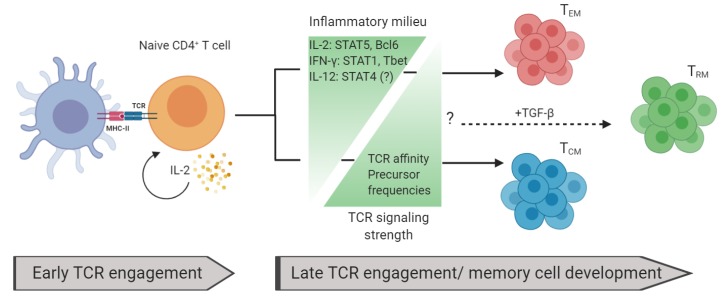
Factors influencing memory T cell development: Naïve T cells are activated by peptide and MHC via TCR. High levels of interleukin (IL)-2 are critical during early TCR engagement for memory-cell development. The memory T cell development fate is dependent on the inflammatory milieu and TCR signaling strength. Increased levels of inflammatory signals favor TEM generation and decreased levels of these signals favor TCM. Conversely, increased levels of TCR affinity and precursor frequencies favor TCM development while decreased levels favor TEM. TGF-β is important for generating TRM. How other inflammatory signals and TCR signaling strength affect TRM generation remains unresolved.
Figure 3
Figure 3
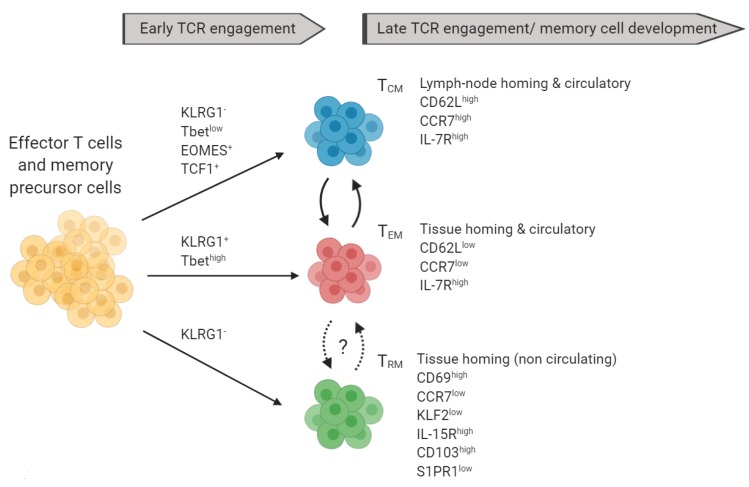
Markers of memory T cell subsets and their precursors: Terminally differentiated TCM (blue) and TEM (red) can be distinguished based on the expression of CD62L, CCR7, IL7R, and other markers not shown. TRM can be further characterized based on the expression of KLF2, IL-15R, CD103, and S1PR1. TCM can give rise to TEM and vice versa. *Recent data suggested that TRM can re-enter the circulation.

References

    1. Jiang S., Dong C. A complex issue on CD4(+) T-cell subsets. Immunol. Rev. 2013;252:5–11. doi: 10.1111/imr.12041. - DOI - PubMed
    1. Raphael I., Nalawade S., Eagar T.N., Forsthuber T.G. T cell subsets and their signature cytokines in autoimmune and inflammatory diseases. Cytokine. 2015;74:5–17. doi: 10.1016/j.cyto.2014.09.011. - DOI - PMC - PubMed
    1. Kumar B.V., Connors T.J., Farber D.L. Human T Cell Development, Localization, and Function throughout Life. Immunity. 2018;48:202–213. doi: 10.1016/j.immuni.2018.01.007. - DOI - PMC - PubMed
    1. Raphael I., Forsthuber T.G. Stability of T-cell lineages in autoimmune diseases. Expert Rev. Clin. Immunol. 2012;8:299–301. doi: 10.1586/eci.12.22. - DOI - PMC - PubMed
    1. Mueller S.N., Gebhardt T., Carbone F.R., Heath W.R. Memory T cell subsets, migration patterns, and tissue residence. Annu. Rev. Immunol. 2013;31:137–161. doi: 10.1146/annurev-immunol-032712-095954. - DOI - PubMed

Publication types

MeSH terms