


Differences in Diagnostic Evaluation in Women and Men After Acute Ischemic Stroke
- PMID: 32106749
- PMCID: PMC7335545
- DOI: 10.1161/JAHA.119.015625
Differences in Diagnostic Evaluation in Women and Men After Acute Ischemic Stroke
Abstract
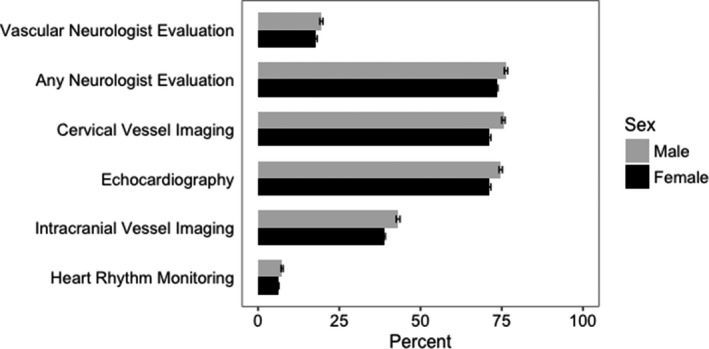
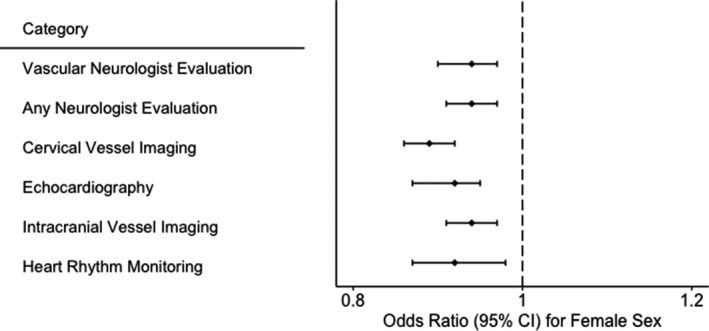
Background Sex differences have been found in stroke risk factors, incidence, treatment, and outcomes. There are conflicting data on whether diagnostic evaluation for stroke may differ between men and women. Methods and Results We performed a retrospective cohort study using inpatient and outpatient claims between 2008 and 2016 from a nationally representative 5% sample of Medicare beneficiaries. We included patients ≥65 years old and hospitalized with ischemic stroke, defined by International Classification of Diseases, Ninth Revision, Clinical Modification (ICD-9-CM) and ICD-10-CM diagnosis codes. Logistic regression was used to determine the association between female sex and the odds of diagnostic testing and specialist evaluation, adjusted for age, race, and number of Charlson comorbidities. Among 78 822 patients with acute ischemic stroke, 58.3% (95% CI, 57.9-58.6%) were women. Female sex was associated with decreased odds of intracranial vessel imaging (odds ratio [OR]: 0.94; 95% CI, 0.91-0.97), extracranial vessel imaging (OR: 0.89; 95% CI, 0.86-0.92), heart-rhythm monitoring (OR: 0.92; 95% CI, 0.87-0.98), echocardiography (OR: 0.92; 95% CI, 0.89-0.95), evaluation by a neurologist (OR: 0.94; 95% CI, 0.91-0.97), and evaluation by a vascular neurologist (OR: 0.94; 95% CI, 0.90-0.97), after adjustment for age, race, and comorbidities. These findings were unchanged in separate sensitivity analyses excluding patients who died during the index hospitalization or were discharged to hospice and excluding patients with atrial fibrillation diagnosed before their index stroke. Conclusions In a nationally representative cohort of Medicare beneficiaries, we found that women with acute ischemic stroke were less likely to be evaluated by stroke specialists and less likely to undergo standard diagnostic testing compared with men.
Keywords: diagnostic evaluation; disparities; ischemic stroke; women.
Figures
References
-
- Benjamin EJ, Virani SS, Callaway CW, Chamberlain AM, Chang AR, Cheng S, Chiuve SE, Cushman M, Delling FN, Deo R, de Ferranti SD, Ferguson JF, Fornage M, Gillespie C, Isasi CR, Jimenez MC, Jordan LC, Judd SE, Lackland D, Lichtman JH, Lisabeth L, Liu S, Longenecker CT, Lutsey PL, Mackey JS, Matchar DB, Matsushita K, Mussolino ME, Nasir K, O'Flaherty M, Palaniappan LP, Pandey A, Pandey DK, Reeves MJ, Ritchey MD, Rodriguez CJ, Roth GA, Rosamond WD, Sampson UKA, Satou GM, Shah SH, Spartano NL, Tirschwell DL, Tsao CW, Voeks JH, Willey JZ, Wilkins JT, Wu JH, Alger HM, Wong SS, Muntner P; American Heart Association Council on Epidemiology and Prevention Statistics Committee and Stroke Statistics Subcommittee . Heart disease and stroke statistics—2018 update: a report from the American Heart Association. Circulation. 2018;137:e67–e492. - PubMed
-
- Roquer J, Campello AR, Gomis M. Sex differences in first‐ever acute stroke. Stroke. 2003;34:1581–1585. - PubMed
-
- Di Carlo A, Lamassa M, Baldereschi M, Pracucci G, Basile AM, Wolfe CD, Giroud M, Rudd A, Ghetti A, Inzitari D; European BSoSCG . Sex differences in the clinical presentation, resource use, and 3‐month outcome of acute stroke in Europe: data from a multicenter multinational hospital‐based registry. Stroke. 2003;34:1114–1119. - PubMed
-
- Phan HT, Blizzard CL, Reeves MJ, Thrift AG, Cadilhac DA, Sturm J, Heeley E, Otahal P, Vemmos K, Anderson C, Parmar P, Krishnamurthi R, Barker‐Collo S, Feigin V, Bejot Y, Cabral NL, Carolei A, Sacco S, Chausson N, Olindo S, Rothwell P, Silva C, Correia M, Magalhaes R, Appelros P, Korv J, Vibo R, Minelli C, Gall SL. Factors contributing to sex differences in functional outcomes and participation after stroke. Neurology. 2018;90:e1945–e1953. - PubMed
Publication types
MeSH terms
Grants and funding
LinkOut - more resources
Full Text Sources
Medical
