


Dilated cardiomyopathies and non-compaction cardiomyopathy
- PMID: 32107565
- PMCID: PMC7198644
- DOI: 10.1007/s00059-020-04903-5
Dilated cardiomyopathies and non-compaction cardiomyopathy
Abstract
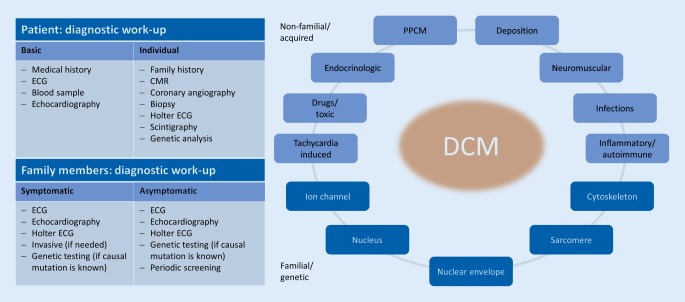
Dilated cardiomyopathy (DCM) is the most common form of cardiomyopathy and one of the most common causes of heart failure. It is characterized by left or biventricular dilation and a reduced systolic function. The causes are manifold and range from myocarditis to alcohol and other toxins, to rheumatological, endocrinological, and metabolic diseases. Peripartum cardiomyopathy is a special form that occurs at the end of or shortly after pregnancy. Genetic mutations can be detected in approximately 30-50% of DCM patients. Owing to the growing possibilities of genetic diagnostics, increasingly more triggering variants and hereditary mechanisms emerge. This is particularly important with regard to risk stratification for patients with variants with an increased risk of arrhythmias. Patient prognosis is determined by the occurrence of heart failure and arrhythmias. In addition to the treatment of the underlying disease or the elimination of triggering harmful toxins, therapy consists in guideline-directed heart failure treatment including drug and device therapy.
Die dilatative Kardiomyopathie (DCM) ist die häufigste Form der Kardiomyopathie und eine der häufigsten Ursachen einer Herzinsuffizienz. Gekennzeichnet ist sie durch eine links- oder biventrikuläre Dilatation sowie eine reduzierte systolische Funktion. Die Ursachen sind mannigfaltig und reichen von einer Myokarditis über Alkohol und andere Toxine bis hin zu rheumatologischen, endokrinologischen und metabolischen Erkrankungen. Eine Sonderform stellt die peripartale Kardiomyopathie dar, die gegen Ende oder kurz nach der Schwangerschaft auftritt. Bei etwa 30–50 % der von einer DCM betroffenen Patienten können genetische Mutationen nachgewiesen werden. Durch die wachsenden Möglichkeiten der genetischen Diagnostik werden immer mehr auslösende Varianten und Vererbungsmechanismen bekannt. Dies hat Bedeutung v. a. für die Risikostratifizierung bei Varianten mit erhöhtem Risiko für Arrhythmien. Die Prognose der Patienten wird durch das Auftreten der Herzinsuffizienz und von Arrhythmien bestimmt. Neben der Behandlung der Grunderkrankung oder dem Verzicht auf auslösende Noxen sind eine leitliniengerechte medikamentöse und Devicetherapie der Herzinsuffizienz erforderlich.
Keywords: Arrhythmias, cardiac; Genetics; Heart failure; Myocarditis; Peripartum cardiomyopathy.
Conflict of interest statement
A. Hänselmann received honoraria and/or travel support from the following companies: Novartis, Bayer, Boehringer Ingelheim, Abiomed, Alnylam. C. Veltmann received honoraria from the following companies and/or is a member of their advisory boards: Abbott, Boston Scientific, Biotronik, Medtronic, CVRx, Daiichi Sankyo, Bayer, Boehringer Ingelheim, BMS, Zoll. J. Bauersachs: Related to the present work: None. Unrelated to the present work: Honoraria for lectures and/or consulting: Novartis, BMS, Pfizer, Vifor, Bayer, Servier, Daichii, CVRx, MSD, Boehringer Ingelheim, AstraZeneca, Abiomed, Abbott, Medtronic; Research support: Zoll, CVRx, Bayer, Vifor, Abiomed, Medtronic. D. Berliner received honoraria and/or travel support from the following companies and/or is a member of their advisory boards: Novartis, Abbott, Daiichi Sankyo, Bayer and Boehringer Ingelheim.
Figures
References
Publication types
MeSH terms
Substances
LinkOut - more resources
Full Text Sources
Medical
