


Home fortification of foods with multiple micronutrient powders for health and nutrition in children under two years of age
- PMID: 32107773
- PMCID: PMC7046492
- DOI: 10.1002/14651858.CD008959.pub3
Home fortification of foods with multiple micronutrient powders for health and nutrition in children under two years of age
Abstract
Background: Vitamin and mineral deficiencies, particularly those of iron, vitamin A, and zinc, affect more than two billion people worldwide. Young children are highly vulnerable because of rapid growth and inadequate dietary practices. Multiple micronutrient powders (MNPs) are single-dose packets containing multiple vitamins and minerals in powder form, which are mixed into any semi-solid food for children six months of age or older. The use of MNPs for home or point-of-use fortification of complementary foods has been proposed as an intervention for improving micronutrient intake in children under two years of age. In 2014, MNP interventions were implemented in 43 countries and reached over three million children. This review updates a previous Cochrane Review, which has become out-of-date.
Objectives: To assess the effects and safety of home (point-of-use) fortification of foods with MNPs on nutrition, health, and developmental outcomes in children under two years of age. For the purposes of this review, home fortification with MNP refers to the addition of powders containing vitamins and minerals to semi-solid foods immediately before consumption. This can be done at home or at any other place that meals are consumed (e.g. schools, refugee camps). For this reason, MNPs are also referred to as point-of-use fortification.
Search methods: We searched the following databases up to July 2019: CENTRAL, MEDLINE, Embase, and eight other databases. We also searched four trials registers, contacted relevant organisations and authors of included studies to identify any ongoing or unpublished studies, and searched the reference lists of included studies.
Selection criteria: We included randomised controlled trials (RCTs) and quasi-RCTs with individual randomisation or cluster-randomisation. Participants were infants and young children aged 6 to 23 months at the time of intervention, with no identified specific health problems. The intervention consisted of consumption of food fortified at the point of use with MNP formulated with at least iron, zinc, and vitamin A, compared with placebo, no intervention, or use of iron-containing supplements, which is standard practice.
Data collection and analysis: Two review authors independently assessed the eligibility of studies against the inclusion criteria, extracted data from included studies, and assessed the risk of bias of included studies. We reported categorical outcomes as risk ratios (RRs) or odds ratios (ORs), with 95% confidence intervals (CIs), and continuous outcomes as mean differences (MDs) and 95% CIs. We used the GRADE approach to assess the certainty of evidence.
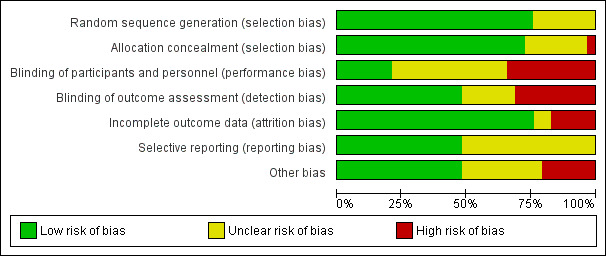
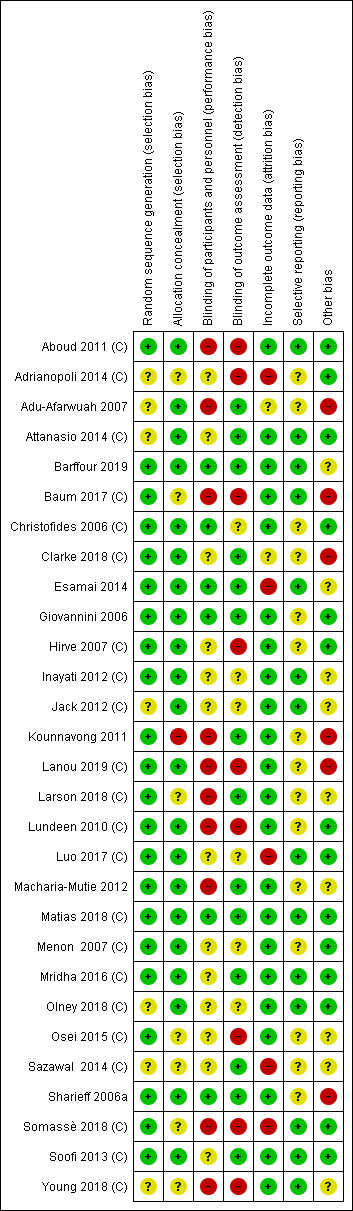
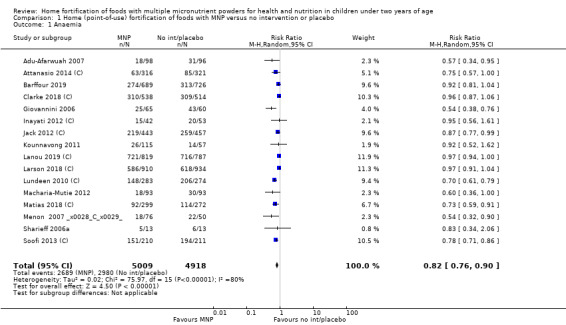
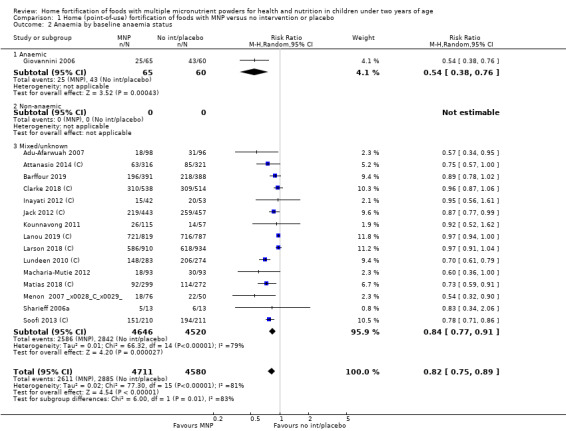
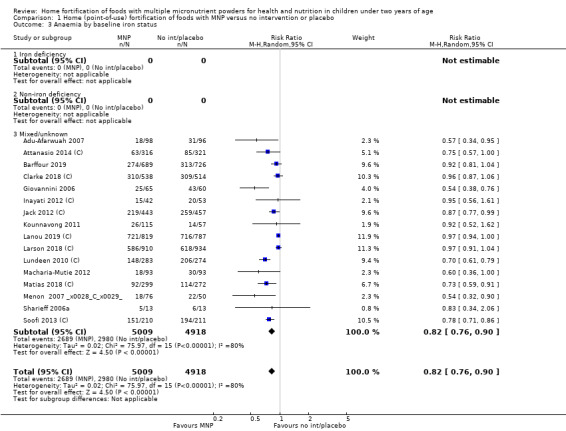
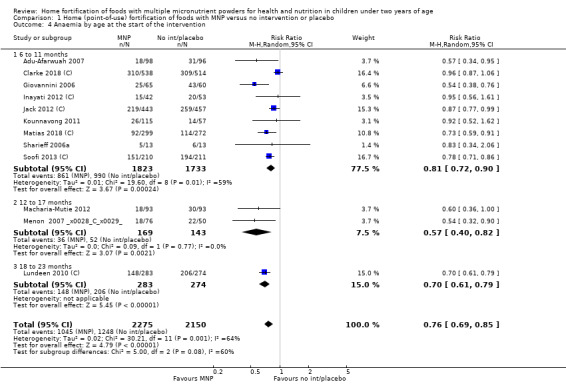
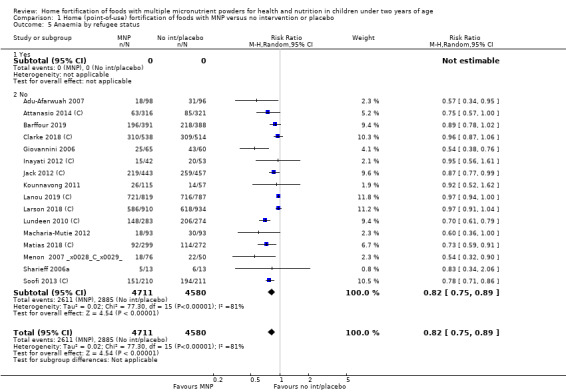
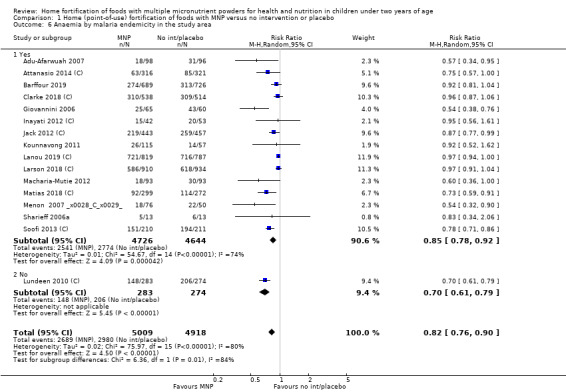
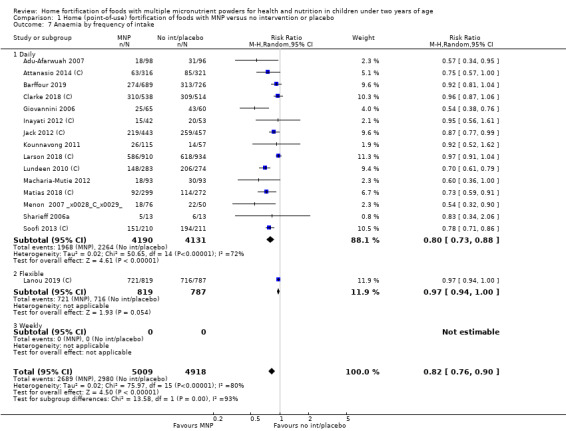
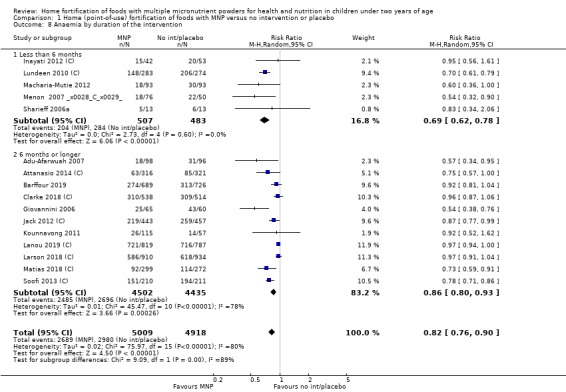
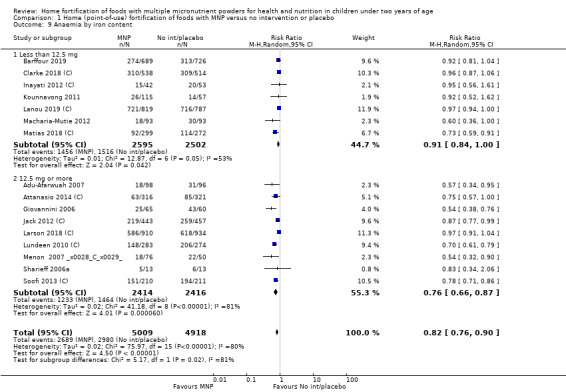
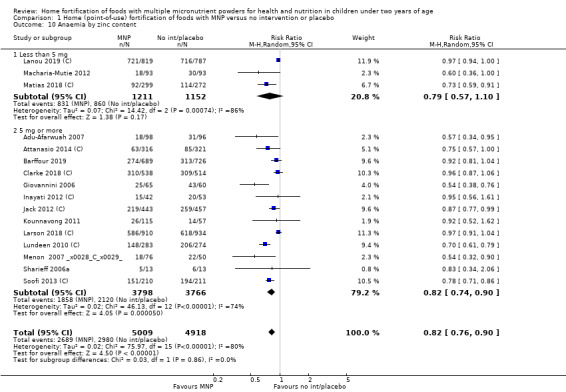
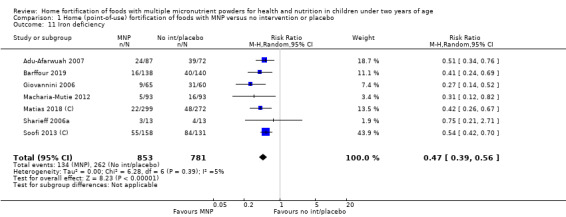
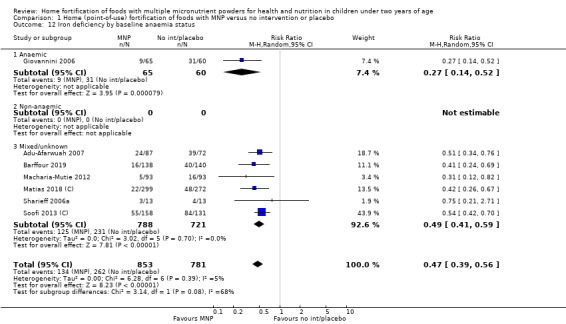
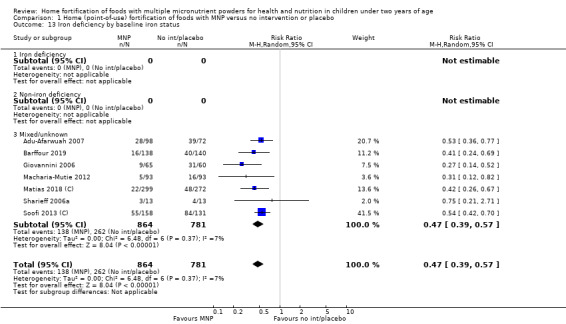
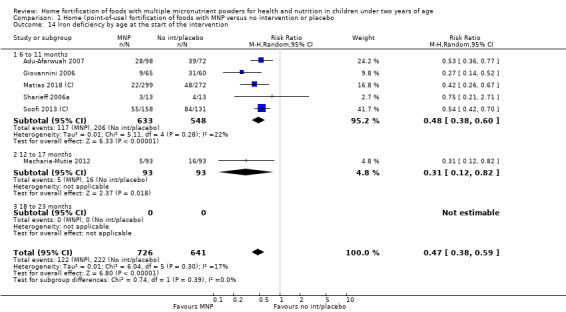
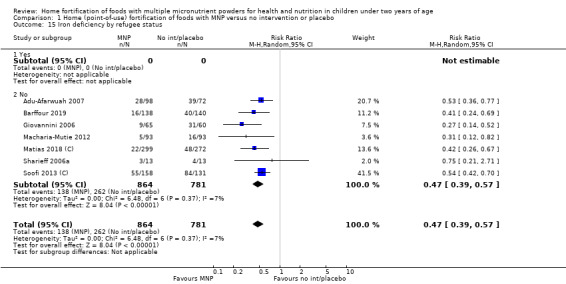
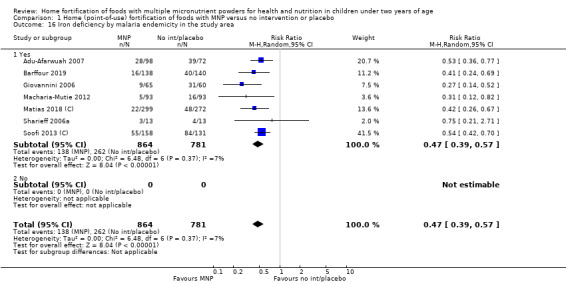
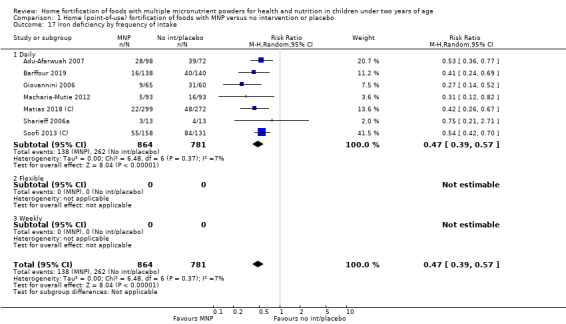
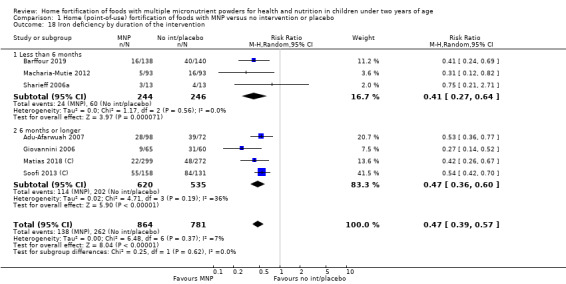
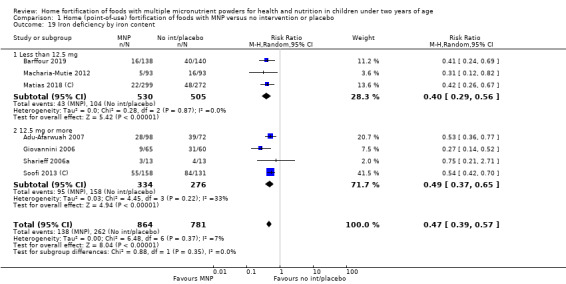
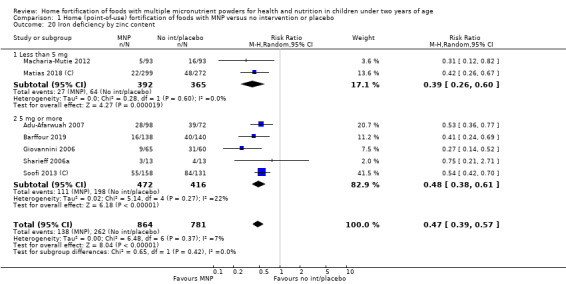
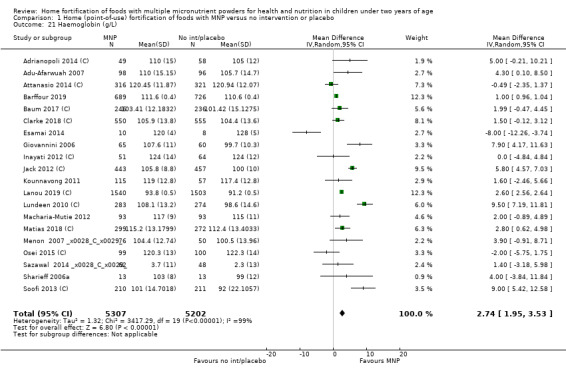
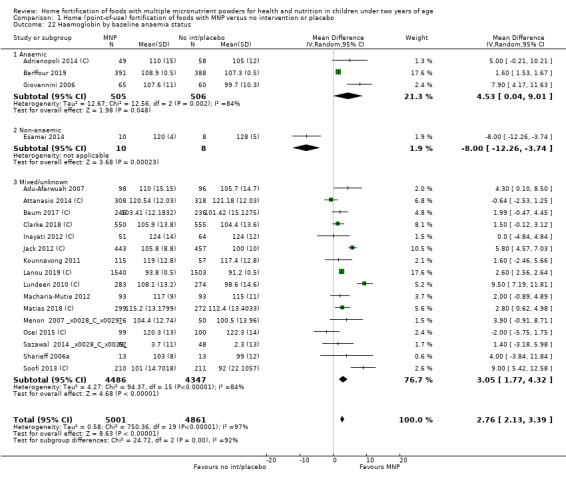
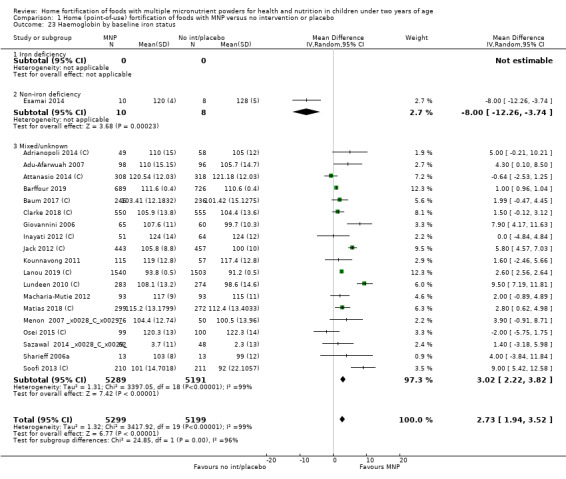
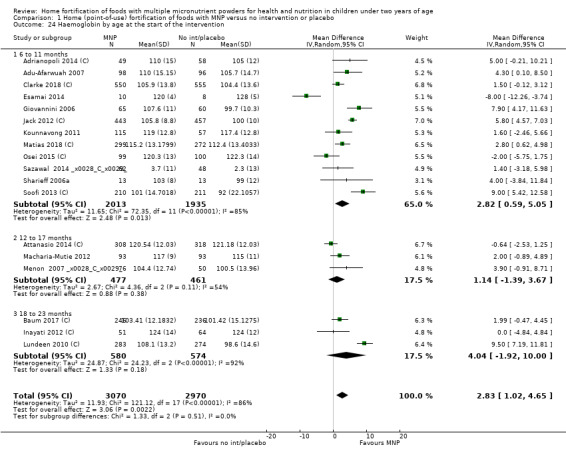
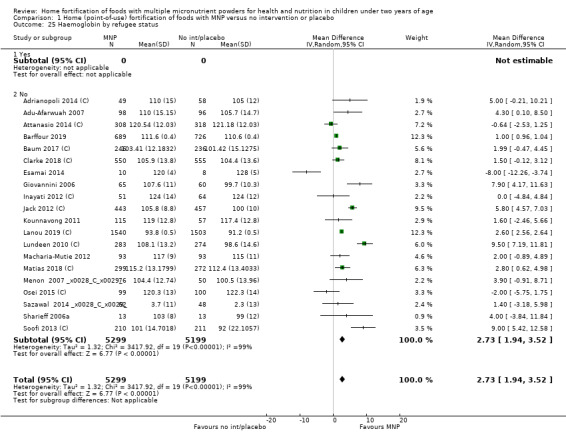
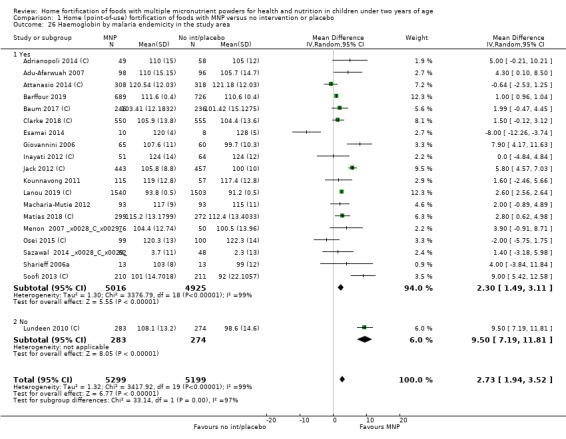
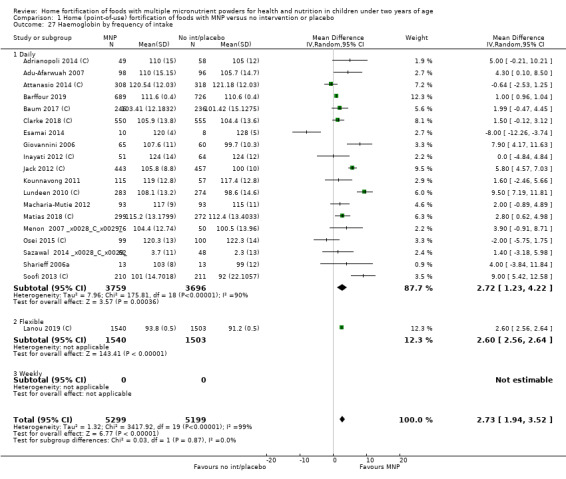
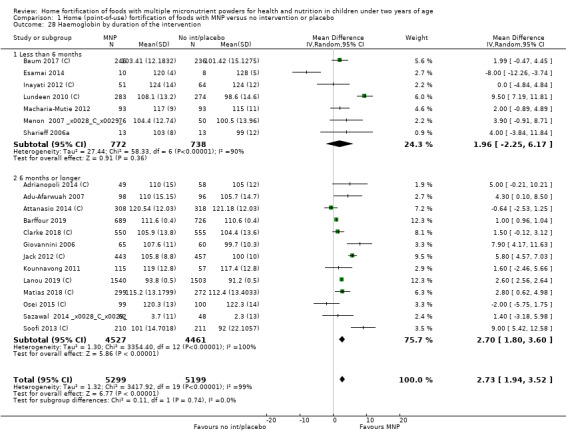
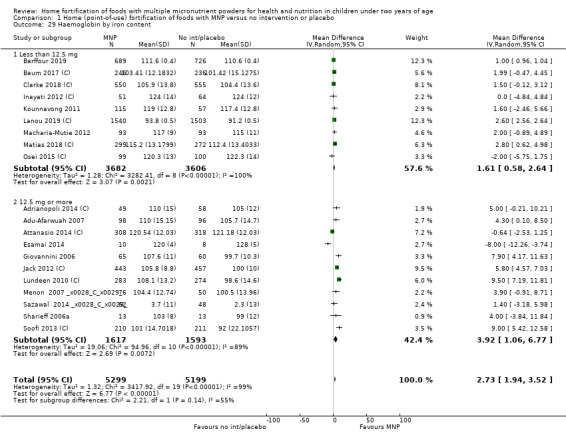
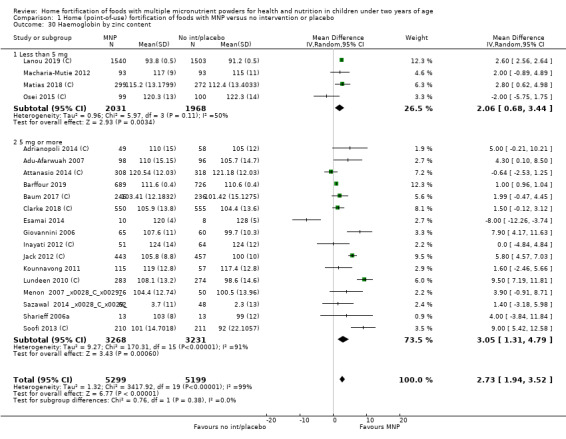
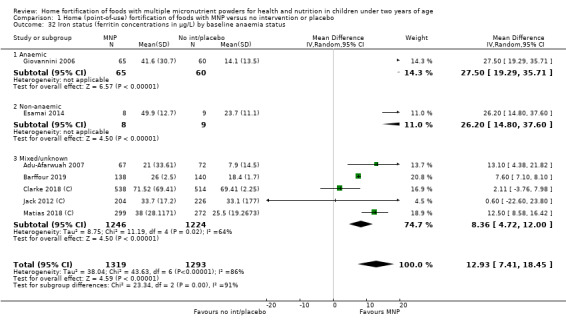
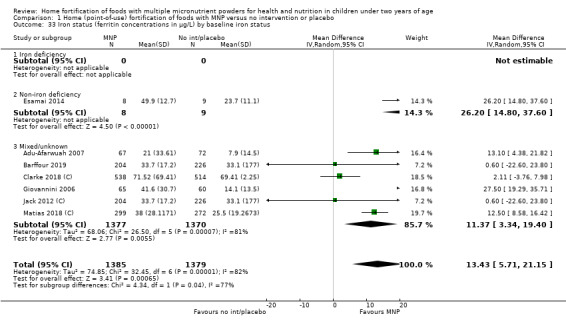
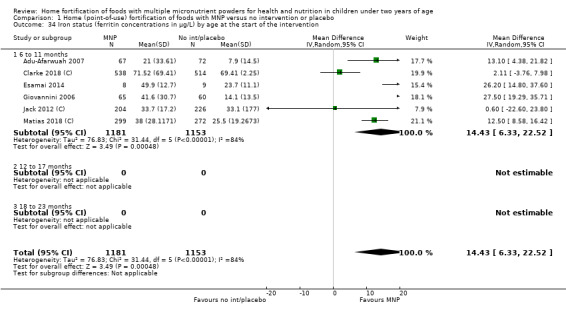
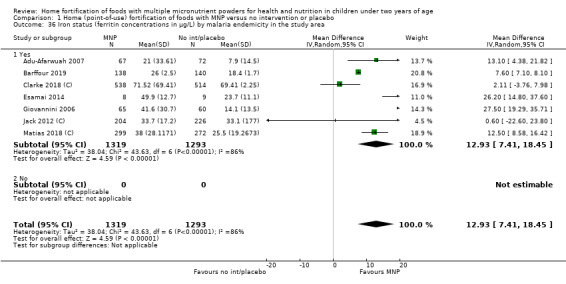
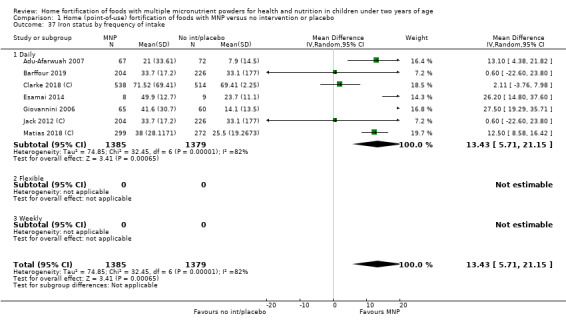
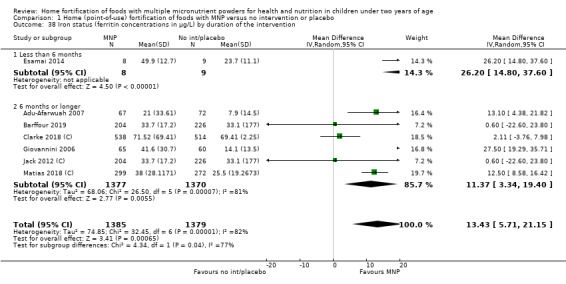
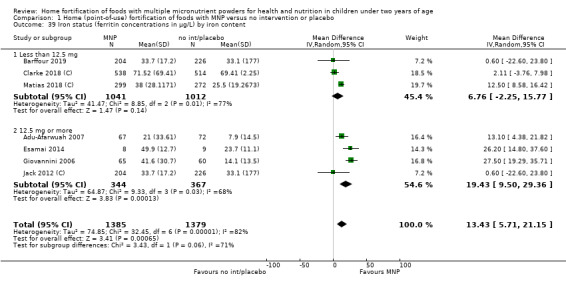
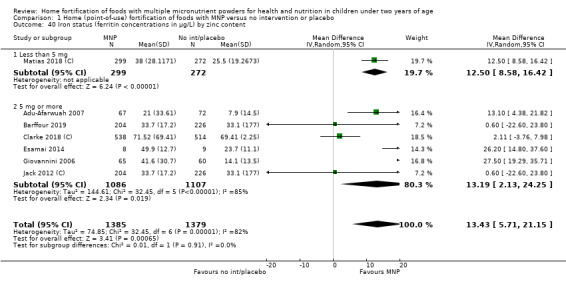
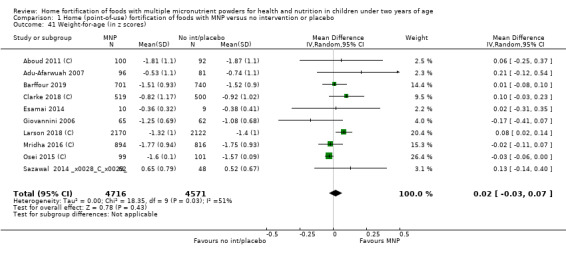
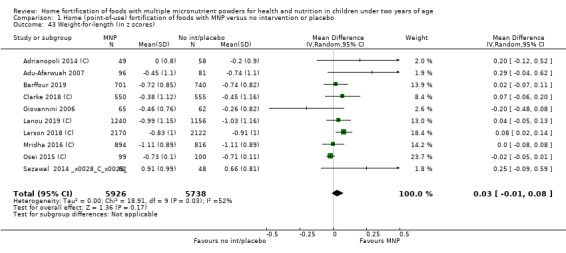
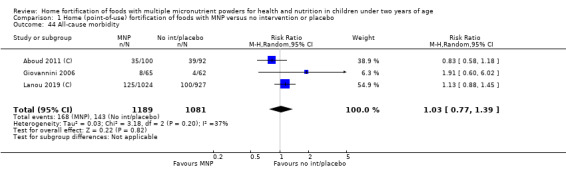
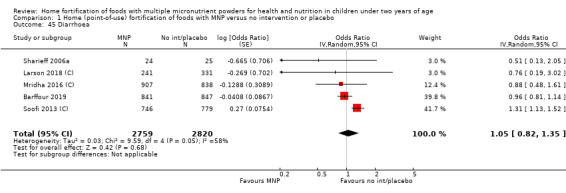
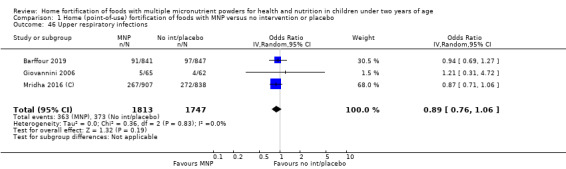
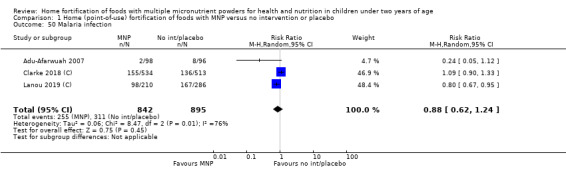
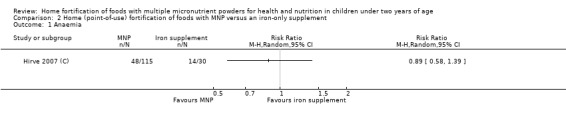
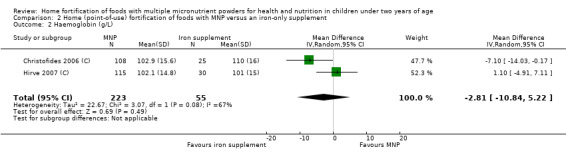
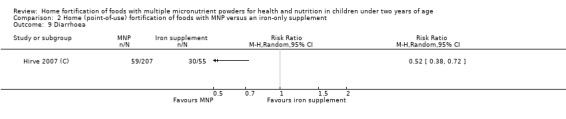
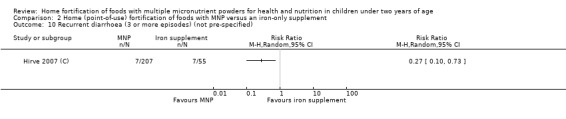
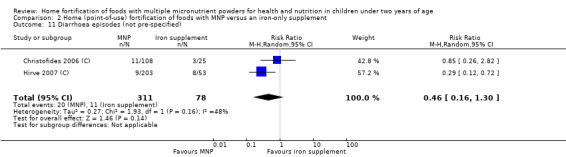
Main results: We included 29 studies (33,147 children) conducted in low- and middle-income countries in Asia, Africa, Latin America, and the Caribbean, where anaemia is a public health problem. Twenty-six studies with 27,051 children contributed data. The interventions lasted between 2 and 44 months, and the powder formulations contained between 5 and 22 nutrients. Among the 26 studies contributing data, 24 studies (26,486 children) compared the use of MNP versus no intervention or placebo; the two remaining studies compared the use of MNP versus an iron-only supplement (iron drops) given daily. The main outcomes of interest were related to anaemia and iron status. We assessed most of the included studies at low risk of selection and attrition bias. We considered some studies to be at high risk of performance and detection bias due to lack of blinding. Most studies were funded by government programmes or foundations; only two were funded by industry. Home fortification with MNP, compared with no intervention or placebo, reduced the risk of anaemia in infants and young children by 18% (RR 0.82, 95% CI 0.76 to 0.90; 16 studies; 9927 children; moderate-certainty evidence) and iron deficiency by 53% (RR 0.47, 95% CI 0.39 to 0.56; 7 studies; 1634 children; high-certainty evidence). Children receiving MNP had higher haemoglobin concentrations (MD 2.74 g/L, 95% CI 1.95 to 3.53; 20 studies; 10,509 children; low-certainty evidence) and higher iron status (MD 12.93 μg/L, 95% CI 7.41 to 18.45; 7 studies; 2612 children; moderate-certainty evidence) at follow-up compared with children receiving the control intervention. We did not find an effect on weight-for-age (MD 0.02, 95% CI -0.03 to 0.07; 10 studies; 9287 children; moderate-certainty evidence). Few studies reported morbidity outcomes (three to five studies each outcome) and definitions varied, but MNP did not increase diarrhoea, upper respiratory infection, malaria, or all-cause morbidity. In comparison with daily iron supplementation, the use of MNP produced similar results for anaemia (RR 0.89, 95% CI 0.58 to 1.39; 1 study; 145 children; low-certainty evidence) and haemoglobin concentrations (MD -2.81 g/L, 95% CI -10.84 to 5.22; 2 studies; 278 children; very low-certainty evidence) but less diarrhoea (RR 0.52, 95% CI 0.38 to 0.72; 1 study; 262 children; low-certainty of evidence). However, given the limited quantity of data, these results should be interpreted cautiously. Reporting of death was infrequent, although no trials reported deaths attributable to the intervention. Information on side effects and morbidity, including malaria and diarrhoea, was scarce. It appears that use of MNP is efficacious among infants and young children aged 6 to 23 months who are living in settings with different prevalences of anaemia and malaria endemicity, regardless of intervention duration. MNP intake adherence was variable and in some cases comparable to that achieved in infants and young children receiving standard iron supplements as drops or syrups.
Authors' conclusions: Home fortification of foods with MNP is an effective intervention for reducing anaemia and iron deficiency in children younger than two years of age. Providing MNP is better than providing no intervention or placebo and may be comparable to using daily iron supplementation. The benefits of this intervention as a child survival strategy or for developmental outcomes are unclear. Further investigation of morbidity outcomes, including malaria and diarrhoea, is needed. MNP intake adherence was variable and in some cases comparable to that achieved in infants and young children receiving standard iron supplements as drops or syrups.
Copyright © 2020 The Cochrane Collaboration. Published by John Wiley & Sons, Ltd.
Conflict of interest statement
Parminder Suchdev (PS)a receives partial salary support from the CDC for research activities in monitoring and evaluating nutrition interventions.
Luz Maria De‐Regil (LD‐R)b was a full‐time member of the staff of Nutrition International between December 2013 and December 2018. Some of the updates of this review took place during that period. Nutrition International is a non‐profit organization that receives and provides funds from or to different institutions to undertake research and implement nutrition programmes in which multiple micronutrient powders may be provided to different age groups. Some of those studies were eligible for inclusion in this review. LD‐R was not directly involved in any such studies and did not assess their eligibility for inclusion in this review. The time that LD‐R devoted to this review during her tenure at NI was partially covered with a grant from Global Affairs Canada to Nutrition International.
Maria Jefferds (MJ)a,b provides technical assistance to multiple countries for the design, implementation, monitoring, and evaluation of MNP programs. Multiple peer review and report publications have been disseminated or are under development based on that work. MJ has participated in UNICEF/CDC regional workshops on scaling up MNP interventions for young children aged 6 to 23 months. MJ is a co‐author for two publications included in a September 2013 Sight and Life supplement on MNP and was an Editor of that supplement. MJ was the co‐ordinator and writer of a monitoring manual for home fortification interventions, including micronutrient powders, for the Home Fortification Technical Advisory Group (HF‐TAG). With colleagues from CDC and UNICEF, MJ was an investigator on the first global assessment of home fortification interventions in 2011, which was published as an HF‐TAG report in 2013, and she wrote a summary journal article published in 2013. As part of UNICEF’s Nutridash System, MJ provided technical assistance in the development of an annual surveillance system of global MNP interventions. Collaborators with UNICEF and CDC also developed a home fortification toolkit and webinar series, which focused heavily on MNP. MJ has participated in executive committee meetings and strategic planning of the HF‐TAG historically and is a member of the Executive Committee.
Erika Ota ‐ none known.
Katharina da Silva Lopes ‐ none known.
aBoth PS and MJ were involved in Suchdev 2012 ‐ an study excluded from this update. They were not involved in assessing the eligibility of this study. LD‐R and EO assessed the study. bMJ and LD‐R are co‐authors on a Cochrane Review of MNP in children 2 to 12 years old (De‐Regil 2017).
Figures



Update of
-
Home fortification of foods with multiple micronutrient powders for health and nutrition in children under two years of age.Cochrane Database Syst Rev. 2011 Sep 7;(9):CD008959. doi: 10.1002/14651858.CD008959.pub2. Cochrane Database Syst Rev. 2011. Update in: Cochrane Database Syst Rev. 2020 Feb 28;2:CD008959. doi: 10.1002/14651858.CD008959.pub3. PMID: 21901727 Updated.
References
References to studies included in this review
Aboud 2011 (C) {published data only}
Adrianopoli 2014 (C) {published data only}
-
- Adrianopoli M, D’Acapito P, Ferrari M, Mistura L, Toti E, Maiani G, et al. Optimized feeding recommendations and in‐home fortification to improve iron status in infants and young children in the Republic of Tajikistan: a pilot project. In: Thompson B, Amoroso L editor(s). Improving Diets and Nutrition: Food Based Approaches. Rome: The Food and Agriculture Organization of the United Nations and CAB International, 2014:230‐245. [9781780642994 (CABI); 9789251073193 (FAO)]
Adu‐Afarwuah 2007 {published data only (unpublished sought but not used)}
-
- Adu‐Afarwuah S, Lartey A, Brown KH, Zlotkin S, Briend A, Dewey KG. Home fortification of complementary foods with micronutrient supplements is well accepted and has positive effects on infant iron status in Ghana. American Journal of Clinical Nutrition 2008;87:929‐38. [DOI: 10.1093/ajcn/87.4.929; PUBMED: 18400716] - DOI - PubMed
-
- Adu‐Afarwuah S, Lartey A, Brown KH, Zlotkin S, Briend A, Dewey KG. Randomized comparison of 3 types of micronutrient supplements for home fortification of complementary foods in Ghana: effects on growth and motor development. American Journal of Clinical Nutrition 2007;86:412‐20. [CENTRAL: CN‐00703403; DOI: 10.1093/ajcn/86.2.412; PUBMED: 17684213] - DOI - PubMed
Attanasio 2014 (C) {published data only}
-
- Andrew A, Attanasio O, Fitzsimons E, Rubio‐Codina M. Why is multiple micronutrient powder ineffective at reducing anaemia among 12–24 month olds in Colombia? Evidence from a randomised controlled trial. SSM ‐ Population Health 2016;2:95‐104. [DOI: 10.1016/j.ssmph.2016.02.004; PMC5757801; PUBMED: 29349132] - DOI - PMC - PubMed
-
- Attanasio OP, Fernández C, Fitzsimons EO, Grantham‐McGregor SM, Meghir C, Rubio‐Codina M. Using the infrastructure of a conditional cash transfer program to deliver a scalable integrated early child development program in Colombia: cluster randomized controlled trial. BMJ 2014;349:g5785. Erratum in: BMJ. 2014;349:g6126. [DOI: 10.1136/bmj.g5785; PMC4179481; PUBMED: 25266222] - DOI - PMC - PubMed
Barffour 2019 {published data only}
-
- Barffour MA, Hinnouho GM, Kounnavong S, Wessells KR, Ratsavong K, Bounheuang B, et al. Effects of daily zinc, daily multiple micronutrient powder, or therapeutic zinc for diarrhea prevention on physical growth, anemia, and micronutrient status in rural Laotian Children: a randomized controlled trial. Journal of Pediatrics 2019;207:80‐9. [DOI: 10.1016/j.jpeds.2018.11.022; PMC6448681; PUBMED: 30580974] - DOI - PMC - PubMed
-
- Barffour MA, Hinnouho GM, Kounnavong S, Wessells KR, Ratsavong K, Bounheuang B, et al. Effects of therapeutic zinc supplementation for diarrhea and two daily preventive zinc interventions on incidence and duration of diarrhea and acute respiratory tract infections in rural Laotian children. BMJ (in press). - PMC - PubMed
-
- Hess SY, Wessells KR, Hinnouho GM, Barffour MA, Sanchaisuriya K, Arnold CD, et al. Iron status and inherited haemoglobin disorders modify the effects of micronutrient powders on linear growth and morbidity among young Lao children in a double‐blind randomised trial. British Journal of Nutrition 2019;122(8):895‐909. [DOI: 10.1017/S0007114519001715; PUBMED: 31303184] - DOI - PMC - PubMed
-
- Suchdev P. Quick question about your Laos MNP trial [personal communication]. Email to: R Wessells, M Barffour, S Hess, C Arnold. 5 September 2019.
Baum 2017 (C) {published data only}
Christofides 2006 (C) {published data only}
-
- Christofides A, Asante KP, Schauer C, Sharieff W, Owusu‐Agyei S, Zlotkin S. Multi‐micronutrient Sprinkles including a low dose of iron provided as microencapsulated ferrous fumarate improves haematologic indices in anaemic children: a randomized clinical trial. Maternal & Child Nutrition 2006;2(3):169‐80. [DOI: 10.1111/j.1740-8709.2006.00060.x; PUBMED: 16881929] - DOI - PMC - PubMed
Clarke 2018 (C) {unpublished data only}
-
- Clarke S, Toure D, Dicko A, Maiga B, Griffiths Y Kraemer K, et al. An integrated parenting, nutrition and malaria prevention package to improve nutrition and child development in infants and pre‐school children: impact evaluation of a randomized controlled trial in Southern Mali. Donor report. Save the Children, 2018.
Esamai 2014 {published data only}
Giovannini 2006 {published data only}
-
- Agostoni C, Giovannini M, Sala D, Usuelli M, Livio L, Francescato C, et al. Double‐blind, placebo‐controlled trial comparing effects of supplementation of two micronutrient sprinkles on fatty acid status in Cambodian infants. Journal of Pediatric Gastroenterology and Nutrition 2007;44(1):136‐42. [DOI: 10.1097/01.mpg.0000243429.24463.2f; PUBMED: 17204967] - DOI - PubMed
-
- Giovannini M, Sala D, Usuelli M, Livio L, Francescato G, Braga M, et al. Double‐blind, placebo‐controlled trial comparing effects of supplementation with two different combinations of micronutrients delivered as sprinkles on growth, anemia, and iron deficiency in Cambodian infants. Journal of Pediatrics Gastroenterology and Nutrition 2006;42(3):306‐12. [DOI: 10.1097/01.mpg.0000189363.07040.4b00011; PUBMED: 16540800] - DOI - PubMed
Hirve 2007 (C) {published and unpublished data}
-
- Regil L. Request of information ‐ Cochrane Review on home fortification of food with multiple micronutrient powders in children under 2 years of age [personal communication]. Email to: S Bhave. 10 February 2011.
-
- Hirve S. KEM Pune sprinkles study ‐ Cochrane Review [personal communication]. Email to: L de Regil. 28 February 2011.
-
- Hirve S, Bhave S, Bavdekar A, Naik S, Pandit A, Schauer C, et al. Low dose 'Sprinkles' ‐ an innovative approach to treat iron deficiency anemia in infants and young children. Indian Pediatrics 2007;44(2):91‐100. [PUBMED: 17351300] - PubMed
Inayati 2012 (C) {published data only}
-
- Regil L. Your paper on MNP [personal communication]. Email to: V Scherbaum. 17 July 2012; 2 August 2012; 29 January 2013; 5 February 2013.
-
- Inayati DA, Scherbaum V, Purwestri RC, Wirawan NN, Suryantan J, Hartono S, et al. Combined intensive nutrition education and micronutrient powder supplementation improved nutritional status of mildly wasted children on Nias Island, Indonesia. Asia Pacific Journal of Clinical Nutrition 2012;21(3):361‐73. [PUBMED: 22705425] - PubMed
-
- Inayati DA, Scherbaum V, Purwestri RC, Wirawan NN, Suryantan J, Hartono S, et al. Improved nutrition knowledge and practice through intensive nutrition education: a study among caregivers of mildly wasted children on Nias Island, Indonesia. Food and Nutrition Bulletin 2012;33(2):117‐27. [DOI: 10.1177/156482651203300205; PUBMED: 22908693] - DOI - PubMed
-
- Purwestri RC, Scherbaum V, Inayati DA, Wirawan NN, Suryantan J, Bloem MA, et al. Supplementary feeding with locally‐produced Ready‐to‐Use Food (RUF) for mildly wasted children on Nias Island, Indonesia: comparison of daily and weekly program outcomes. Asia Pacific Journal of Clinical Nutrition 2012;21(3):374‐9. [PUBMED: 22705426] - PubMed
-
- Scherbaum V. Your paper on MNP [personal communication]. Email to: L de Regil. 18 July 2012; 5 February 2013; 8 February 2013.
Jack 2012 (C) {published data only}
Kounnavong 2011 {published data only}
-
- Kounnavong S, Sunahara T, Mascie‐Taylor CG, Hashizume M, Okumura J, Moji K, et al. Effect of daily versus weekly home fortification with multiple micronutrient powder on haemoglobin concentration of young children in a rural area, Lao People's Democratic Republic: a randomised trial. Nutrition Journal 2011;10:129. [DOI: 10.1186/1475-2891-10-129; PMC3266642 ; PUBMED: 22111770] - DOI - PMC - PubMed
Lanou 2019 (C) {published data only}
-
- Lanou HB, Osendarp SJM, Argaw A, Polnay K, Ouédraogo C, Kouanda S, et al. Micronutrient powder supplements combined with nutrition education marginally improve growth amongst children aged 6‐23 months in rural Burkina Faso: a cluster randomized controlled trial. Maternal & Child Nutrition 2019;15(4):12820. [DOI: 10.1111/mcn.12820; PUBMED: 30941887] - DOI - PMC - PubMed
Larson 2018 (C) {published data only}
-
- Larson LM, Young MF, Bauer PJ, Mehta R, Webb Girard A, Ramakrishnan U, et al. Effectiveness of a home fortification programme with multiple micronutrients on infant and young child development: a cluster‐randomised trial in rural Bihar, India. British Journal of Nutrition 2018;120(2):176‐87. [DOI: 10.1017/S000711451800140X; PMC6088539; PUBMED: 29947323] - DOI - PMC - PubMed
-
- Young MF. Bihar MNP results [personal communication]. Email to: P Suchdev. 5 December 2019.
-
- Young MF, Mehta R, Gosdin L, Kekre P, Verma P, Larson L, et al. Impact of home fortification of complementary foods program on child anemia and stunting in Bihar, India. FASEB Journal 2017;31(1 Suppl). [Abstract #165.7]
Lundeen 2010 (C) {published and unpublished data}
-
- Lundeen E, Schueth T, Toktobaev N, Zlotkin S, Hyder SM, Houser R. Daily use of Sprinkles micronutrient powder for 2 months reduces anemia among children 6 to 36 months of age in the Kyrgyz Republic: a cluster‐randomized trial. Food and Nutrition Bulletin 2010;31(3):446‐60. [DOI: 10.1177/156482651003100307; PUBMED: 20973465 ] - DOI - PubMed
Luo 2017 (C) {published data only}
-
- Luo R, Yue A, Zhou H, Shi Y, Zhang L, Martorell R, et al. The effect of a micronutrient powder home fortification program on anemia and cognitive outcomes among young children in rural China: a cluster randomized trial. BMC Public Health 2017;17(1):738. [DOI: 10.1186/s12889-017-4755-0; PMC5613507; PUBMED: 28946866] - DOI - PMC - PubMed
Macharia‐Mutie 2012 {published data only}
-
- Macharia‐Mutie CW, Moretti D, Briel N, Omusundi AM, Mwangi AM, Kok FJ, et al. Maize porridge enriched with a micronutrient powder containing low‐dose iron as NaFeEDTA but not amaranth grain flour reduces anemia and iron deficiency in Kenyan preschool children. Journal of Nutrition 2012;142(9):1756‐63. [DOI: 10.3945/jn.112.157578; PUBMED: 22810982] - DOI - PubMed
-
- Macharia‐Mutie CW, Omusundi AM, Mwai JM, Mwangi AM, Brouwer ID. Simulation of the effect of maize porridge fortified with grain amaranth or micronutrient powder containing NaFeEDTA on iron intake and status in Kenyan children. Public Health Nutrition 2013;16(9):1605‐13. [DOI: 10.1017/S1368980012005174; PUBMED: 23218415] - DOI - PMC - PubMed
Matias 2018 (C) {published data only}
-
- Matias SL, Mridha MK, Young RT, Khan MSA, Siddiqui Z, Ullah MB, et al. Prenatal and postnatal supplementation with lipid‐based nutrient supplements reduces anemia and iron deficiency in 18‐month‐old Bangladeshi children: a cluster‐randomized effectiveness trial. Journal of Nutrition 2018;148(7):1167‐76. [DOI: 10.1093/jn/nxy078; PUBMED: 29901736] - DOI - PubMed
Menon 2007 (C) {published and unpublished data}
-
- Loechl CU, Menon P, Arimond M, Ruel MT, Pelto G, Habicht JP, et al. Using programme theory to assess the feasibility of delivering micronutrient Sprinkles through a food‐assisted maternal and child health and nutrition programme in rural Haiti. Maternal & Child Nutrition 2009;5(1):33‐48. [DOI: 10.1111/j.1740-8709.2008.00154.x; PUBMED: 19161543] - DOI - PMC - PubMed
-
- Menon P, Ruel MT, Loechl CU, Arimond M, Habicht JP, Pelto G, et al. Micronutrient Sprinkles reduce anemia among 9‐ to 24‐mo‐old children when delivered through an integrated health and nutrition program in rural Haiti. Journal of Nutrition 2007;137(4):1023‐30. [DOI: 10.1093/jn/137.4.1023; PUBMED: 17374671] - DOI - PubMed
Mridha 2016 (C) {published data only}
-
- Dewey KG, Mridha MK, Matias SL, Arnold CD, Cummins JR, Khan MS, et al. Lipid‐based nutrient supplementation in the first 1000 d improves child growth in Bangladesh: a cluster‐randomized effectiveness trial. American Journal of Clinical Nutrition 2017;105(4):944‐57. [DOI: 10.3945/ajcn.116.147942; PUBMED: 28275125] - DOI - PubMed
-
- Matias SL, Mridha MK, Tofail F, Arnold CD, Khan MS, Siddiqui Z, et al. Home fortification during the first 1000 d improves child development in Bangladesh: a cluster‐randomized effectiveness trial. American Journal of Clinical Nutrition 2017;105(4):958‐69. [DOI: 10.3945/ajcn.116.150318; PUBMED: 28275128] - DOI - PubMed
-
- Mridha MK, Matias SL, Chaparro CM, Paul RR, Hussain S, Vosti SA, et al. Lipid‐based nutrient supplements for pregnant women reduce newborn stunting in a cluster‐randomized controlled effectiveness trial in Bangladesh. American Journal of Clinical Nutrition 2016;103(1):236‐49. [DOI: 10.3945/ajcn.115.111336; PMC6443293; PUBMED: 26607935] - DOI - PMC - PubMed
-
- Ullah MB, Mridha MK, Arnold CD, Matias SL, Khan MSA, Siddiqui Z, et al. Provision of pre‐ and postnatal nutritional supplements generally did not increase or decrease common childhood illnesses in Bangladesh: a cluster‐randomized effectiveness trial. Journal of Nutrition 2019;149(7):1271‐81. [DOI: 10.1093/jn/nxz059; PUBMED: 31162588] - DOI - PubMed
Olney 2018 (C) {published data only}
-
- Olney DK, Leroy J, Bliznashka L, Ruel MT. PROCOMIDA, a food‐assisted maternal and child health and nutrition program, reduces child stunting in Guatemala: a cluster‐randomized controlled intervention trial. Journal of Nutrition 2018;148(9):1493‐505. [DOI: 10.1093/jn/nxy138; PMC6118165; PUBMED: 30184223] - DOI - PMC - PubMed
Osei 2015 (C) {published data only}
-
- Osei KA, Pandey P, Spiro D, Adhikari D, Haselow N, Morais C, et al. Adding multiple micronutrient powders to a homestead food production programme yields marginally significant benefit on anaemia reduction among young children in Nepal. Maternal & Child Nutrition 2015;11(Suppl 4):188‐202. [DOI: 10.1111/mcn.12173; PUBMED: 25682798] - DOI - PMC - PubMed
Sazawal 2014 (C) {published data only}
-
- Sazawal S, Dhingra P, Dhingra U, Gupta S, Iyengar V, Menon VP, et al. Compliance with home‐based fortification strategies for delivery of iron and zinc: its effect on haematological and growth markers among 6‐24 months old children in north India. Journal of Health, Population and Nutrition 2014;32(2):217‐26. [PMC4216958; PUBMED: 25076659] - PMC - PubMed
Sharieff 2006a {published data only}
Somassè 2018 (C) {published data only}
-
- Somassè YE, Dramaix M, Traoré B, Ngabonziza I, Touré O, Konaté M, et al. The WHO recommendation of home fortification of foods with multiple‐micronutrient powders in children under 2 years of age and its effectiveness on anaemia and weight: a pragmatic cluster‐randomized controlled trial. Public Health Nutrition 2018;21(7):1350‐8. [DOI: 10.1017/S1368980017003858; PUBMED: 29352829] - DOI - PMC - PubMed
Soofi 2013 (C) {published data only}
-
- Soofi S, Cousens S, Iqbal SP, Akhund T, Khan J, Ahmed I, et al. Effect of provision of daily zinc and iron with several micronutrients on growth and morbidity among young children in Pakistan: a cluster‐randomised trial. Lancet 2013;382(9886):29‐40. [DOI: 10.1016/S0140-6736(13)60437-7; PUBMED: 23602230] - DOI - PubMed
Young 2018 (C) {published data only}
References to studies excluded from this review
Avula 2011 {published data only}
Bagni 2009 {published data only}
-
- Bagni UV, Baiao MR, Souza Santos MMA, Luiz RR, Veiga GV. Effect of weekly rice fortification with iron on anaemia prevalence and haemoglobin concentration among children attending public daycare centres in Rio de Janeiro, Brazil [Efeito da fortificao semanel do arroz com ferro quelato sobre a frequencia de anemia e concentracao de hemoglobina em criancas de creches municipais de Rio de Janeiro, Brasil]. Cadernos de Saude Publica 2009;25(2):291‐302. [PUBMED: 19219236] - PubMed
Barth‐Jaeggi 2015 {published data only}
-
- Barth‐Jaeggi T, Moretti D, Kvalsvig J, Holding PA, Njenga J, Mwangi A, et al. In‐home fortification with 2.5 mg iron as NaFeEDTA does not reduce anaemia but increases weight gain: a randomised controlled trial in Kenyan infants. Maternal & Child Nutrition 2015;11(Suppl 4):151‐62. [DOI: 10.1111/mcn.12163; PUBMED: 25420455] - DOI - PMC - PubMed
Bilenko 2014 {published data only}
-
- Bilenko N, Belmaker I, Vardi H, Fraser D. Efficacy of multiple micronutrient supplementations on child health: study design and baseline characteristics. Israel Medical Association Journal 2010;12(6):342‐7. [PUBMED: 20928987] - PubMed
-
- Bilenko N, Fraser D, Vardy H, Belmaker I. Impact of multiple micronutrient supplementation ("sprinkles") on iron deficiency anemia in Bedouin Arab and Jewish infants. Israel Medical Association Journal 2014;16(7):434‐8. [PUBMED: 25167690] - PubMed
Cardoso 2016 {published data only}
-
- Cardoso MA, Augusto RA, Bortolini GA, Oliveira CS, Tietzman DC, Sequeira LA, et al. ENFAC Working Group. Effect of providing multiple micronutrients in powder through primary healthcare on anemia in young Brazilian children: a multicentre pragmatic controlled trial. PLoS One 2016;11(3):e0151097. [DOI: 10.1371/journal.pone.0151097; PMC4871551 ; PUBMED: 27192494] - DOI - PMC - PubMed
-
- Silva LLS, Augusto RA, Tietzmann DC, Sequeira LAS, Hadler MCCM, Muniz PT, et al. ENFAC Working Group. The impact of home fortification with multiple micronutrient powder on vitamin A status in young children: a multicenter pragmatic controlled trial in Brazil. Maternal & Child Nutrition 2017;13(4):e12403. [10.1111/mcn.12403; PUBMED: 27925426] - PMC - PubMed
Chen 2008 {published data only}
-
- Chen K, Li TY, Chen L, Qu P, Liu YX. Effects of vitamin A, vitamin A plus iron and multiple micronutrient‐fortified seasoning powder on preschool children in a suburb of Chongqing, China. Journal of Nutritional Science and Vitaminology 2008;54(6):440‐7. [PUBMED: 19155581] - PubMed
Geltman 2009 {published data only}
-
- Geltman PL, Hironaka LK, Mehta SD, Padilla P, Rodrigues P, Meyers AF, et al. Iron supplementation of low‐income infants: a randomized clinical trial of adherence with ferrous fumarate sprinkles versus ferrous sulfate drops. Journal of Pediatrics 2009;154(5):738‐43. [DOI: 10.1016/j.jpeds.2008.11.003; PUBMED: 19111318 ] - DOI - PubMed
Goyena 2019 {published data only}
-
- Goyena EA, Barba CVC, Talavera MTM, Paunlagui MM, Rola AC, Tandang NA. Acceptance and compliance with micronutrient powder and complementary food blend use by Filipino mothers and their promotion by community workers. Food and Nutrition Bulletin 2019;40(2):202‐20. [DOI: 10.1177/0379572119833853; PUBMED: 30866669] - DOI - PubMed
Ip 2009 {published data only}
-
- Ip H, Hyder SM, Haseen F, Rahman M, Zlotkin SH. Improved adherence and anaemia cure rates with flexible administration of micronutrient Sprinkles: a new public health approach to anaemia control. European Journal of Clinical Nutrition 2009;63(2):165‐72. [DOI: 10.1038/sj.ejcn.1602917; PUBMED: 17895911 ] - DOI - PubMed
Jaeggi 2015 {published data only}
-
- Jaeggi T, Kortman GA, Moretti D, Chassard C, Holding P, Dostal A, et al. Iron fortification adversely affects the gut microbiome, increases pathogen abundance and induces intestinal inflammation in Kenyan infants. Gut 2015;64:731‐42. [DOI: 10.1136/gutjnl-2014-307720; NCT01111864.; PUBMED: 25143342] - DOI - PubMed
Jyoti 2014 {published data only}
-
- Jyoti V, Sharma S. Impact of micronutrients sprinkle on weight and height of children aged 6‐36 months in Tonk district of Rajasthan state. Indian Journal of Community Health 2014;26:294‐9.
Khan 2014 {published data only}
-
- Khan WU, Shafique S, Shikder H, Shakur YA, Sellen DW, Chowdhury JS, et al. Home fortification with calcium reduces Hb response to iron among anaemic Bangladeshi infants consuming a new multi‐micronutrient powder formulation. Public Health Nutrition 2014;17:1578. [DOI: 10.1017/S1368980013001742; PUBMED: 23816321] - DOI - PMC - PubMed
Lemaire 2011 {published data only}
-
- Lemaire M, Islam QS, Shen H, Khan MA, Parveen M, Abedin F, et al. Iron‐containing micronutrient powder provided to children with moderate‐to‐severe malnutrition increases hemoglobin concentrations but not the risk of infectious morbidity: a randomized, double‐blind, placebo‐controlled, noninferiority safety trial. American Journal of Clinical Nutrition 2011;94(2):585‐93. [DOI: 10.3945/ajcn.110.009316; PUBMED: 21715512] - DOI - PubMed
Munayco 2013 {published data only}
-
- Harding K, Zavaleta N, Roche M, Neufeld L. Caregiver perceptions, practices, and preferences relating to multiple micronutrient powders for children 6‐23 mo of age in the northern highlands of Peru. FASEB Journal 2014;28(1 Suppl). [Abstract #: 804.28]
-
- Munayco CV, Ulloa‐Rea ME, Medina‐Osis J, Lozano‐Revollar CR, Tejada V, Castro‐Salazar C, et al. Evaluation of the impact of multiple micronutrient powders on children anemia in three Andean regiones in Peru [Evaluación del impacto de los multimicronutrientes en polvo sobre la anemia infantil en tres regiones andinas del Perú]. Revista Peruana de Medicina Experimental y Salud Publica 2013;30(2):229‐34. [PUBMED: 23949507] - PubMed
-
- Trelles S, Munayco CV. Impact and adherence of multi‐micronutrient supplementation in Peruvian children [Impacto y adherencia de la suplementación con multimicronutrientes en niños de Perú]. Revista Peruana de Medicina Experimental y Salud Publica 2019;36(1):147‐8. [DOI: 10.17843/rpmesp.2019.361.4051; PUBMED: 31116330] - DOI - PubMed
Neufeld 2008 {unpublished data only}
-
- Colchero A, Neufeld LM. Cost estimations of different types of micronutrient supplements for children and pregnant women. FASEB Journal 2008; Vol. 22, issue 1 Suppl. [Abstract #: 678.21]
-
- García‐Guerra A, Neufeld LM, Domínguez CP, García‐Feregrino R, Hernández‐Cabrera A. Effect of three supplements with identical micronutrient content on anemia in Mexican children. FASEB Journal 2008; Vol. 22, issue 1 Suppl. [Abstract #: 677.5]
Rawat 2015 {published data only}
-
- Rawat R, Saha K, Kennedy A, Ruel M, Menon P. Sale of micronutrient powders (MNPs) by frontline workers (FLWs) enables high reach, but low uptake limits impact on anemia and iron status: a cluster randomized study in Bangladesh. FASEB Journal 2015;29(1 Suppl):391.6.
Samadpour 2011 {published data only}
-
- Samadpour K, Long KZ, Hayatbakhsh R, Marks GC. Randomised comparison of the effects of Sprinkles and Foodlets with the currently recommended supplement (Drops) on micronutrient status and growth in Iranian children. European Journal of Clinical Nutrition 2011;65(12):1287‐94. [DOI: 10.1038/ejcn.2011.124; PUBMED: 21750564] - DOI - PubMed
Shafique 2014 {published data only}
-
- Shafique S, Singla D, Aboud F, Jolly S, Zlotkin S. Multiple micronutrient powders reduce stunting and anemia and improve language development among full‐term low birth weight children in Bangladesh (389.3). FASEB Journal 2014;28(1 Suppl):389.3.
Sharieff 2006b {published data only}
-
- Sharieff W, Yin SA, Wu M, Yang Q, Schauer C, Tomlinson G, et al. Short‐term daily or weekly administration of micronutrient Sprinkles has high compliance and does not cause iron overload in Chinese schoolchildren: a cluster‐randomized trial. Public Health Nutrition 2006;9(3):336‐44. [PUBMED: 16684385] - PubMed
Singla 2014 {published data only}
-
- Shafique S, Sellen DW, Lou W, Jalal CS, Jolly SP, Zlotkin SH. Mineral‐ and vitamin‐enhanced micronutrient powder reduces stunting in full‐term low‐birth‐weight infants receiving nutrition, health, and hygiene education: a 2 × 2 factorial, cluster‐randomized trial in Bangladesh. American Journal of Clinical Nutrition 2016;103:1357‐69. [DOI: 10.3945/ajcn.115.117770; PUBMED: 27053383] - DOI - PubMed
Smuts 2005 {published data only}
-
- Smuts CM, Dhansay MA, Faber M, Stuijvenberg ME, Swanevelder S, Gross R, et al. Efficacy of multiple micronutrient supplementation for improving anemia, micronutrient status, and growth in South African infants. Journal of Nutrition 2005;135(3):653S‐9S. [DOI: 10.1093/jn/135.3.653S; PUBMED: 15735110] - DOI - PubMed
Suchdev 2012 {published and unpublished data}
-
- Centers for Disease Control and Prevention. Baseline data from the Nyando Integrated Child Health and Education Project ‐ Kenya, 2007. Morbidity and Mortality Weekly Report: MMWR 2007;56(42):1109‐13. [PUBMED: 17962803] - PubMed
-
- Suchdev PS, Addo OY, Martorell R, Grant FKE, Ruth LJ, Patel MK, et al. Effects of community‐based sales of micronutrient powders on morbidity episodes in preschool children in Western Kenya. American Journal of Clinical Nutrition 2016;103:934‐41. [DOI: 10.3945/ajcn.115.118000; NCT01088958; PUBMED: 26864367] - DOI - PMC - PubMed
-
- Suchdev PS, Addo Y, Martorell R, Grant FK, Ruth LJ, Patel M, et al. Effects of community‐based sales of micronutrient powders on morbidity episodes in preschool children in Western Kenya. American Journal of Clinical Nutrition 2016;103:934‐41. [DOI: 10.3945/ajcn.115.118000; PUBMED: 26864367 ] - DOI - PMC - PubMed
-
- Suchdev PS, Ruth LJ, Woodruff BA, Mbakaya C, Mandava U, Flores‐Ayala R, et al. Selling Sprinkles micronutrient powder reduces anemia, iron deficiency, and vitamin A deficiency in young children in Western Kenya: a cluster‐randomized controlled trial. American Journal of Clinical Nutrition 2012;95(5):1223‐30. [DOI: 10.3945/ajcn.111.030072; NCT01088958; PUBMED: 22492366] - DOI - PMC - PubMed
Teshome 2017 {published data only}
-
- Teshome EM, Andang'o PEA, Osoti V, Terwel SR, Otieno W, Demir AY, et al. Daily home fortification with iron as ferrous fumarate versus NaFeEDTA: a randomised, placebo‐controlled, non‐inferiority trial in Kenyan children. BMC Medicine 2017;15(1):89. [DOI: 10.1186/s12916-017-0839-z; PMC5408380; PUBMED: 28449690] - DOI - PMC - PubMed
-
- Teshome EM, Oriaro VS, Andango PEA, Prentice AM, Verhoef H. Adherence to home fortification with micronutrient powders in Kenyan pre‐school children: self‐reporting and sachet counts compared to an electronic monitoring device. BMC Public Health 2018;18(1):205. [DOI: 10.1186/s12889-018-5097-2; PMC5796300; PUBMED: 29391008] - DOI - PMC - PubMed
-
- Teshome EM, Otieno W, Terwel SR, Osoti V, Demir AY, Andango PEA, et al. Comparison of home fortification with two iron formulations among Kenyan children: rationale and design of a placebo‐controlled non‐inferiority trial. Contemporary Clinical Trials Communications 2017;7:1‐10. [DOI: 10.1016/j.conctc.2017.04.007; PMC5898495; PUBMED: 29696163] - DOI - PMC - PubMed
Troesch 2009 {published data only}
-
- Troesch B. Optimized micronutrient powder containing low levels of highly bioavailable iron and zinc together with EDTA, phytase and ascorbic acid improves the nutritional status of children. Sight and Life Magazine 2010, issue 3:9‐14.
-
- Troesch B, Egli I, Zeder C, Hurrell RF, Pee S, Zimmermann MB. Optimization of a phytase‐containing micronutrient powder with low amounts of highly bioavailable iron for in‐home fortification of complementary foods. American Journal of Clinical Nutrition 2009;89(2):539‐44. [DOI: 10.3945/ajcn.2008.27026; PUBMED: 19106242] - DOI - PubMed
Troesch 2011 {published data only}
-
- Troesch B, Stujivenberg ME, Smuts CM, Kruger HS, Biebinger R, Hurrell RF, et al. A micronutrient powder with low doses of highly absorbable iron and zinc reduces iron and zinc deficiency and improves weight‐for‐age Z‐scores in South African children. Journal of Nutrition 2011;141(2):237‐42. [DOI: 10.3945/jn.110.129247; PUBMED: 21178093] - DOI - PubMed
Van der Kam 2016a {published data only}
-
- Kam S, Salse‐Ubach N, Roll S, Swarthout T, Gayton‐Toyoshima S, Jiya NM, et al. Effect of short‐term supplementation with ready‐to‐use therapeutic food or micronutrients for children after illness for prevention of malnutrition: a randomised controlled trial in Nigeria. PLoS Medicine 2016;13(2):e1001952. [DOI: 10.1371/journal.pmed.1001952; PMC4747530; PUBMED: 26859559] - DOI - PMC - PubMed
Van der Kam 2016b {published data only}
-
- Kam S, Roll S, Swarthout T, Edyegu‐Otelu G, Matsumoto A, Kasujja FX, et al. Effect of short‐term supplementation with ready‐to‐use therapeutic food or micronutrients for children after illness for prevention of malnutrition: a randomised controlled trial in Uganda. PLoS Medicine 2016;13(2):e1001951. [DOI: 10.1371/journal.pmed.1001951; PMC4747529; PUBMED: 26859481] - DOI - PMC - PubMed
Wang 2017 {published data only}
-
- Trehan I. A combined package of micronutrients and albendazole does not improve environmental enteric dysfunction or stunting in rural Malawian children. Journal of Pediatric Gastroenterology and Nutrition 2016;63(Suppl 2):S38.
-
- Wang AZ, Shulman RJ, Crocker AH, Thakwalakwa C, Maleta KM, Devaraj S, et al. A combined intervention of zinc, multiple micronutrients, and albendazole does not ameliorate environmental enteric dysfunction or stunting in rural Malawian children in a double‐blind randomized controlled trial. Journal of Nutrition 2017;147(1):97‐103. [DOI: 10.3945/jn.116.237735; NCT02253095; PUBMED: 27807040] - DOI - PubMed
Wijaya‐Erhardt 2007 {published data only}
-
- Wijaya‐Erhardt M, Erhardt JG, Untoro J, Karyadi E, Wibowo L, Gross R. Effects of daily or weekly multiple‐micronutrient and iron foodlike tablets on body iron stores of Indonesian infants aged 6‐12 mo: a double‐blind, randomized, placebo‐controlled trial. American Journal of Clinical Nutrition 2007;86(6):1680‐6. [DOI: 10.1093/ajcn/86.6.1680; PUBMED: 18065586] - DOI - PubMed
Yousafzai 2014 {published data only}
-
- Yousafzai AK, Obradović J, Rasheed MA, Rizvi A, Portilla XA, Tirado‐Strayer N, et al. Effects of responsive stimulation and nutrition interventions on children's development and growth at age 4 years in a disadvantaged population in Pakistan: a longitudinal follow‐up of a cluster‐randomised factorial effectiveness trial. Lancet Global Health 2016;4(8):e548‐58. [DOI: 10.1016/S2214-109X(16)30100-0; PUBMED: 27342433] - DOI - PubMed
-
- Yousafzai AK, Rasheed MA, Rizvi A, Armstrong R, Bhutta ZA. Effect of integrated responsive stimulation and nutrition interventions in the lady health worker programme in Pakistan on child development, growth, and health outcomes: a cluster‐randomised factorial effectiveness trial. Lancet 2014;384(9950):1282‐93. [DOI: 10.1016/S0140-6736(14)60455-4.; PUBMED: 24947106] - DOI - PubMed
Zlotkin 2001 {published data only}
Zlotkin 2003a {published data only}
Zlotkin 2003b {published data only}
Zlotkin 2013 {published data only}
References to studies awaiting assessment
Fernandez‐Rao 2014 {published data only}
-
- Fernandeez‐Rao S, Hurley K, Nair M, Balakrishna N, Tilton N, Radhakrishna V, et al. Multiple micronutrients and early learning interventions promote Infant micronutrient status and development. FASEB Journal 2015;29(1 Suppl):28.2.
-
- Fernandez‐Rao S, Hurley KM, Nair KM, Balakrishna N, Radhakrishna KV, Ravinder P, et al. Integrating nutrition and early child‐development interventions among infants and preschoolers in rural India. Annals of the New York Academy of Sciences 2014;1308:218‐31. [DOI: 10.1111/nyas.12278; PUBMED: 24673168] - DOI - PubMed
Hasan 2017 {published and unpublished data}
-
- Hasan MI, Hossain SJ, Braat S, Dibley MJ, Fisher J, Grantham‐McGregor S, et al. Benefits and Risks of Iron interventionS in Children (BRISC): protocol for a three‐arm parallel‐group randomised controlled field trial in Bangladesh. BMJ Open 2017;7(11):e018325. [DOI: 10.1136/bmjopen-2017-018325; PMC5695407; PUBMED: 29146650] - DOI - PMC - PubMed
Islam 2018b {published data only}
-
- Islam MM, McDonald CM, Krebs NF, Westcott J, Rahman AE, Arifeen S, et al. Study protocol for a randomized, double‐blind, community‐based efficacy trial of various doses of zinc in micronutrient powders or tablets in young Bangladeshi children. Nutrients 2018;10(2):132. [DOI: 10.3390/nu10020132; PMC5852708; PUBMED: 30720778] - DOI - PMC - PubMed
ISRCTN39244429 {published and unpublished data}
-
- ISRCTN39244429. Nutritional supplement sprinkles with zinc and micronutrients [Efficacy of the nutritional supplement sprinkles with zinc and micronutrients on anaemia and acute diarrhoea in Peruvian children]. www.isrctn.com/ISRCTN39244429 (first received 12 February 2010).
-
- Warthon‐Medina M, Qualter P, Zavaleta N, Dillon S, Lazarte F, Lowe NM. The long term impact of micronutrient supplementation during infancy on cognition and executive function performance in pre‐school children. Nutrients 2015;7(8):6606‐27. [DOI: 10.3390/nu7085302; PMC4555141 ; PUBMED: 26262642] - DOI - PMC - PubMed
ISRCTN57594793 {unpublished data only}
-
- ISRCTN57594793. Multiple micronutrient supplementation improves growth and hemoglobin of infants in Gaza Strip, Palestine [Multiple micronutrient supplementation improves growth and hemoglobin of infants in Gaza Strip, Palestine: a randomized community trial]. www.isrctn.com/ISRCTN57594793 (first received 2 January 2018).
Additional references
Adetifa 2009
Angermayr 2004
Balshem 2010
Beaton 1993
-
- Beaton G, Martorell R, Aronson K, Edmonston B, McCabe G, Ross CA, et al. Effectiveness of vitamin A supplementation in the control of young child morbidity and mortality in developing countries. UN, ACC/SCN State‐of‐the‐Art Series. Nutrition Policy Discussion Paper No 13. 1993.
Beaton 1999
-
- Beaton GH, McCabe GP. Efficacy of intermittent iron supplementation in the control of iron deficiency anaemia in developing countries. An analysis of experience: final report to the Micronutrient Initiative. Ottowa, Micronutrient Initiative. [ISBN 1‐894217‐08‐X]
Berger 1997
-
- Berger J, Aguayo VM, Tellez W, Lujan C, Traissac P, San Miguel JL. Weekly iron supplementation is as effective as 5 day per week iron supplementation in Bolivian school children living at high altitude. European Journal of Clinical Nutrition 1997;51(6):381‐6. [PUBMED: 9192196] - PubMed
Bhutta 2013
Black 2008
Brown 2001
-
- Brown KH, Wuehler SE, Peerson JM. The importance of zinc in human nutrition and estimation of the global prevalence of zinc deficiency. Food and Nutrition Bulletin 2001;22(2):113‐25.
Brown 2009
-
- Brown KH, Baker SK, IZiNCG Steering Committee (International Zinc Nutrition Consultative Group). Galvanizing action: conclusions and next steps for mainstreaming zinc interventions in public health programs. Food and Nutrition Bulletin 2009;30(1 Suppl 1):179‐84. - PubMed
De Barros 2016
De Pee 2008
-
- Pee S, Kraemer K, Briel T, Boy E, Grasset C, Moench‐Pfanner R, et al. Quality criteria for micronutrient powder products: report of a meeting organized by the World Food Programme and Sprinkles Global Health Initiative. Food and Nutrition Bulletin 2008;29(3):232‐41. [DOI: 10.1177/156482650802900309; PUBMED: 18947036] - DOI - PubMed
De Pee 2013
-
- Pee S, Flores‐Ayala R, Jefferds ME, Irizarry L, Kraemer K, Monterrosa E, et al. editor(s). Home Fortification With Micronutrient Powders (MNP). Basel: Sight and Life on behalf of the Home Fortification Technical Advisory Group (HF‐TAG), 2013.
De‐Regil 2017
-
- De‐Regil LM, Jefferds MED, Peña‐Rosas JP. Point‐of‐use fortification of foods with micronutrient powders containing iron in children of preschool and school‐age. Cochrane Database of Systematic Reviews 2017, Issue 11. [DOI: 10.1002/14651858.CD009666.pub2; PMC6486284; PUBMED: 29168569] - DOI - PMC - PubMed
Dewey 2003
Dewey 2009
Fawzi 1993
-
- Fawzi WW, Chalmers TC, Herrera MG, Mosteller F. Vitamin A supplementation and child mortality. A meta‐analysis. JAMA 1993;269(7):898‐903. [PUBMED: 8426449] - PubMed
Galloway 1994
-
- Galloway R, McGuire J. Determinants of compliance with iron supplementation: supplies, side effects or psychology. Social Science and Medicine 1994;39:381‐90. [PUBMED: 7939855] - PubMed
Galloway 2002
-
- Galloway R, Dusch E, Elder L, Achadi E, Grajeda R, Hurtado E, et al. Women's perceptions of iron deficiency and anemia prevention and control in eight developing countries. Social Science and Medicine 2002;55(4):529‐44. [PUBMED: 12188461] - PubMed
Glasizou 1993
GRADEpro GDT [Computer program]
-
- McMaster University (developed by Evidence Prime). GRADEpro GDT. Version accessed 2 June 2019. Hamilton (ON): McMaster University (developed by Evidence Prime).
Higgins 2017
-
- Higgins JPT, Altman DG, Sterne JAC, (editors), on behalf of the Cochrane Statistical Methods Group and the Cochrane Bias Methods Group. Chapter 8: Assessing risk of bias in included studies. In: Higgins JPT, Churchill R, Chandler J, Cumpston MS (editors). Cochrane Handbook for Systematic Reviews of Interventions Version 5.2.0 (updated June 2017). Cochrane, 2017. Available from www.training.cochrane.org/handbook.
Higgins 2019
-
- Higgins JPT, Eldridge S, Li T (editors). Chapter 23: Including variants on randomized trials. In: Higgins JPT, Thomas J, Chandler J, Cumpston M, Li T, Page MJ, Welch VA (editors). Cochrane Handbook for Systematic Reviews of Interventions version 6.0 (updated July 2019). Cochrane, 2019. Available from www.training.cochrane.org/handbook.
Horton 2008
-
- Horton S, Alderman H, Rivera JA. Copenhagen Consensus 2008. Challenge paper: hunger and malnutrition. www.copenhagenconsensus.com/Admin/Public/Download.aspx?file=Files%2fFile... (accessed prior to 6 September 2018).
Hyder 2007
-
- Hyder SMZ, Haseen F, Rahman M, Tondeur M, Zlotkin SH. Effect of daily versus once‐weekly home fortification with micronutrient Sprinkles on hemoglobin and iron status among young children in rural Bangladesh. Food Nutrition Bulletin 2007;28(2):156‐64. [DOI: 10.1177/156482650702800204; PUBMED: 24683674] - DOI - PubMed
Imdad 2017
INACG 1998
-
- International Nutritional Anemia Consultative Group (INACG). Guidelines for iron supplementation to prevent iron deficiency anemia. In: Stoltzfus RJ, Dreyfuss ML editor(s). Guidelines for the Use of Iron Supplements to Prevent and Treat Iron Deficiency Anemia. Washington DC: ILSI Press, 1998.
Islam 2018a
-
- Islam MM, McDonald CM, Krebs NF, Westcott J, Rahman AE, Arifeen S, et al. Study protocol for a randomized, double‐blind, community‐based efficacy trial of various doses of zinc in micronutrient powders or tablets in young Bangladeshi children. Nutrients 2018;10(2):132. [DOI: 10.3390/nu10020132; PMC5852708; PUBMED: 30720778] - DOI - PMC - PubMed
Jefferds 2013
-
- Jefferds ME, Irizarry L, Timmer A, Tripp K. UNICEF‐CDC 2011 Home Fortification Global Assessment: current status, new directions, and implications for policy and programmatic guidance. Food and Nutrition Bulletin 2013;34(4):434‐43. [DOI: 10.1177/156482651303400409; PUBMED: 24605694 ] - DOI - PMC - PubMed
Lobo 2019
Lozoff 2007
-
- Lozoff B. Iron deficiency and child development. Food and Nutrition Bulletin 2007;28(4 Suppl 4):S560‐71. - PubMed
Menon 2007
-
- Menon P, Ruel MT, Loechl CU, Arimond M, Habicht JP, Pelto G, et al. Micronutrient Sprinkles reduce anemia among 9‐ to 24‐mo‐old children when delivered through an integrated health and nutrition program in rural Haiti. Journal of Nutrition 2007;137(4):1023‐30. [DOI: 10.1093/jn/137.4.1023; PUBMED: 17374671] - DOI - PubMed
Micronutrient Initiative 2009
-
- Micronutrient Initiative, Flour Fortification Initiative, USAID, GAIN, WHO, The World Bank, UNICEF. Investing in the Future: A United Call to Action on Vitamin and Mineral Deficiencies: Global Report 2009. Ottawa, Canada: Micronutrient Initiative, 2009. [ISBN 978‐1‐894217‐31‐6]
Neuberger 2016
Oppenheimer 2001
Paganini 2016
Paganini 2017
-
- Paganini D, Uyoga MA, Cercamondi CI, Moretti D, Mwasi E, Schwab C, et al. Consumption of galacto‐oligosaccharides increases iron absorption from a micronutrient powder containing ferrous fumarate and sodium iron EDTA: a stable‐isotope study in Kenyan infants. American Journal of Clinical Nutrition 2017;106(4):1020‐31. [DOI: 10.3945/ajcn.116.145060; NCT02666417; PUBMED: 28814396] - DOI - PubMed
PAHO 2001
-
- PAHO/WHO. Guiding Principles for Complementary Feeding of the Breastfed Child. Washington DC: Pan American Health Organization, 2001.
Raiten 2011
Review Manager 2014 [Computer program]
-
- Nordic Cochrane Centre, The Cochrane Collaboration. Review Manager 5 (RevMan 5). Version 5.3. Copenhagen: Nordic Cochrane Centre, The Cochrane Collaboration, 2014.
Salam 2013
Sanghvi 2007
-
- Sanghvi T, Ross J, Heymann H. Why is reducing vitamin and mineral deficiencies critical for development? The links between VMD and survival, health, education and productivity. Food and Nutrition Bulletin 2007;28(1 Suppl 2):S167‐S173. - PubMed
Sazawal 2006
-
- Sazawal S, Black RE, Ramsan M, Chwaya HM, Stoltzfus RJ, Dutta A, et al. Effects of routine prophylactic supplementation with iron and folic acid on admission to hospital and mortality in preschool children in a high malaria transmission setting: community‐based, randomized, placebo‐controlled trial. Lancet 2006;367(9505):133‐43. [DOI: 10.1016/S0140-6736(06)67962-2; PUBMED: 16413877] - DOI - PubMed
Stephensen 2001
Stevens 2013
-
- Stevens GA, Finucane MM, De‐Regil LM, Paciorek CJ, Flaxman SR, Branca F, et al. Global, regional and national trends in haemoglobin concentration and prevalence of total and severe anaemia in children and pregnant and non‐pregnant women for 1995‐2011: a systematic analysis of population‐representative data. Lancet Global Health 2013;1:e16‐e25. [DOI: 10.1016/S2214-109X(13)70001-9; PUBMED: 25103581] - DOI - PMC - PubMed
Stoltzfus 2011
Suchdev 2013
Suchdev 2016
Sun 2011
-
- Sun J, Dai Y, Zhang S, Huang J, Yang Z, Huo J, et al. Implementation of a programme to market a complementary food supplement (Ying Yang Bao) and impacts on anaemia and feeding practices in Shanxi, China. Maternal & Child Nutrition 2011;7(Suppl 3):96‐111. [DOI: 10.1111/j.1740-8709.2011.00353.x; PUBMED: 21929638] - DOI - PMC - PubMed
Timmer 2013
-
- Timmer A, Irizarry L, Tripp K, Flores‐Ayala R, Jefferds MED. UNICEF and CDC collaboration: leveraging regional workshops to support the scaling‐up of home fortification to improve the quality of complementary foods for young children 6‐23 months of age. Sight and Life 2013:42‐50.
UNICEF 2011
-
- UNICEF. The State of the World's Children 2011. Adolescence: An Age of Opportunity. New York: United Nations Children’s Fund, 2011. [ISBN: 978‐92‐806‐4555‐]
UNICEF 2014
-
- UNICEF. NutriDash: Global Report 2014. New York (NY): UNICEF, 2014. [www.ign.org/p142002958.html?from=0142002801]
UNICEF‐CDC 2013
Visser 2017
Viteri 1997
-
- Viteri FE. Iron supplementation for the control of iron deficiency in populations at risk. Nutrition Reviews 1997;55(6):195‐209. [PUBMED: 9279056] - PubMed
Wang 2013
WHO 2005
-
- World Health Organization. Guiding Principles for Feeding Non‐Breastfed Children 6‐24 Months of Age. Geneva: World Health Organization, 2005. [ISBN: 9241593431]
WHO 2006
-
- World Health Organization. Workshop to review the results of studies evaluating the impact of zinc supplementation on childhood mortality and severe morbidity: conclusions and next steps; 2006 15‐16 Sept, Geneva, Switzerland. www.who.int/child_adolescent_health/documents/pdfs/zinc_mortality_worksh... (accessed prior to 6 September 2018).
WHO 2009
-
- World Health Organization. Global Health Risks: Mortality and Burden of Disease Attributable to Selected Major Risks. Geneva: World Health Organization, 2009. [ISBN 9789241563871]
WHO 2011
-
- World Health Organization. WHO Guideline: Use of Multiple Micronutrient Powders for Home Fortification of Foods Consumed by Infants and Children 6–23 Months of Age. Geneva: World Health Organization, 2011. [ISBN 9789241549943] - PubMed
WHO 2016a
-
- World Health Organization. Daily Iron Supplementation in Infants and Children. Guideline. Geneva: World Health Organization, 2016. [ISBN: 9789241549523]
WHO 2016b
-
- WHO. WHO Guideline: Use of Multiple Micronutrient Powders for Point‐of‐Use Fortification of Foods Consumed by Infants and Young Children Aged 6–23 Months and Children Aged 2–12 Years. Geneva: WHO, 2016. [Licence: CC BY‐NC‐SA 3.0 IGO] - PubMed
WHO 2018
-
- WHO. World Malaria Report 2018. Geneva: WHO, 2018. [Licence: CC BY‐NC‐SA 3.0 IGO]
WHO/UNICEF 2004
-
- World Health Organization/The United Nations Children's Fund. Clinical management of acute diarrhoea. apps.who.int/iris/bitstream/handle/10665/68627/WHO_FCH_CAH_04.7.pdf?sequ... (accessed prior to 07 September 2018). [UNICEF/PD/Diarrhoea/01; WHO/FCH/CAH/04.7 ]
WHO/WFP/UNICEF 2007
-
- World Health Organization, World Food Programme, The United Nations Children's Fund. Preventing and controlling micronutrient deficiencies in populations affected by an emergency. www.who.int/nutrition/publications/WHO_WFP_UNICEFstatement.pdf (accessed prior to 07 September 2018).
World Bank 2010
-
- World Bank, UNICEF, WHO, WFP. Scaling up nutrition: a framework for action.. Food and Nutrition Bulletin 2010;31(1):178‐86. - PubMed
Zlotkin 2004
-
- Zlotkin SH, Tondeur M. Specific strategies to address micronutrient deficiencies in the young child: supplementation and home fortification. In: Pettifor J, Zlotkin S editor(s). Micronutrient Deficiencies During the Weaning Period and the First Years of Life. Nestlé Nutrition Workshops Series Pediatric Program. Vol. 54, Basel: Nestec Ltd, 2004:233‐48.
References to other published versions of this review
De‐Regil 2011
Publication types
MeSH terms
Substances
LinkOut - more resources
Full Text Sources
Other Literature Sources
Medical
Research Materials
Miscellaneous
