


Experimental infections and co-infections with Leishmania braziliensis and Leishmania infantum in two sand fly species, Lutzomyia migonei and Lutzomyia longipalpis
- PMID: 32108151
- PMCID: PMC7046706
- DOI: 10.1038/s41598-020-60600-7
Experimental infections and co-infections with Leishmania braziliensis and Leishmania infantum in two sand fly species, Lutzomyia migonei and Lutzomyia longipalpis
Abstract
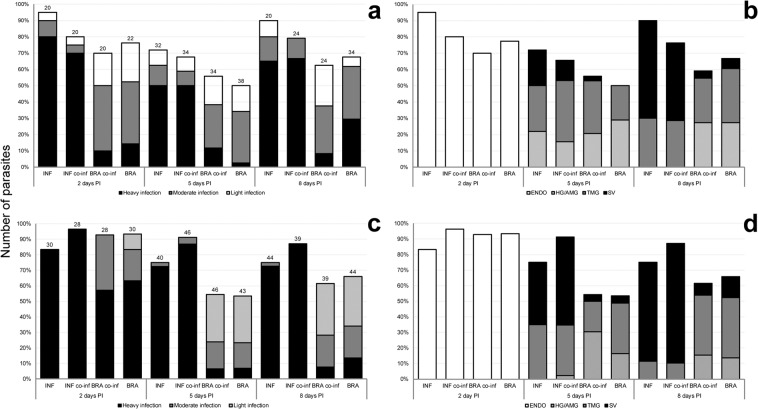
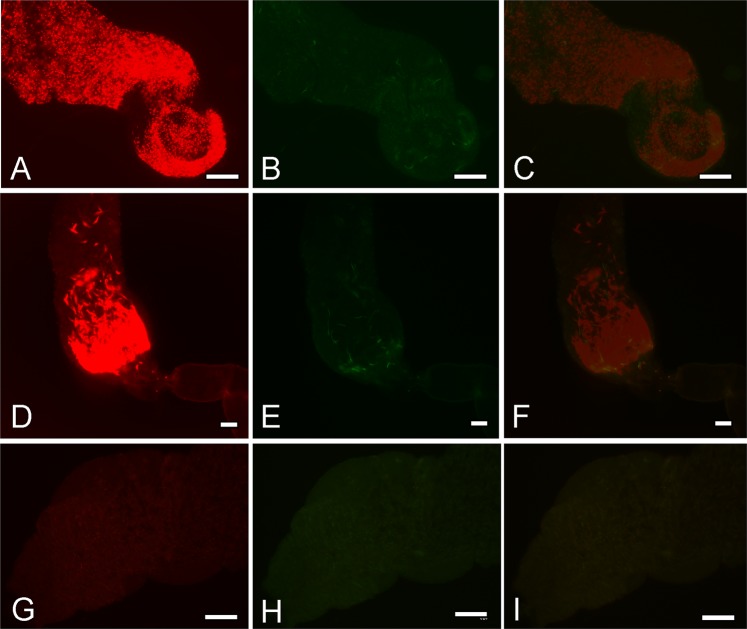
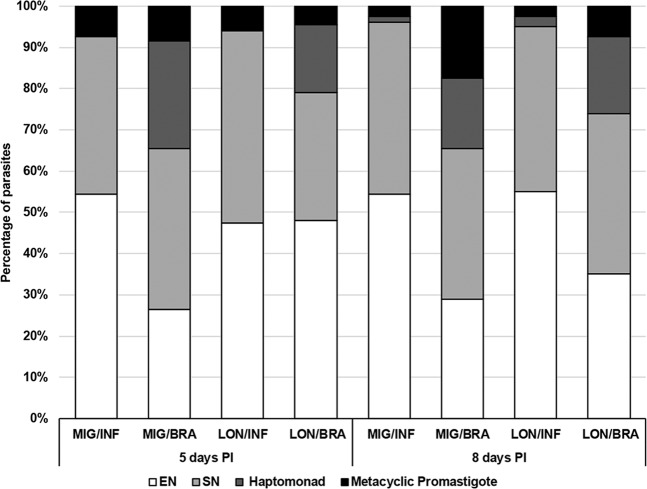
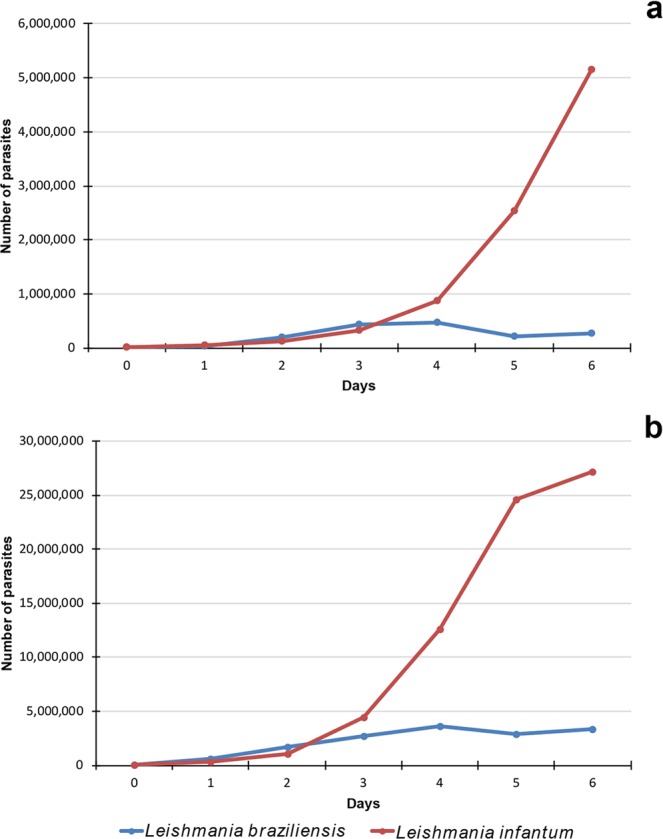
Leishmaniases are neglected tropical diseases and Leishmania (Leishmania) infantum and Leishmania (Viannia) braziliensis are the most important causative agents of leishmaniases in the New World. These two parasite species may co-circulate in a given endemic area but their interactions in the vector have not been studied yet. We conducted experimental infections using both single infections and co-infections to compare the development of L. (L.) infantum (OGVL/mCherry) and L. (V.) braziliensis (XB29/GFP) in Lutzomyia longipalpis and Lutzomyia migonei. Parasite labelling by different fluorescein proteins enabled studying interspecific competition and localization of different parasite species during co-infections. Both Leishmania species completed their life cycle, producing infective forms in both sand fly species studied. The same happens in the co infections, demonstrating that the two parasites conclude their development and do not compete with each other. However, infections produced by L. (L.) infantum reached higher rates and grew more vigorously, as compared to L. (V.) braziliensis. In late-stage infections, L. (L.) infantum was present in all midgut regions, showing typical suprapylarian type of development, whereas L. (V.) braziliensis was concentrated in the hindgut and the abdominal midgut (peripylarian development). We concluded that both Lu. migonei and Lu. longipalpis are equally susceptible vectors for L. (L.) infantum, in laboratory colonies. In relation to L. (V.) braziliensis, Lu. migonei appears to be more susceptible to this parasite than Lu. longipalpis.
Conflict of interest statement
The authors declare no competing interests.
Figures
References
-
- Lainson R, Ready PD, Shaw JJ. Leishmania in phlebotomid sandflies. VII. On the taxonomic status of Leishmania peruviana, causative agent of Peruvian ‘uta’, as indicated by its development in the sandfly, Lutzomyia longipalpis. Proc. R. Soc. Lond. 1979;206:307–18. - PubMed
-
- Dvorak, V, Shaw, J. J. & Volf, P. Parasite biology: The vectors. In The leishmaniases: Old neglected tropical diseases (ed. Bruschi, F. & Gradoni, L.) 31–78 (Springer International Publishing, 2018).
Publication types
MeSH terms
LinkOut - more resources
Full Text Sources
Miscellaneous
